
For research use only. Not for human consumption, diagnostic, or potential wellness benefit.
What Procurement Teams Look for in Peptide QA Summaries: A Buyer’s Documentation Guide
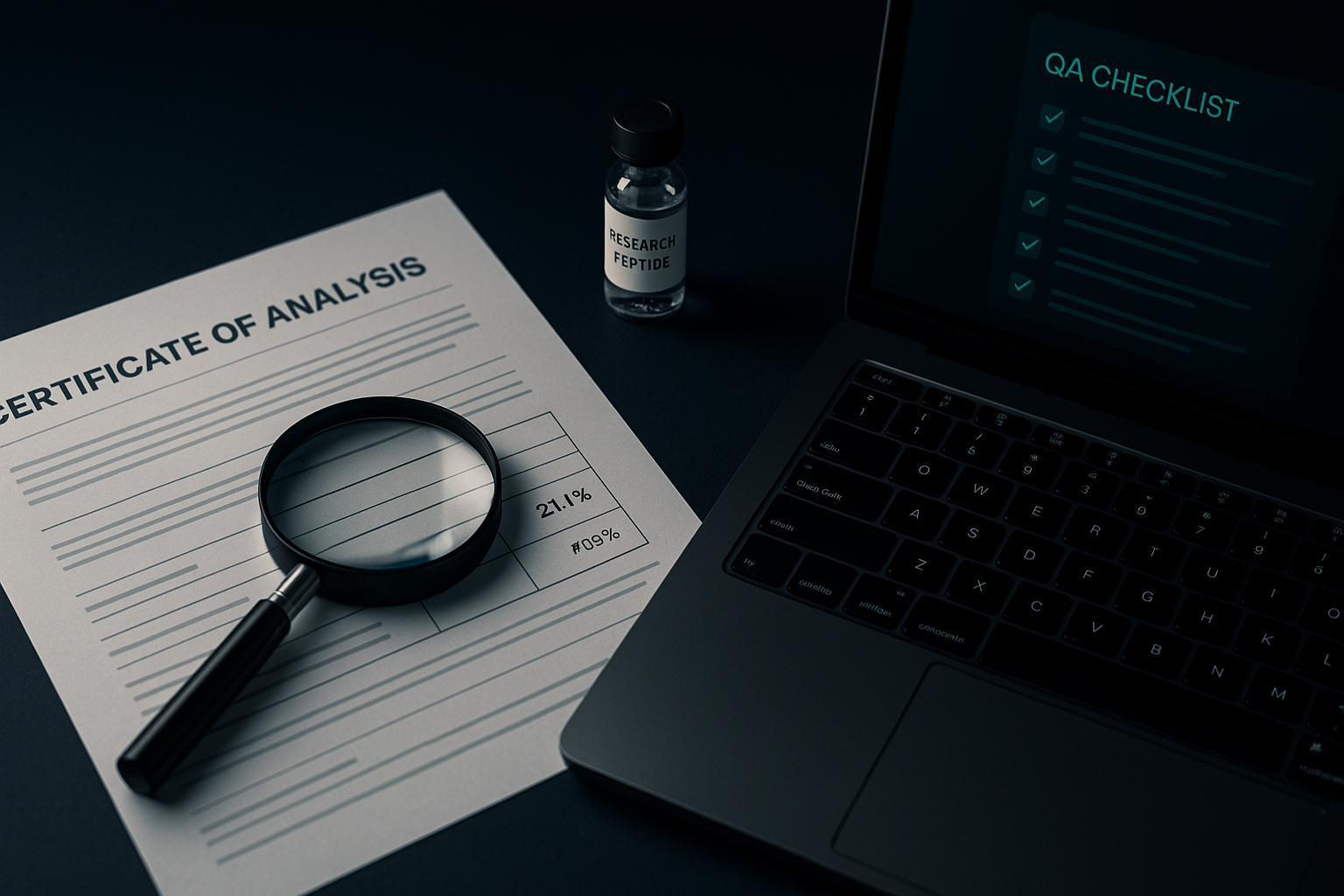
In the research peptide supply chain, the Certificate of Analysis (COA) is the single most important quality document a buyer will ever review.
Unlike regulated compound, RUO research peptides have no FDA-style premarket approval process validating each vial. Procurement teams rely on documented evidence, including supplier evaluations from Origin Research.
The global peptide therapeutics market was valued at approximately $140.9 billion in 2025 and is projected to reach $294.6 billion by 2033 (Grand View Research, June 2026), driving sophisticated bulk procurement.
Procurement teams focus on five key quality indicators when reviewing a COA: batch traceability, analytical methods, third-party verification, purity thresholds, and document authenticity. For a deeper look at bulk procurement, see the guide to buying research peptides in bulk. This guide is for clinic owners buying in bulk and entrepreneurs building a white-label RUO brand.
What Is a Peptide QA Summary and Why Does It Matter in Procurement?
A peptide QA summary is the Certificate of Analysis (COA) and any accompanying quality documentation for a batch of research peptides. It states the identity (sequence and mass), chromatographic purity, manufacturing date, retest date, and the analytical methods used for that specific lot, as described by Compound Review.
For procurement teams in the RUO space, the COA replaces the regulatory oversight that governs compound-grade materials. No FDA review covers research-use-only peptides, so the COA is the primary objective evidence that a batch meets its label claims.
YourPeptideBrand provides batch-specific COAs on every order, generated by independent third-party labs. The quality of that single document is the best signal of whether a supplier understands quality control. For more detail, see this breakdown of COA components for RUO peptides.
The 5-Point Procurement Checklist for Peptide QA Documentation
When reviewing a Certificate of Analysis, procurement teams apply five verification criteria before accepting a batch. Each point targets a specific failure mode in the unregulated research-peptide supply chain.
1. Lot / Batch Number Match
The COA must carry a batch or lot number that matches the vial or packaging label exactly. BluGen Research states: “If you cannot match the lot number on the vial to the lot number on the COA, stop there. You are no longer reviewing evidence for that material.”
2. HPLC Purity >= High Standard
Research peptide purity is assessed via HPLC at 214 nm. Procurement teams typically require high purity levels – 98% or above – for research-grade materials. Anything below 95% raises concerns about experimental reproducibility and potential interference from impurities.
3. Mass Spectrometry Identity Confirmation
HPLC alone can miss a co-eluting impurity or wrong compound. A 2023 study on peptide reference standards in PMC explains that orthogonal methods are necessary: mass spectrometry confirms the molecular weight matches the theoretical value, providing a secondary identity check.
4. Named Third-Party Laboratory
The issuing lab must be identifiable and independent from the supplier. Forged third-party reports are a documented fraud pattern in the unregulated market. An unnamed or in-house COA provides no independent verification.
5. Test Date Currency
A COA from a batch manufactured 18 months ago does not reflect current inventory. Procurement teams require test dates within the product’s stability window – typically one to two years for lyophilized research peptides stored at -20 degrees C. An outdated COA cannot guarantee the material has not degraded.
HPLC Purity vs. Mass Spectrometry Identity: What Each Method Confirms
HPLC quantifies research peptide purity; mass spectrometry confirms molecular identity. A Certificate of Analysis (COA) that omits either method leaves a critical gap in quality assurance.
| Method | What It Measures | Typical Threshold | Why Procurement Needs It |
|---|---|---|---|
| HPLC | Purity (area under the primary peak) | 95%+ baseline; 98%+ strongly preferred | Ensures sample is free of significant impurities |
| Mass Spectrometry | Identity (molecular weight match) | Observed mass within 0.1% of theoretical | Confirms the intended peptide, not a truncated or degraded variant |
A credible COA requires both methods. HPLC can report 99% purity, yet if mass spectrometry was not performed, the molecule could be entirely different – a shorter fragment or a similar-weight contaminant. PepPal, a widely used COA-reading tool, states the practical purity baseline is at least 95% for research purposes. Batches at 98% and above are considered stronger but still need identity confirmation.
Procurement teams looking at a COA should check that both HPLC and mass spec data are present, not just one. Purity without identity is only half the picture. For a deeper breakdown of how these methods work together, see this guide to HPLC, mass spectrometry, and other testing methods.
Download Our Full Product Catalog
To start evaluating specific research peptides with full COA documentation, download the complete YPB product catalog.
Download Our Full 60+ SKU Catalog
White-label research peptides, wholesale pricing, and dropshipping details.
Why Procurement Teams Insist on Third-Party Verification
Procurement teams evaluate peptide QA summaries by first asking who ran the test. In-house testing – where the same supplier that manufactured the research peptide also analyzes it – creates an inherent conflict of interest. The supplier controls the sampling, the testing protocol, and the interpretation of results. That arrangement makes any Certificate of Analysis (COA) less trustworthy from the buyer’s perspective.
Third-party testing removes that conflict. An independent lab receives a blind or semi-blind sample, runs the assays, and reports the raw data without commercial pressure to produce a favorable outcome. The lab’s only incentive is accuracy. For research-grade peptide procurement, a COA from an independent lab is the minimal acceptable standard of quality verification. Suppliers that offer only in-house documentation often fail procurement audits.
What Accreditation Matters
Procurement teams check not just that a test was third-party, but that the lab itself operates under recognized quality management standards. The most common benchmark is ISO 17025 accreditation. Labs carrying this accreditation have passed an external audit demonstrating competence in calibration, sample handling, record-keeping, and reporting. An ISO 17025-accredited lab provides an additional layer of confidence that the test methods are valid and the results are reproducible.
How YPB Supports Procurement Due Diligence
YPB provides COAs from independent laboratories, each linked to a specific batch. The documentation includes the lab’s accreditation status and the batch-specific results. This practice aligns with what procurement teams expect: a clear, auditable chain that separates the producer from the tester. No in-house manipulation of data. No reused certificates. Just a direct line from the sample to the independent measurement.
How QA Documentation Enables the White-Label Research Peptide Model
QA documentation is not just a compliance checkbox. For clinic owners and entrepreneurs building a branded RUO line, batch-specific Certificates of Analysis (COAs) serve a dual role. A clinic owner supplies the COA to internal compliance teams to confirm handling and storage requirements. An entrepreneur shares it with their own customers as proof of quality control.
Many suppliers that force bulk minimums treat COA access as a paid add-on. They issue a single generic document per lot and charge extra for each copy. This model creates friction for anyone building a white-label business, since every order needs traceable documentation that matches the buyer’s branded labels.
YourPeptideBrand’s model removes that barrier. Every order, regardless of quantity, includes batch-specific COAs. On-demand label printing and custom packaging let you align the documentation with your own brand. Direct dropshipping means the COA ships with the product, not as a separate request. There are no minimum order quantities, so you can test small runs before scaling.
To see how full quality transparency affects your margins, use the Profit Calculator. It models pricing with documentation costs built in, not added later.
For a deeper look at how documentation fits into the sourcing process, read the complete guide to sourcing research peptides. And for why domestic sourcing improves documentation reliability, see why sourcing from a US research peptide supplier matters for documentation quality.
Book a Free Procurement Consultation
Ready to discuss your procurement needs and see how YPB’s quality documentation supports your brand? Book a free consultation.
Ready to Launch Your White-Label Research Peptide Brand?
Book a free call with our team. We will walk you through pricing, setup, and your first order.
The YPB Quality Documentation Standard: Batch-Specific COAs on Every Order
Every batch of every research peptide from YourPeptideBrand (YPB) includes a comprehensive Certificate of Analysis (COA) generated by an independent ISO 17025-accredited laboratory. The testing uses reversed-phase HPLC (RP-HPLC) and mass spectrometry to verify purity and identity.
All COAs are accessible through the searchable YPB COA Library, viewable at any time by procurement teams and account holders. Verified Peptides notes that “a COA is a formal document prepared by a laboratory that details the peptide test results for a specific batch, signed by an authorized analyst.” (Verified Peptides, Certificates of Analysis Explained)
YPB’s COA documentation includes the full product name and amino acid sequence, the batch or lot number, manufacture and test dates, HPLC purity percentage with the accompanying chromatogram, mass spectrometry identity confirmation with observed versus theoretical mass, and the signature of the analyst who performed the testing.
Procurement teams can browse the full library at any time to verify a specific batch before placing an order. Browse the YPB COA Library to see the documentation standard applied across the entire catalog.
Red Flags That Signal a Weak QA Summary
A generic COA template reused across different products or batches tells a procurement team one thing: the supplier is not testing each batch. Lot-specific data is non-negotiable. If the document lists the same HPLC chromatogram or identical purity numbers for two distinct lot numbers, the COA is not a certificate of analysis – it is a marketing PDF.
Another warning sign is HPLC purity reported without mass spectrometry (MS) identity data. Purity alone does not confirm the right molecular weight. Missing methodology – no column type, gradient program, UV wavelength, or ionization mode – makes the result impossible to reproduce or verify. As PepPal notes, “generic PDFs reused across multiple products or missing method data are major warning signs.”
Unnamed or untraceable laboratories are a third red flag. A COA that says “in-house testing” without naming the facility or showing third-party credentials is self-attestation, not independent verification. When a COA triggers two or more of these flags, procurement teams treat it as copy with COA aesthetics, not as analytical evidence.
To protect their supply chain, procurement teams follow a verification protocol. They compare lot numbers against the batch received. They confirm the named laboratory exists as an independent entity, often by checking accreditation databases. They verify any unique key or QR code against the lab’s public portal. And they maintain an immutable file for each batch received, so that a later discrepancy can be traced to the original document.
Supplier documents that fail any of these checks signal a weak quality system. For a deeper look at building a trustworthy QA process, see our guide on quality assurance practices for RUO peptides in the US market and how to evaluate and work with third-party testing laboratories.
Calculate Your Margins With Verified COAs
Use the YPB Profit Calculator to model your margins with verified COA documentation. Batch-specific quality documentation protects your brand and drives repeat purchases.
Calculate Your White-Label Margins
See exactly how much margin you can make at your price point.
Frequently Asked Questions About Peptide QA Summaries
What is the single most important document a procurement team should request from a research peptide supplier?
The batch-specific Certificate of Analysis (COA). As documented by Origin Research (June 2026), a proper COA includes the batch number, manufacture date, analytical methods used, numerical results, acceptance criteria, analyst attribution, and the actual chromatogram and mass spectrum images, not just summary purity figures. Without batch specificity, the document cannot be linked to the material received.
What HPLC purity percentage do procurement teams typically require for research peptides?
Research published in Pharmaceutics (PMC4406950) confirms that HPLC at 214 nm is the standard for detecting peptide purity. Most procurement and QA teams set a minimum threshold of 98% purity for research-grade peptides according to industry benchmarks from multiple supplier guides (PepPal 2026, Origin Research 2026). Anything below 95% raises concerns about experimental reproducibility.
Why do procurement teams require both HPLC and mass spectrometry data on a COA?
HPLC measures purity (how clean the sample is), while mass spectrometry confirms identity (what the compound actually is). A study published in PMC (PMC10338602, 2023) on peptide reference standards emphasizes that orthogonal methods are necessary because a sample can be 99% pure by HPLC yet be the wrong molecule entirely. Procurement teams require both to confirm the material matches the label claim.
How does a procurement team verify that a third-party COA is genuine?
The standard verification method is to contact the testing laboratory directly using contact information obtained from the lab’s own website rather than from the supplier (Origin Research, June 2026). Many accredited labs maintain online verification portals where a unique key or task number from the COA can be entered to retrieve the original report. Forged reports are a documented fraud pattern in the unregulated market.
Why does batch traceability matter in research peptide procurement?
Traceability is the only mechanism by which a quality problem can be investigated (Origin Research, June 2026). If a vial fails purity testing after receipt, the batch number allows the buyer and supplier to determine whether other vials from the same lot are affected and whether the issue is isolated or systemic. Procurement teams treat missing or non-matching lot numbers as a hard rejection criterion.
What documentation should a white-label peptide buyer expect from their supplier beyond the COA?
Buyers sourcing for a branded RUO line should also understand the role of documentation in peptide compliance and quality assurance, which explains the full documentation chain. YourPeptideBrand provides batch-specific COAs via a searchable COA Library for every production lot, along with synthesis documentation, RUO-compliant labeling, and chain-of-custody records. YPB’s model includes zero minimum order quantities, on-demand label printing, and direct dropshipping, which means every batch shipped carries the same verified documentation regardless of order size.
How does the no-MOQ model affect documentation consistency in peptide procurement?
Suppliers that force bulk minimums often bundle COA access as a paid add-on, which undermines quality verification. YourPeptideBrand provides batch-specific COAs on every order regardless of volume. Each COA is generated by an independent third-party lab using HPLC and mass spectrometry. Procurement teams can verify the documentation before committing to scale, using the Profit Calculator to model margins with full quality transparency.
What are the red flags procurement teams look for on a peptide COA?
Common red flags include: no identifiable third-party lab name, purity figures reported without chromatograms, batch numbers that do not match the product label, rounded purity values (exactly 99.00%), missing test dates, generic COAs reused across multiple products, and in-house testing presented as independent verification. YPB’s COA Library provides batch-specific, third-party verified documentation that meets procurement-grade standards.
Whether you are a clinic owner sourcing in bulk or an entrepreneur building a white-label brand, YPB’s batch-specific COAs and transparent quality documentation give your procurement a solid foundation. Book a call to discuss your requirements.
Ready to Launch Your White-Label Research Peptide Brand?
Book a free call with our team. We will walk you through pricing, setup, and your first order.
Last updated: July 2026