
For research use only. Not for human consumption, diagnostic, or potential wellness benefit.
Institutional Procurement KPIs for Research Material Suppliers
A multi-location clinic procurement manager sits down three months after approving a new research peptide supplier. The decision to renew, expand, or drop that vendor now requires data, not gut feel. That data comes from post-approval procurement KPIs – quantifiable metrics that track supplier performance after vetting.
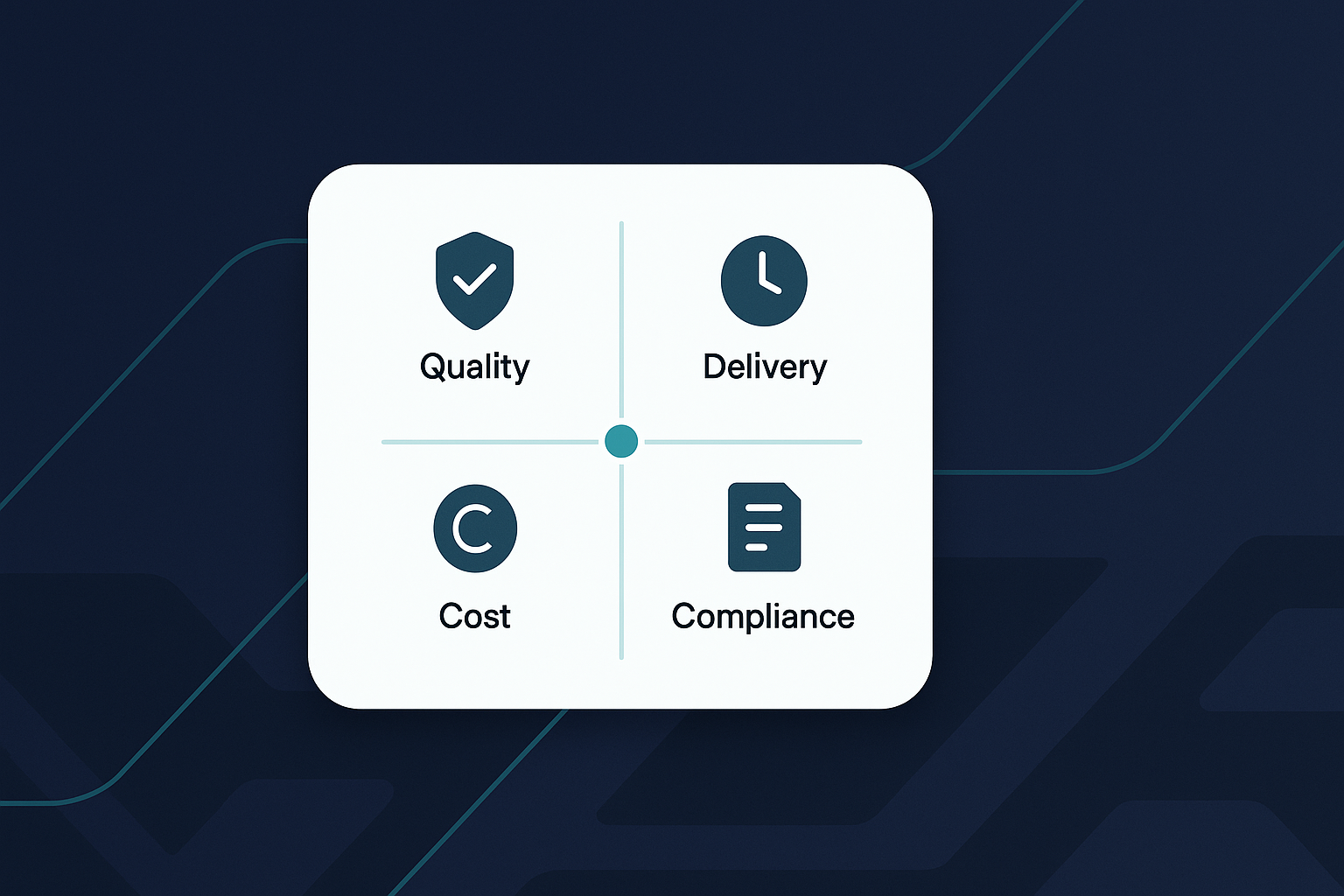
The seven essential KPIs institutional buyers use to monitor research material suppliers fall into four core domains: Quality, Delivery, Cost, and Compliance. This framework is outlined in Oracle NetSuite’s procurement KPI guide (2025). According to the Institute for Supply Management (ISM, 2025), high-performing procurement teams target sub-1% defect rates and above-95% on-time delivery rates as baseline supplier thresholds. Those numbers apply directly to research peptide batches and their third-party Certificates of Analysis.
What Are Institutional Procurement KPIs for Research Material Suppliers?
Institutional procurement KPIs are quantifiable metrics that clinic and research buyers use to track supplier performance after initial approval and contracting. These KPIs measure quality consistency, delivery reliability, cost efficiency, and compliance documentation – the four pillars that determine whether a supplier remains on the approved vendor list. YourPeptideBrand (YPB) structures its operations around these four categories.
A critical distinction exists between pre-approval checks and ongoing post-approval monitoring. Pre-approval metrics include COA verification, facility audits, and documentation review during supplier onboarding. Post-approval KPIs track every batch, order, and shipment over time – catching drift before it becomes a compliance gap.
Oracle NetSuite’s procurement KPI framework identifies four metrics most commonly tracked across industries: on-time delivery rate, supplier defect rate, spend under management, and procurement cycle time (Oracle NetSuite procurement KPIs guide, 2025). For research-material suppliers, defect rate maps directly to COA batch consistency, and cycle time measures how fast an order moves from request to delivered vials.
The Four Categories of Post-Approval Procurement KPIs
After a supplier is approved, procurement teams track performance across four key categories. The table below defines each metric, its formula, benchmark target, and why it matters specifically for research peptides. These KPIs ensure that every batch meets the purity and documentation standards required for reproducible research.
| Category | KPI Example | Formula | Benchmark Target | Why It Matters for Research Peptides |
|---|---|---|---|---|
| Quality | Supplier Defect Rate | (Defective Units / Total Units) x 100 | Sub-1% target | Directly reflects COA accuracy and HPLC purity consistency across batches. |
| Delivery | On-Time Delivery Rate | (On-Time Orders / Total Orders) x 100 | 95%+ target | Ensures lab research schedules are not disrupted by delayed shipments. |
| Cost | Spend Under Management | (Managed Spend / Total Spend) x 100 | 80%+ target per Ardent Partners (Oracle NetSuite, 2025) | Shows procurement control over research material budgets. |
| Compliance | COA Documentation Rate | (Batches with Full COA / Total Batches) x 100 | 100% target | Verifies that every shipment includes batch-specific third-party testing results. |
The Institute for Supply Management provides a broader framework for supplier performance measurement, including additional metrics that complement these four categories (ISM, 2025). Tracking these KPIs gives research peptide buyers a clear, repeatable way to evaluate supplier reliability and product consistency.
Quality KPIs: Defect Rate, COA Accuracy, and Purity Consistency
Supplier defect rate is the most direct measure of product reliability. In procurement, it is calculated as defects per million units, with sub-1% defect rates considered a standard operational target. The Institute for Supply Management (2025) defines this as a baseline KPI for supplier performance evaluation.
For research peptide sourcing, defect rate translates into batch-level purity variance. Labs use HPLC and mass spectrometry to verify that a batch matches its stated purity. A batch with purity outside the accepted tolerance constitutes a defect, making this KPI critical for researchers who depend on consistent material.
Certificate of Analysis (COA) accuracy is a secondary quality KPI: does the documentation match the actual product? Discrepancies between a COA and the delivered research peptide can halt a study or invalidate results. For a deeper look at why COAs matter in procurement decisions, see the role of Certificates of Analysis in peptide sales.
YourPeptideBrand provides batch-specific COAs for every research peptide, making the COA documentation rate verifiable at 100% for each order. This eliminates the documentation gap that many procurement teams encounter when suppliers provide generic or out-of-date certificates.
Delivery KPIs: On-Time and In-Full Fulfillment for Research Orders
On-time delivery rate is the primary KPI for research material fulfillment: (on-time deliveries / total deliveries) x 100. According to TradeCentric (2026), suppliers that consistently meet delivery windows strengthen buyer relationships and capture higher wallet share over competitors that miss deadlines. For institutional buyers, this metric directly affects research calendar integrity and staffing allocation.
In-full delivery rate matters equally, especially for multi-location clinic networks. An order that arrives on time but missing a single research peptide can stall a multi-site protocol, forcing a costly re-order and protocol deviation documentation. Procurement teams track this as: (orders shipped completely / total orders) x 100. Incomplete shipments compound across sites, making it a higher-stakes metric for distributed research programs.
Domestic sourcing provides a structural advantage for both metrics. US-based suppliers reduce customs delays, carrier handoffs, and weather-related border holds that plague cross-border shipments. Faster transit windows naturally support higher on-time rates. For a deeper look at this advantage, see why sourcing from a US research peptide supplier matters for institutional procurement teams.
Download Our Full 60+ SKU Catalog
White-label research peptides, wholesale pricing, and dropshipping details.
Cost KPIs: Spend Under Management and Procurement ROI
Spend under management (SUM) is a standard procurement metric calculated as (Managed Spend / Total Spend) x 100. Oracle NetSuite’s 2025 guide notes that higher SUM correlates with better cost control and spend visibility across an organization.
For clinic procurement teams sourcing research peptides, SUM improves when every purchase — small or large — routes through formal procurement. A supplier that accepts any order size, with no minimum order quantity (MOQ), allows all spending to be managed. Suppliers that enforce bulk minimums push smaller transactions outside procurement, lowering SUM. This directly raises the ratio because fewer dollars fall outside the system.
Procurement ROI is defined as (Annual Cost Savings / Annual Procurement Cost) x 100. A 2025 analysis by Akirolabs recommends tracking this metric to determine whether procurement delivers net value relative to its operational costs. For research peptide procurement, cost savings often come from negotiating per-unit pricing on larger volumes, while procurement cost includes staff time and system expenses.
Clinics can model per-unit costs to support both KPIs. YourPeptideBrand’s Profit Calculator helps estimate unit costs based on order size and packaging preferences, directly feeding into SUM and procurement ROI tracking.
For more detail on structuring research peptide purchases for institutional procurement, see the guide to buying research peptides in bulk.
Compliance KPIs: COA Documentation Rate and RUO Labeling Accuracy
The COA documentation rate measures the percentage of incoming shipments that arrive with a complete, batch-specific, third-party Certificate of Analysis. In RUO procurement, the target is 100%. A rate below that introduces risk: without a batch-specific COA, researchers cannot confirm purity or identity, which can invalidate in vitro or in vivo study results. Procurement metric frameworks published by Precoro (Precoro procurement KPIs (2026)) highlight documentation completeness as a baseline compliance KPI.
RUO labeling accuracy tracks whether every element of the shipment – vial labels, carton markings, packing slips, and electronic documentation – consistently displays “For Research Use Only.” A single non-compliant label can compromise the audit trail for an institution’s internal review process. Consistency across all units in a batch is non-negotiable. Labeling accuracy also covers the digital footprint: supplier portals and packing lists must match the vial statement.
YourPeptideBrand supports both KPIs at the batch level. Every batch receives six-panel third-party testing, and each vial includes a scan-to-COA tag. Compliance teams can verify documentation through the COA Library without handling physical paperwork. For clinic owners and entrepreneurs building a branded RUO business, verifying both KPIs at intake prevents downstream compliance issues during third-party audits. This workflow design keeps COA documentation rates at the 100% target and RUO labeling consistent across every shipment.
Ready to Launch Your White-Label Research Peptide Brand?
Book a free call with our team. We will walk you through pricing, setup, and your first order.
KPI Dashboard: How to Track Supplier Performance Across Orders
Clinic procurement teams that manage multiple suppliers need a simple dashboard to track performance over time. Without standardized metrics, defect patterns or delivery delays stay hidden until they disrupt research schedules. A basic KPI dashboard built in a spreadsheet or business-intelligence tool gives a clear picture per supplier per quarter.
Four metrics cover most operational risk:
- On-time delivery rate (per quarter) – the percentage of orders that arrive by the promised date. ThoughtSpot’s 2026 procurement KPI guide flags this as the top indicator of supplier reliability.
- Supplier defect rate (per batch) – number of batches that fail visual or documentation checks divided by total batches received. Sievo’s 2025 procurement KPI framework recommends tracking this at batch level to spot trends early.
- COA documentation rate (per order) – the share of orders that arrive with a complete, verifiable Certificate of Analysis. Missing COAs add administrative cost and delay in-house acceptance.
- Average PO cycle time (in days) – time from purchase order submission to order receipt. Long cycle times push buffer stock higher and complicate reorder planning.
YPB’s consistent batch documentation and standardized labeling simplify data collection for clinics building these dashboards. Each order ships with a matching COA and uniform vial labels, so the COA documentation rate stays near 100% and the defect rate is easy to verify without recoding part numbers. For a deeper look at reorder logic, see building an inventory management system for peptide brands. Clinics scaling their research operation can also reference growth phase preparation with KPI benchmarks, which identifies batch turnaround time, defect rate, and on-time shipping as three core operational KPIs.
White-Label Opportunity: How Supplier KPIs Drive Business Outcomes
Clinics or entrepreneurs evaluating YourPeptideBrand as a white-label partner apply the same institutional KPI framework outlined in this guide. For buyers building a branded research program, aligning with a supplier that performs well on procurement metrics removes downstream compliance friction before it starts.
YPB differentiators map directly to standard supplier KPIs. No MOQ improves Spend Under Management (SUM) by eliminating forced inventory carrying costs. Batch-specific COAs published in the COA library achieve a 100% documentation rate for every shipment, eliminating retrieval delays during audits. On-demand dropshipping supports on-time delivery targets without warehousing overhead. Third-party testing documented on the COA keeps defect rates minimal across 60+ SKUs.
A single dashboard covering 60+ research peptides simplifies contract compliance rate tracking. Managing one supplier point of accountability is less administrative overhead than juggling multiple vendors with separate documentation standards.
This model is validated by clinics and distributors who have scaled their operations. Read the B2B peptide supplier case study on predictable revenue. For a wider framework on vetting partners, review the complete guide to sourcing research peptides.
Calculate Your White-Label Margins
See exactly how much margin you can make at your price point.
How YPB’s Quality Infrastructure Supports Institutional Procurement Standards
Every batch shipped from YourPeptideBrand (YPB) carries a six-panel Certificate of Analysis (COA), turning quality from a promise into auditable data. That single document satisfies the quality KPI that institutional procurement teams demand before approval.
YPB’s domestic US supply chain eliminates cross-border shipping delays, directly answering the delivery KPI. No minimum order quantities and transparent wholesale pricing remove cost uncertainty, meeting the cost KPI without the bulk commitments that suppliers with forced minimums require.
Compliance is built into the packaging itself: RUO-compliant labels and vial tags with scan-to-COA functionality. Procurement teams can verify documentation on the spot, fulfilling the compliance KPI without manual file requests. The COA Library serves as a centralized repository for ongoing audit needs.
From supplier evaluation to a branded product line, YPB’s fast launch timeline compresses what typically takes weeks into days. That cycle time reduction directly improves a clinic’s or entrepreneur’s procurement cycle time KPI, allowing them to allocate capital and research resources faster.
Ready to Launch Your White-Label Research Peptide Brand?
Book a free call with our team. We will walk you through pricing, setup, and your first order.
Frequently Asked Questions About Procurement KPIs for Research Material Suppliers
What is on-time delivery rate as a procurement KPI for research material suppliers?
On-time delivery rate measures the percentage of orders delivered within the agreed-upon window. According to NetSuite’s guide on procurement KPIs (2025), it is calculated as on-time deliveries divided by total deliveries, multiplied by 100. For research material suppliers, consistent on-time delivery protects lab research schedules and prevents inventory stockouts. A rate above 95% is considered strong performance in institutional procurement contexts.
What is supplier defect rate and why is it important for research peptide sourcing?
Supplier defect rate calculates the percentage of goods received that fail to meet quality standards, typically measured in defects per million units. The Institute for Supply Management (ISM, 2025) notes that sub-1% defect rates are the benchmark for high-performing suppliers. For research peptide procurement, defect rate directly relates to HPLC purity verification and COA accuracy, making it a critical quality indicator.
How is spend under management (SUM) used in institutional procurement?
Spend under management is the percentage of total organizational spend actively controlled through formal procurement processes and approved suppliers. Oracle NetSuite (2025) defines SUM as a key metric of procurement maturity. For multi-location clinics sourcing research materials, higher SUM indicates better cost control, reduced maverick spend, and stronger supplier governance across all locations.
What is purchase order (PO) cycle time in research material procurement?
PO cycle time measures the duration between submitting a purchase requisition and sending a purchase order to a supplier. According to Kissflow’s procurement KPI guide (2026), shorter cycle times indicate efficient internal procurement processes. For research peptide buyers, minimizing PO cycle time ensures that lab research protocols are not delayed by administrative bottlenecks.
What does contract compliance rate measure for research material suppliers?
Contract compliance rate tracks the percentage of purchases made under negotiated contract terms versus off-contract spend. ThoughtSpot’s procurement metrics guide (2026) identifies this as essential for measuring supplier adherence to agreed pricing, quality specifications, and delivery schedules. For clinic procurement teams, high compliance rates reduce rogue spending and ensure that every order meets pre-negotiated quality standards.
How does YourPeptideBrand help clinic owners meet institutional procurement KPIs?
YourPeptideBrand (YPB) supports clinic owners by providing batch-specific Certificates of Analysis for every order, enabling direct measurement of the supplier quality KPI. YPB’s zero-minimum-order-quantity model eliminates bulk-commitment risk, which improves spend under management by allowing clinics to purchase only what their research protocols require. On-demand dropshipping with domestic shipping supports on-time delivery rate targets.
What COA documentation does YPB provide that supports quality KPIs?
YPB provides a six-panel Certificate of Analysis for every research peptide batch, including HPLC purity percentage, mass spectrometry identity confirmation, and impurity profiling. The COA Library at YourPeptideBrand.com makes batch-specific documentation publicly accessible, supporting the documentation rate KPI. This transparency allows clinic procurement teams to verify quality metrics before committing to larger volume orders.
How does YPB’s no-MOQ model affect procurement KPI tracking for clinics?
YPB’s zero-minimum-order-quantity model allows clinics to order exact quantities needed for specific research protocols, which directly improves spend under management by eliminating forced inventory. It also reduces the cost-per-PO KPI by removing the need for bulk-commitment contracts. Clinics can use YPB’s Profit Calculator to model per-unit costs across order sizes, supporting cost-saving KPI targets without upfront volume commitments.
Last updated: July 2026
Institutional Procurement KPIs for Research Material Suppliers
Three months after approval, a multi-location clinic procurement manager sits down with performance data to decide: renew, expand, or drop a research peptide supplier. The initial vetting earned the supplier a spot on the roster, but ongoing performance determines whether that relationship delivers measurable value for the organization’s research material spend.
Post-approval procurement KPIs – quantifiable metrics that track supplier performance after vetting – provide the data needed for that renewal decision. This article identifies the seven essential KPIs institutional buyers use to monitor research material suppliers, answering which metrics matter most after a supplier is approved.
These KPIs organize into four core domains. Quality covers defect rates, certificate accuracy, and batch consistency. Delivery tracks on-time rates, lead-time reliability, and backorder frequency. Cost includes total landed cost, price stability, and invoice accuracy. Compliance monitors regulatory documentation, labeling adherence, and audit readiness. Each domain matters, though institutions typically weight them differently based on their research priorities. Oracle NetSuite’s procurement KPIs guide (2025) provides a widely used framework for organizing these domains in supplier evaluation.
Benchmark data from the Institute for Supply Management (ISM, 2025) shows that high-performing procurement teams target sub-1% defect rates and above-95% on-time delivery rates as baseline supplier thresholds. These figures set the minimum bar for institutional research material suppliers and directly inform the renewal decision the manager now faces. A supplier falling below either threshold triggers a performance review or replacement search.
What Are Institutional Procurement KPIs for Research Material Suppliers?
Institutional procurement KPIs are quantifiable metrics that clinic and research buyers use to track supplier performance after initial approval and contracting. These KPIs measure quality consistency, delivery reliability, cost efficiency, and compliance documentation – the four pillars that determine whether a supplier remains on the approved vendor list. YourPeptideBrand (YPB) structures its operations around these four categories.
A key distinction exists between supplier onboarding metrics and post-approval KPIs. Onboarding metrics are pre-approval checks like COA verification, facility audits, and sample testing. They confirm a supplier meets basic standards before being added to the approved list. Post-approval KPIs are the ongoing numbers that tell you whether that supplier keeps delivering. They monitor every batch, order, and shipment after the vendor is active.
The Oracle NetSuite procurement KPIs guide identifies four metrics most commonly tracked across industries: on-time delivery rate, supplier defect rate, spend under management, and procurement cycle time. For research material suppliers, defect rate maps directly to COA compliance, and on-time delivery matters especially for short-shelf-life research peptides where lab schedules depend on predictable arrival.
The Four Categories of Post-Approval Procurement KPIs
After approving a supplier, procurement teams monitor four domains that directly affect research material consistency. The table below organizes the categories, sample formulas, benchmark targets, and relevance to research peptides.
| Category | KPI Example | Formula | Benchmark Target | Why It Matters for Research Peptides |
|---|---|---|---|---|
| Quality | Supplier Defect Rate | (Defective Units / Total Units) x 100 | Sub-1% target | Directly reflects COA accuracy and HPLC purity consistency across batches. |
| Delivery | On-Time Delivery Rate | (On-Time Orders / Total Orders) x 100 | 95%+ target | Ensures lab research schedules are not disrupted by delayed shipments. |
| Cost | Spend Under Management | (Managed Spend / Total Spend) x 100 | 80%+ target per Ardent Partners (Oracle NetSuite, 2025) | Shows procurement control over research material budgets. |
| Compliance | COA Documentation Rate | (Batches with Full COA / Total Batches) x 100 | 100% target | Verifies that every shipment includes batch-specific third-party testing results. |
The quality and delivery benchmarks follow standards from the Institute for Supply Management (2025). The spend under management target originates from Ardent Partners research as cited by Oracle NetSuite. Monitoring these four categories gives procurement teams a clear dashboard for supplier reliability in research peptide supply chains.
Quality KPIs: Defect Rate, COA Accuracy, and Purity Consistency
Supplier defect rate is the foundational quality KPI in institutional procurement. Measured as defects per million units, a sub-1% defect rate is the typical target threshold for sourcing raw materials and lab consumables (Institute for Supply Management, 2025). A rate above 1% triggers corrective action or supplier review, especially in regulated research environments where material integrity directly affects experimental reproducibility.
In research peptide procurement, the defect rate translates directly to batch-level purity variance. Suppliers screen each batch using techniques such as HPLC and mass spectrometry to verify that the stated purity – often ≥95% – is consistent across the lot. A “defect” in this context is a batch that fails its purity specification or shows unexpected impurities, triggering a rejection or a request for a replacement batch.
COA accuracy is a secondary quality KPI that checks whether the documentation matches the actual product. A supplier can claim a low defect rate in shipping but still have inaccurate COAs – for example, a COA that omits the specific HPLC trace or mass spec peak data for that batch. Verification requires comparing the printed COA with the actual batch’s analytical results, a step many buyers skip.
For a deeper look at what a proper COA should contain and how to audit it, see our guide on the role of Certificates of Analysis in peptide sales.
YourPeptideBrand provides batch-specific COAs for every research peptide in its catalog, making COA documentation rate verifiable at 100%. Any institutional buyer can request the COA for a given lot number and compare it to the product received – no guesswork, no missing data.
Delivery KPIs: On-Time and In-Full Fulfillment for Research Orders
On-time delivery rate is a primary KPI for any research material supplier. Formula: (On-time deliveries / Total deliveries) x 100. A supplier that consistently hits its promised shipping windows signals reliability across the procurement cycle.
According to TradeCentric research (2026), suppliers that meet agreed delivery windows strengthen buyer relationships and capture higher wallet share from institutional accounts. For a multi-location clinic running parallel in vitro studies, late shipments can stall an entire research timeline.
In-full delivery rate is equally critical. This metric tracks whether orders ship with every line item present and correct. An incomplete shipment forces your research team to reorder, wait for backordered vials, or adjust protocols mid-experiment. In-full delivery rate = (Orders shipped complete / Total orders) x 100.
Domestic sourcing supports both KPIs. A US-based supplier ships inside the same Customs net, avoiding cross-border delays. That advantage directly translates to higher on-time delivery scores and fewer incomplete shipments from lost customs holds. For a deeper breakdown of why this matters for your procurement team, see why sourcing from a US research peptide supplier matters.
Download Our Full 60+ SKU Catalog
White-label research peptides, wholesale pricing, and dropshipping details.
Cost KPIs: Spend Under Management and Procurement ROI
Spend under management (SUM) measures the percentage of total organizational spend that flows through formal procurement channels. The formula is (Managed Spend / Total Spend) x 100. Higher SUM correlates with better cost control because more purchases are tracked, negotiated, and audited (Oracle NetSuite, 2025). For a clinic buying research peptides, a supplier that accepts any order size (no minimum order quantity) directly improves SUM. Every vial purchase can be processed through procurement rather than bypassing it via small-dollar spot buys.
Procurement ROI evaluates the efficiency of the procurement function itself: (Annual Cost Savings / Annual Procurement Cost) x 100 (Akirolabs, 2025). If a clinic saves $20,000 annually through supplier consolidation and the procurement team costs $5,000 to run, ROI is 400%. Tracking this KPI requires reliable per-unit cost data. YourPeptideBrand’s Profit Calculator helps clinics model per-unit costs across order sizes, supporting both cost tracking and ROI projections.
For a deeper look at structuring purchases for maximum savings, see our guide to buying research peptides in bulk.
Compliance KPIs: COA Documentation Rate and RUO Labeling Accuracy
For institutional RUO research procurement, two compliance KPIs direct the supplier evaluation: COA documentation rate and RUO labeling accuracy. The COA documentation rate measures the percentage of shipments that include a complete, batch-specific, third-party certificate of analysis. The target is 100%. RUO labeling accuracy ensures that every vial, package, and accompanying document consistently displays the required research-use-only designation and no therapeutic claims.
COA Documentation Rate
Each shipment should contain a COA that matches the exact batch received. A 2026 report on procurement KPIs identifies traceability documentation as a core metric for regulated material supply chains (Precoro, 2026). Any gap in COA delivery breaks chain-of-custody requirements and should trigger a supplier review. A rate below 100% is unacceptable for institutional buyers who must keep COAs on file for audit readiness.
RUO Labeling Accuracy
Labeling accuracy covers vial labels, outer packaging, and any included paperwork. Every element must carry the research-use-only statement and avoid any wording that implies human use. Inconsistent labeling can create compliance risks for the buyer’s own documentation practices and may force costly repackaging before materials can enter the lab.
YourPeptideBrand supports both KPIs at the batch level. Each product ships with a six-panel third-party COA, and vial tags include a scan-to-COA feature that links directly to the batch record in the YPB COA Library. This eliminates documentation gaps and labeling inconsistencies. Introducing these KPIs into your procurement checklist ensures that every order meets the same standard you hold your own branded materials to.
Ready to Launch Your White-Label Research Peptide Brand?
Book a free call with our team. We will walk you through pricing, setup, and your first order.
KPI Dashboard: How to Track Supplier Performance Across Orders
A clinic procurement team managing multiple research peptide suppliers needs a standardized way to measure performance. A simple KPI dashboard built in a spreadsheet or lightweight analytics tool gives a real-time view of four core metrics. According to a 2026 analysis of procurement KPIs by ThoughtSpot, tracking on-time delivery, defect rates, documentation completeness, and order cycle time is standard practice across regulated industries.
YourPeptideBrand (YPB) supports this process by providing consistent batch documentation and standardized labeling, which simplify data collection for every order. A 2025 overview of procurement KPIs by Sievo notes that suppliers with clear, repeatable documentation reduce the audit burden on buyers.
| Metric | Definition | Why It Matters |
|---|---|---|
| On-time delivery rate (per quarter) | Percentage of orders received by the agreed date | Directly affects inventory availability and experiment scheduling |
| Supplier defect rate (per batch) | Number of batches failing in-house QC per total received | Indicates supplier consistency and lot-to-lot reproducibility |
| COA documentation rate (per order) | Share of orders that include a complete Certificate of Analysis | Ensures traceability and supports third-party verification |
| Average PO cycle time (in days) | Days from purchase order issue to order receipt | Reveals supplier responsiveness and logistics reliability |
Teams can pull these KPIs into a rolling dashboard to compare suppliers quarter over quarter. For a deeper breakdown of stock control, refer to building an inventory management system for peptide brands. To see how these metrics scale as order volume grows, review growth phase preparation with KPI benchmarks.
White-Label Opportunity: How Supplier KPIs Drive Business Outcomes
Clinics and entrepreneurs evaluating YourPeptideBrand as a white-label partner apply the same KPI framework they use for any procurement decision. Supplier differentiators map directly to the metrics tracked post-approval.
No minimum order quantities improve supply utilization metrics by removing forced bulk purchases and allowing just-in-time ordering. Batch-specific Certificates of Analysis achieve a 100% documentation rate, satisfying quality assurance requirements for every lot. On-demand dropshipping supports on-time delivery targets without inventory risk or storage overhead. Third-party testing keeps defect rates minimal, reducing rejection and return costs. Together, these attributes create predictable revenue streams and protect margins – key outcomes tracked in post-approval reviews.
A single dashboard supplier with 60+ SKUs simplifies contract compliance rate tracking by consolidating sourcing to one documentation and quality standard. This aggregation reduces administrative overhead and audit complexity. For a real-world example, see this B2B peptide supplier case study on predictable revenue. For a broader evaluation framework, consult the complete guide to sourcing research peptides.
Calculate Your White-Label Margins
See exactly how much margin you can make at your price point.
How YPB’s Quality Infrastructure Supports Institutional Procurement Standards
YourPeptideBrand’s operational model is built around the KPI categories that institutional procurement teams track. Every batch ships with a six-panel Certificate of Analysis, directly addressing the quality KPI with verifiable, lot-specific data. A domestic US supply chain keeps delivery KPIs predictable – no international customs delays or unpredictable transit times.
Cost KPIs are met with transparent wholesale pricing and no minimum order quantities, eliminating the inventory-carrying risk that forces many clinics to consolidate orders. Compliance KPIs are covered through RUO-compliant labeling and scan-to-COA vial tags, which let researchers verify batch documentation instantly without additional paperwork. The centralized COA Library acts as a single source of truth for institutional auditors.
The fast launch timeline is the procurement cycle time KPI in practice: from initial supplier evaluation to a branded product line in days, not weeks. That compression reduces the administrative burden on procurement teams and lets clinics respond to research demand faster than with traditional suppliers.
Each of these features – COA traceability, domestic logistics, no-MOQ pricing, and compliance-ready packaging – maps directly to a procurement metric, making YPB a predictable partner for institutions that hold themselves to rigorous performance standards.
Ready to Launch Your White-Label Research Peptide Brand?
Book a free call with our team. We will walk you through pricing, setup, and your first order.
Frequently Asked Questions About Procurement KPIs for Research Material Suppliers
What is on-time delivery rate as a procurement KPI for research material suppliers?
On-time delivery rate measures the percentage of orders delivered within the agreed-upon window. According to NetSuite’s guide on procurement KPIs (2025), it is calculated as on-time deliveries divided by total deliveries, multiplied by 100. For research material suppliers, consistent on-time delivery protects lab research schedules and prevents inventory stockouts. A rate above 95% is considered strong performance in institutional procurement contexts.
What is supplier defect rate and why is it important for research peptide sourcing?
Supplier defect rate calculates the percentage of goods received that fail to meet quality standards, typically measured in defects per million units. The Institute for Supply Management (ISM, 2025) notes that sub-1% defect rates are the benchmark for high-performing suppliers. For research peptide procurement, defect rate directly relates to HPLC purity verification and COA accuracy, making it a critical quality indicator.
How is spend under management (SUM) used in institutional procurement?
Spend under management is the percentage of total organizational spend actively controlled through formal procurement processes and approved suppliers. Oracle NetSuite (2025) defines SUM as a key metric of procurement maturity. For multi-location clinics sourcing research materials, higher SUM indicates better cost control, reduced maverick spend, and stronger supplier governance across all locations.
What is purchase order (PO) cycle time in research material procurement?
PO cycle time measures the duration between submitting a purchase requisition and sending a purchase order to a supplier. According to Kissflow’s procurement KPI guide (2026), shorter cycle times indicate efficient internal procurement processes. For research peptide buyers, minimizing PO cycle time ensures that lab research protocols are not delayed by administrative bottlenecks.
What does contract compliance rate measure for research material suppliers?
Contract compliance rate tracks the percentage of purchases made under negotiated contract terms versus off-contract spend. ThoughtSpot’s procurement metrics guide (2026) identifies this as essential for measuring supplier adherence to agreed pricing, quality specifications, and delivery schedules. For clinic procurement teams, high compliance rates reduce rogue spending and ensure that every order meets pre-negotiated quality standards.
How does YourPeptideBrand help clinic owners meet institutional procurement KPIs?
YourPeptideBrand (YPB) supports clinic owners by providing batch-specific Certificates of Analysis for every order, enabling direct measurement of the supplier quality KPI. YPB’s zero-minimum-order-quantity model eliminates bulk-commitment risk, which improves spend under management by allowing clinics to purchase only what their research protocols require. On-demand dropshipping with domestic shipping supports on-time delivery rate targets.
What COA documentation does YPB provide that supports quality KPIs?
YPB provides a six-panel Certificate of Analysis for every research peptide batch, including HPLC purity percentage, mass spectrometry identity confirmation, and impurity profiling. The COA Library at YourPeptideBrand.com makes batch-specific documentation publicly accessible, supporting the documentation rate KPI. This transparency allows clinic procurement teams to verify quality metrics before committing to larger volume orders.
How does YPB’s no-MOQ model affect procurement KPI tracking for clinics?
YPB’s zero-minimum-order-quantity model allows clinics to order exact quantities needed for specific research protocols, which directly improves spend under management by eliminating forced inventory. It also reduces the cost-per-PO KPI by removing the need for bulk-commitment contracts. Clinics can use YPB’s Profit Calculator to model per-unit costs across order sizes, supporting cost-saving KPI targets without upfront volume commitments.
Last updated: May 2025