For research use only. Not for human consumption, diagnostic, or potential wellness benefit.
Buying Peptides in Bulk: A Practical Guide – Market Context and Procurement Pillars
How do you buy research peptides in bulk without getting low-quality material or unfavorable terms? The global peptide therapeutics market was valued at approximately $140.9 billion in 2025 and is projected to reach $294.6 billion by 2033 (Grand View Research, June 2026). This sustained demand drives bulk procurement for academic, clinical, and commercial labs.
This article breaks down the three pillars of bulk peptide buying: (1) how the process works, (2) what factors drive pricing, and (3) the quality checks every buyer should run before committing to a supplier. Understanding each pillar helps you avoid material that fails purity standards and contracts that lock you into rigid minimums.
The research-use-only (RUO) market has distinct supply-chain dynamics compared to compound-grade sourcing. RUO procurement typically involves smaller batch sizes, faster turnaround, and more flexible labeling requirements. A supplier that forces bulk minimums on every order or lacks third-party testing on each batch creates unnecessary risk for the clinic or entrepreneur.
What Is Bulk Buying of Research Peptides?
Bulk buying of research peptides refers to purchasing larger quantities than single-unit retail, typically 25 to 1,000+ vials per order. YourPeptideBrand provides a bulk ordering model that starts at a 25-unit minimum for physical locations with zero minimums for online orders.
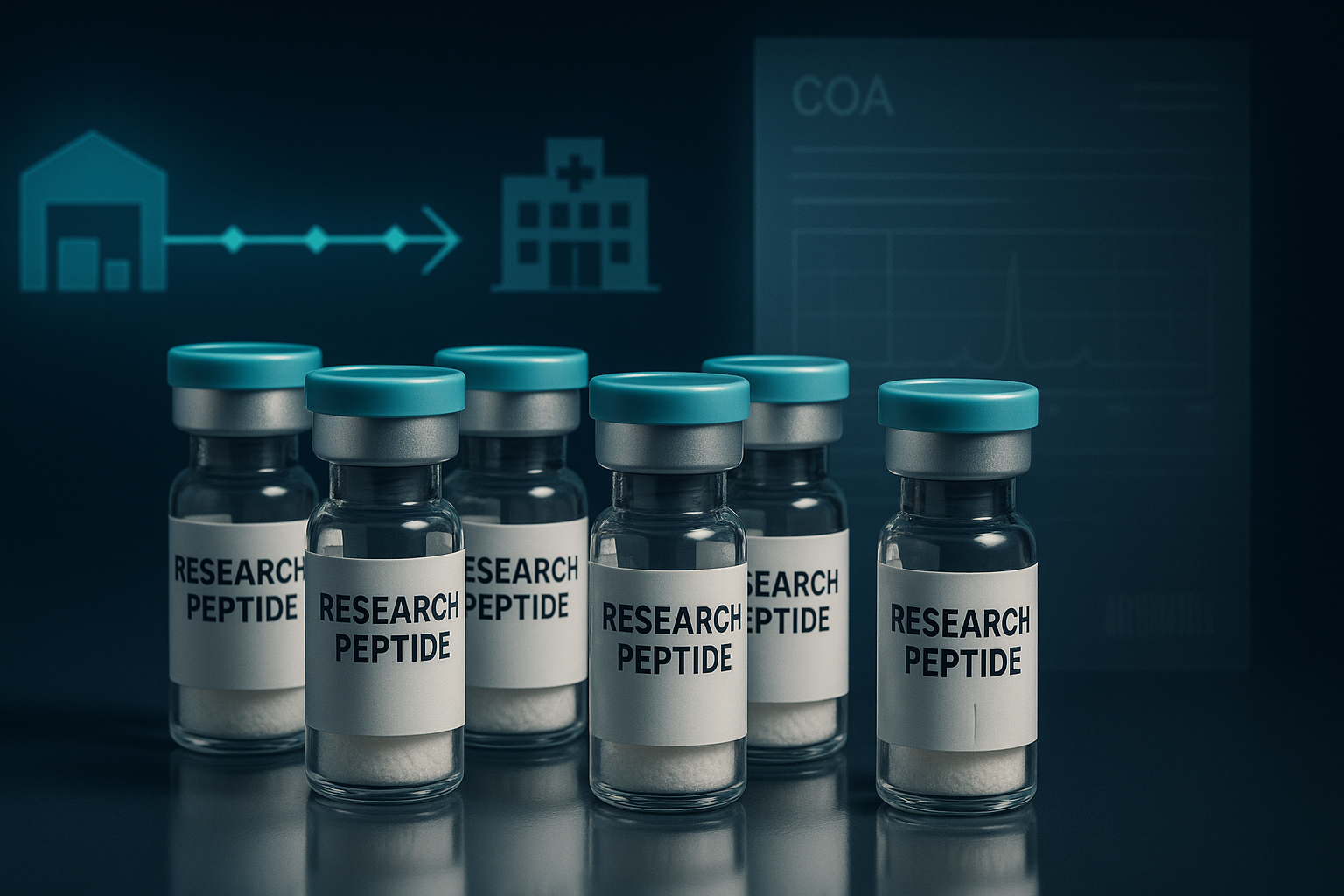
Bulk procurement of research peptides operates differently from consumer retail. Pricing follows a tiered structure where per-vial cost decreases as order volume increases. Each batch in a bulk order carries its own Certificate of Analysis (COA), which must be verified before shipment to ensure consistency across the entire lot.
Custom labeling is a standard part of bulk buying for clinic owners and white-label brands. YourPeptideBrand allows you to apply your own labels and packaging on every vial in the order, so the end user sees your brand, not the supplier. That branding capability is built into the order process, not an aftermarket add-on.
Logistics coordination becomes more involved at scale. A multi-location clinic might split a 500-vial order across three physical addresses, each with its own shipping label and delivery window. Bulk suppliers that handle this cleanly save you significant administrative time compared to placing three separate orders.
How Does Bulk Pricing Work for Research Peptides?
Bulk pricing for research peptides is not a single flat rate. It depends on four primary variables that determine the final cost per vial. Understanding these factors helps you evaluate supplier quotes and budget for your research program.
Purity grade is the first variable. Standard HPLC purity at 98% may cost less than 99%+ purity. Higher purity requires more rigorous purification and analytical verification, which adds to production expense.
Synthesis complexity also drives cost. Peptides with longer amino acid sequences or multiple disulfide bridges require more synthesis steps and specialized techniques. A simple linear peptide will cost less than one requiring cyclization or post-synthetic modification.
Order volume creates tiered pricing. Many suppliers offer discounts per vial as order size increases, but the baseline price per unit matters. Some vendors inflate their base price and then discount heavily, making it hard to compare apples to apples.
Customization adds service fees. Custom labeling, blended research peptide formulations, and non-standard vial sizes all incur additional charges. These services are valuable for branding but should be quoted separately to avoid hidden costs.
A mid-2026 Reddit vendor comparison found BPC-157 10mg pricing across 10 suppliers ranged from approximately $64.99 to $99.99 per vial, illustrating wide variance even for the same compound, purity, and vial size (Reddit vendor comparison). This range shows that supplier pricing is not standardized and depends on the factors above.
Many wholesale suppliers require 100+ vial minimums to access any discount, locking out smaller buyers. YourPeptideBrand offers a zero-MOQ model for online orders, allowing you to buy a single vial at the same per-unit price available to high-volume purchasers. No minimums mean you can test new research compounds before scaling up.
Research Summary: Market Data on Bulk Peptide Demand
The global peptide market reached an estimated $140.9 billion in 2025 and is projected to grow to $294.6 billion by 2033, a compound annual growth rate (CAGR) of 8.7% according to Grand View Research. This forecast reflects broad expansion across compound and research-use sectors.
Within that total, the research-use-only (RUO) segment benefits from a steady rise in PubMed-indexed publications for popular compounds. As more academic and preclinical studies cite specific research peptides, institutional and commercial labs increase their purchasing volumes, driving bulk demand.
Healing-and-recovery category research peptides such as BPC-157, TB-500, and GHK-Cu show lower keyword difficulty scores (KD 4-8) compared to metabolic categories, signaling growing but accessible market interest (BPC-157 research guide, YPB 2026). For buyers evaluating bulk orders, these figures help prioritize compounds with measurable demand and manageable competition. To verify the quality of incoming material, review common peptide testing methods explained.
White-Label Opportunity: Why Bulk Buying and Private Labeling Go Together
A clinic ordering 100 vials of a research peptide under its own brand captures the margin between wholesale cost and branded retail pricing, without managing synthesis, testing, or fulfillment. That margin is the core of the white-label business model: you own the label, you set the price, and the supplier handles production and logistics. For a clinic or entrepreneur buying research peptides in bulk, white labeling turns a procurement expense into a revenue-generating product line.
YourPeptideBrand’s turnkey model makes this structure accessible at any scale. On-demand label printing means you can order custom-branded labels for even a single batch. Custom packaging and direct dropshipping let you sell under your own name without holding inventory. And with zero minimum order quantity, you are never forced to buy more than you can sell or validate. The typical supplier that forces bulk minimums of 500 or 1,000 vials cannot offer this flexibility, and those minimums often kill the economics for a new brand.
YourPeptideBrand supports more than 250 active white-label storefronts with a catalog of over 60 third-party-tested research peptides. That breadth means you can launch with a full lineup, not just one or two compounds. To decide where to sell, read our roundup of the best platforms for selling research peptides. For a step-by-step roadmap from brand creation to first sale, see the complete guide to launching a white-label peptide brand.
Want to see how white labeling works for your clinic or brand? Book a free strategy call with the YPB team to discuss volumes, custom packaging, and launch timelines.
Quality Checks to Run Before You Order Research Peptides in Bulk
1. Verify Batch-Specific Certificates of Analysis
A Certificate of Analysis (COA) is only meaningful when it matches the exact lot number you receive. Every bulk order must come with a COA that includes an HPLC chromatogram, mass spectrometry (MS) confirmation, the lot number, and the test date from a named third-party lab. Research published in Pharmaceutics (PMC4406950) emphasizes that HPLC at 214 nm is the standard for detecting peptide purity and impurities. Without batch-specific documentation, the COA could belong to a different production run, providing no assurance for your research.
2. Confirm HPLC Purity of 98% or Higher at 214 nm
Research-grade purity for research peptides generally requires 98% or higher when measured at 214 nm wavelength. A study in PMCID PMC4406950 (PMID 26463645) confirms that HPLC at 214 nm is the most reliable method for quantifying peptide content and detecting closely related impurities. Any purity claim below that threshold should raise questions about the suitability of the research peptide for your research protocol.
3. Cross-Reference the Lot Number with the Issuing Lab Directly
Fraudulent or recycled COAs are not uncommon in bulk peptide procurement. Before committing to a large order, take the lot number from the COA and verify it directly with the third-party lab that performed the test. Legitimate labs maintain databases or can confirm on request. If the lab cannot match the lot number, the document has no credibility.
4. Review Storage and Handling Documentation
Lyophilized research peptides require storage at -20 degrees Celsius to maintain stability. Repeated freeze-thaw cycles degrade the peptide structure, so the supplier should provide clear handling instructions and use packaging that supports cold-chain integrity during transit. Request their storage protocol before ordering; a supplier that cannot articulate it may not manage temperature-sensitive inventory properly.
5. Evaluate Vendor Transparency and Public COA Libraries
Suppliers that maintain a public COA library offer far more accountability than those that only provide certificates on request. A 2026 Reddit community analysis of 10 vendors (see the ScienceBioTechnology discussion) found that only suppliers with publicly available, batch-specific third-party COAs ranked highest in community trust. Make the same call before you buy: if the COA library is missing or generic, move on.
Once you confirm quality, the next step is figuring out how to price and position your peptide products in a competitive market.
Additional detail on HPLC testing protocols is available from Spartan Peptides’ HPLC purity guide.
COA and Quality: The Third-Party Testing Standard
A Certificate of Analysis (COA) is only as valuable as the methods behind it. The gold standard for research peptide testing combines high-performance liquid chromatography (HPLC) with mass spectrometry. HPLC quantifies purity by separating and measuring the main peak. Mass spectrometry confirms the compound’s molecular identity by measuring its exact mass and fragmentation pattern. Used together, these two techniques give a complete picture: purity and identity.
HPLC alone cannot confirm that the sample is the correct molecule. A research peptide could show 99% purity by HPLC while still containing a wrong compound that happens to co-elute at the same retention time (Apex Laboratory, 2026). In other words, a single-method COA can mask a substitution or contamination. Mass spectrometry removes that ambiguity. Without it, you cannot be sure the substance in the vial matches the label.
Reputable research-grade peptide suppliers should apply both HPLC and mass spectrometry to every batch they release. A single-method COA – especially HPLC-only – is not sufficient for confirming molecular identity. When evaluating a bulk order, ask for a batch-specific COA that lists both the purity percentage and the mass spectrometry results, and check that the reported molecular weight matches the expected value for the research peptide.
YourPeptideBrand provides batch-specific COAs for all 60+ SKUs via the COA Library. Each document shows the analytical methods used, the purity result, and the mass spectrometry confirmation. You can browse the full library at any time: Browse the COA Library.
Research Guide: How to Evaluate a Bulk Research Peptide Supplier
| Criteria | Industry Average | YourPeptideBrand |
|---|---|---|
| Testing Transparency | COA available only upon request; some charge a fee for a copy | Public COA library with batch-specific certificates for every product |
| Purity Standard | Often no minimum purity stated; occasional 95% HPLC with no MS confirmation | 98%+ HPLC with mass spectrometry (MS) confirmation per batch |
| MOQ Flexibility | 25-, 50-, or 100-vial minimums; no single-vial ordering | Zero minimum order quantity for online orders |
| Domestic Shipping | International, 10-21 day transit with customs risk | US-based fulfillment and dropship; domestic shipping times |
| Payment Options | Crypto-only or wire transfer; no credit cards accepted | Credit card, debit, and major online payment methods accepted |
Many wholesalers lock buyers into rigid minimums and charge extra for quality documentation. For example, a supplier that demands 100-vial MOQs and withholds COAs unless you pay an additional fee creates friction for anyone testing new compounds or validating a product line. By contrast, YourPeptideBrand removes those barriers: every research peptide ships with a batch-specific COA, and there is no minimum order quantity on any listed product.
When evaluating a supplier, look beyond the price per vial. Testing transparency directly affects the reliability of your FDA-compliant product page and the trust your own brand builds. Independent resources like HonestPeptide’s vendor selection guide (HonestPeptide, 2023) and Biolongevity Labs’ quality control overview (Biolongevity Labs, 2023) reinforce that COA access and purity standards are non-negotiable for serious research use.

Ready to see what those zero-MOQ margins look like in your business? Try the Profit Calculator to estimate revenue scenarios based on your target volume and markup.
Frequently Asked Questions About Buying Research Peptides in Bulk
What does HPLC purity mean on a peptide Certificate of Analysis?
HPLC (High-Performance Liquid Chromatography) purity indicates the percentage of the target peptide relative to total components. A result of 98% means 98% of the sample is the intended peptide, with the remainder being impurities like truncated sequences or solvents. This metric is critical for researchers to ensure the peptide’s identity and consistency. (Spartan Peptides)
What are common impurities found in research peptides?
Common impurities include truncated peptides (incomplete synthesis), oxidation byproducts, residual solvents from purification, and counterions from salt forms. These can affect solubility and stability. Analyzing the Certificate of Analysis for impurity profiles helps researchers assess batch quality. (Spartan Peptides)
How is peptide content verified in bulk orders?
Content verification typically involves mass spectrometry (MS) to confirm molecular weight and HPLC to quantify purity. Amino acid analysis may also be used to confirm the sequence. Reputable suppliers provide a COA documenting these tests for each batch. (Peptides Lab UK)
Why is solubility data included on a COA?
Solubility data indicates which solvent (e.g., water, acetic acid) is recommended to dissolve the peptide for research use. This ensures the peptide is fully reconstituted, avoiding aggregation or degradation that could skew experimental results. Proper solubility is essential for accurate dosing in in vitro studies. (PMID 24958008)
How do storage conditions affect peptide stability?
Lyophilized peptides are stable at -20 degrees Celsius for months, but once reconstituted, they degrade faster. Factors like pH, temperature, and freeze-thaw cycles can cause hydrolysis or aggregation. Researchers should store bulk peptide vials desiccated and away from light to maintain integrity. (PMID 24958008)
What is the typical minimum order for bulk peptide suppliers?
Many suppliers require minimum orders of 50 to 100 vials per peptide. This can be a barrier for clinics or entrepreneurs wanting to test multiple compounds. YourPeptideBrand eliminates this hurdle with no minimum order quantities, allowing you to order as few as 25 units per SKU while still receiving wholesale pricing.
How does YourPeptideBrand ensure quality across 60+ research peptides?
YourPeptideBrand provides batch-specific Certificates of Analysis for all 60+ research peptides, tested by third-party labs for purity, content, and solubility. All COAs are accessible via the online COA Library. This transparency allows you to verify each lot before research use, without relying on supplier claims.
Can I estimate profit margins before placing a bulk order?
Yes. YourPeptideBrand offers a Profit Calculator that lets you model margin scenarios based on your retail pricing and order volume. Since there are no minimum order quantities, you can start with small batches to validate demand. The calculator accounts for labeling, packaging, and dropshipping costs to give a realistic projection.
Conclusion – Build Your Own Research Peptide Brand with Bulk Purchasing
Understanding pricing structures, performing quality checks, and selecting a white-label partner are the pillars of a smart bulk research peptide buying strategy. When you own the brand and control the customer relationship, every batch you source directly affects your margins and reputation.
Whether you are a clinic owner scaling research operations or an entrepreneur building a branded RUO dropshipping business, YourPeptideBrand provides the infrastructure: no minimum order quantities, on-demand drop-shipping, custom labeling, and batch-specific COAs.
Run the numbers with the Profit Calculator or download the full catalog to explore 60+ SKUs. If you prefer a guided walkthrough, book a free strategy call with our team.
Speak with our team about bulk pricing, custom labels, and launching your brand.
Last updated: July 2026