

Direct answer: Market a research peptide brand by helping a defined business buyer make a documented decision. Before release, review the complete message, connect factual statements to evidence, and record who approved each asset. A research-use-only statement belongs within that process; it does not replace it.
This guide provides an original internal review framework for brand founders and operators. It is an operational aid, not legal advice, a regulatory certification, or a promise that a campaign will be accepted by an advertising platform.
Start with the buyer decision
Choose one decision for each page: comparing an operating model, reviewing supplier documentation, or discussing a launch plan. Mixing all three into every asset makes the next step harder to understand. Write down who the page serves, what they need to evaluate, and what evidence your team can actually provide.
For example, a supplier-selection page can organize the documents a buyer should request. A branding page can explain the materials needed for a design discussion. Neither needs an unsupported claim about a product’s effects. If you are still defining the business, begin with the YPB launch-planning guide.
Turn your brand idea into a clear next step.
Bring your intended audience, launch model, and open questions to a business-planning conversation with YPB.
What RUO wording can and cannot do
The FTC’s Health Products Compliance Guidance explains that advertisers need support for objective express and implied claims before dissemination. Review the overall impression created by words and images, not just a disclaimer. The guidance does not provide a safe harbor.
In its February 2025 USApeptide.com warning letter, FDA identified evidence of intended human use despite research-use labeling. That is a specific enforcement example, not a determination about YPB.
Scope matters when choosing sources. FDA’s RUO/IUO guidance for in vitro diagnostic products addresses that particular product category. Do not turn it into blanket authorization for every research peptide. Escalate uncertain classification or advertising questions to qualified counsel.
A reusable claims-review matrix
Create one record per asset and keep its exact version. Use the table below as an original internal operating framework—not a regulator-approved test. “Hold” means the asset does not move to your release queue until the recorded question is resolved.
| Asset or message | Evidence to inspect | Decision and owner | Recheck trigger |
|---|---|---|---|
| Catalog fact | Exact specification, applicable lot or catalog version, and dated supplier record. | Operations owner confirms the match; hold statements that exceed the record. | Supplier, specification, or catalog change. |
| Image and headline | The complete layout, including captions, neighboring text, and intended audience. | Asset owner records the likely message; escalate an unresolved health implication. | New crop, headline, placement, or audience. |
| Customer quotation | Original statement, permission record, proposed excerpt, and surrounding copy. | Named reviewer checks accuracy and context; hold unsupported outcome statements. | Edited quotation, new attribution, or changed context. |
| Citation or outbound link | Live destination, source scope, and the exact statement it is being used to support. | Content owner records the match; hold a citation that does not support the claim. | Redirect, changed source, broken link, or revised claim. |
| Follow-up message | Email or reply together with the page and offer that prompted it. | Campaign owner checks consistency; route unresolved questions for review. | New sequence, offer, reply template, or customer question. |
Add fields for the asset URL, version, evidence location, reviewer, decision date, open questions, and next review date. Suggested decisions are ready for release, revise, and hold for qualified review. A completed spreadsheet is a record of your process, not proof of legal compliance.
Work through one hypothetical campaign
Suppose a brand wants to announce an updated catalog. The first draft says “Documentation available for every listed item.” Your operator checks the actual catalog and finds that one record is missing. The decision is a hold: obtain the missing record or narrow the statement to what can be demonstrated. Changing the button text does not resolve the evidence gap.
Next, the designer replaces a neutral catalog screenshot with an image suggesting a personal health outcome. Reopen the image-and-headline row because the asset has changed. Finally, review the follow-up email alongside the landing page. Save the final versions together so the team knows which combination was reviewed.
This is a hypothetical workflow example, not a report of YPB results. For the supplier-documentation side of the process, use the 12-point supplier due-diligence scorecard.
A release checklist your team can actually use
- Freeze a review version. Capture the page, images, CTA destination, and related follow-up copy.
- Separate facts from recommendations. Attach evidence to product or service facts. Label examples and proposed internal practices clearly.
- Resolve holds. Assign a person and an actual decision date; an empty field is not approval.
- Check the complete journey. Open citations, inspect the booking destination, and read the page on a narrow screen.
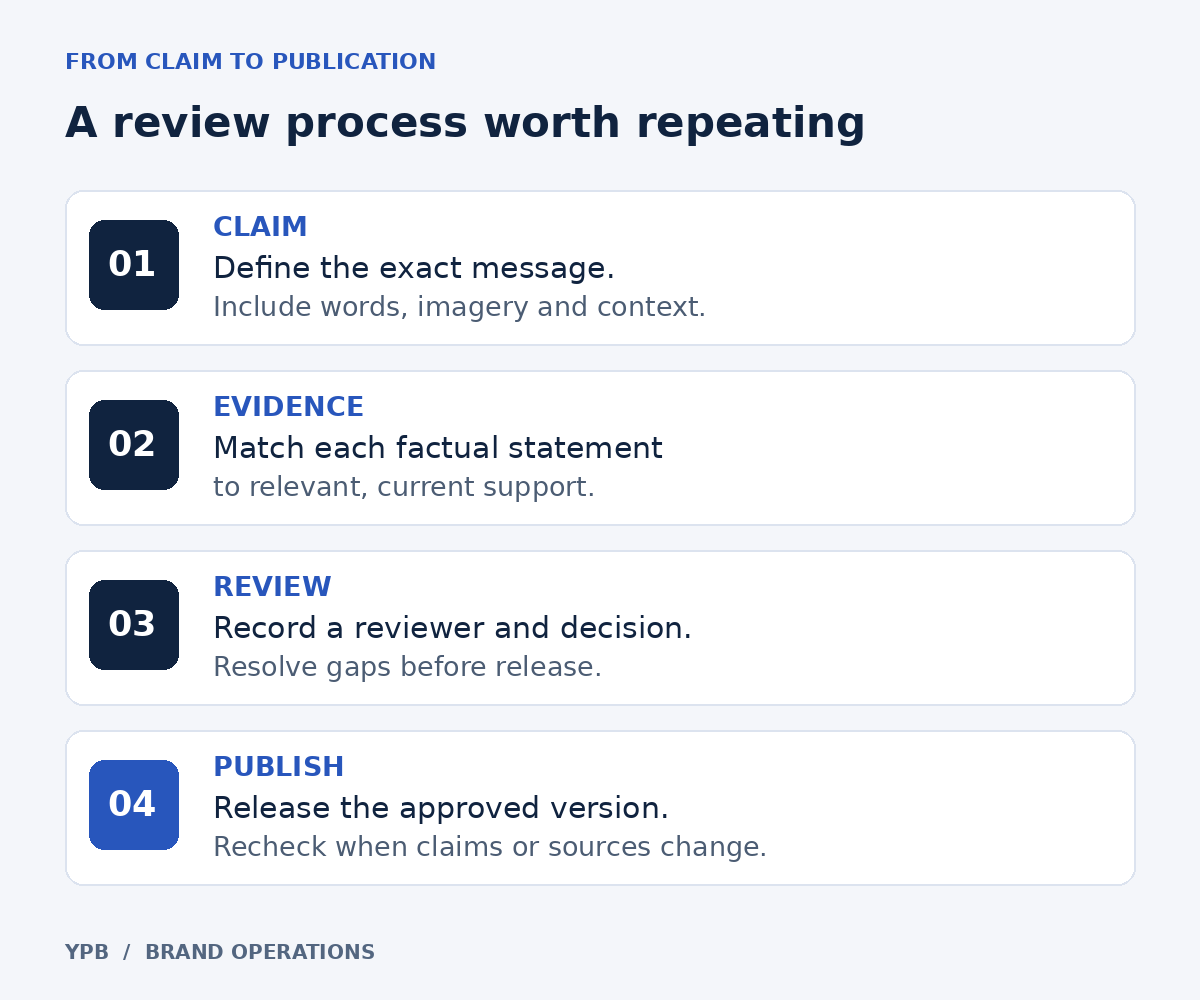
- Release the reviewed version. Record its URL and publication time. Keep a recoverable copy of the prior version when updating a page.
- Reopen review after material changes. Use the triggers in the matrix rather than assuming approval lasts indefinitely.
Measure qualified demand
Define a qualified inquiry before counting it. For an internal starting definition, you might look for a prospective business operator with a stated launch model, a practical question, and an interest in discussing the next step. Adjust that definition to your actual sales process.
Track article visits, booking-link clicks, completed bookings where measurement is available, and qualified conversations. Treat a click as a click—not a booked call. Compare your own periods and record tracking gaps. Use the questions raised in calls to improve the article; do not manufacture benchmarks or promise conversion results.
Common questions
Does a source link make a claim ready to publish?
No. In this review framework, record which statement the source supports and where its scope ends. If the connection is unclear, revise the statement or keep the asset on hold.
Should every edit restart the review?
Use judgment tied to the message. A changed product fact, image, quotation, destination, or audience deserves another look. Record the change and the reviewer’s decision so the team can distinguish a formatting correction from a new claim.
Bring a better brief to your launch conversation.
Outline your audience, catalog questions, and unresolved decisions. Review YPB’s branding service, or discuss which business-planning step fits your situation. A strategy call does not replace independent legal review.
For research use only. Not for human consumption, diagnostic, or therapeutic use.