
For research use only. Not for human consumption, diagnostic, or potential wellness benefit.
What Is Documentation Readiness in RUO Peptide Supply?
Documentation readiness separates suppliers that enable fast institutional approvals from those that create bottlenecks. IACUC and IRB committees now require pre-verified chain-of-custody, batch-specific COAs, and institutional verification records before protocol approval. Missing paperwork delays research for weeks.
As of April 2026, purchasing institutions must provide IRB registration, IACUC approval, or equivalent oversight documentation per Real Peptides’ legal analysis. Research Peptides Legal 2026 – Current FDA Rules Explained confirms this requirement.
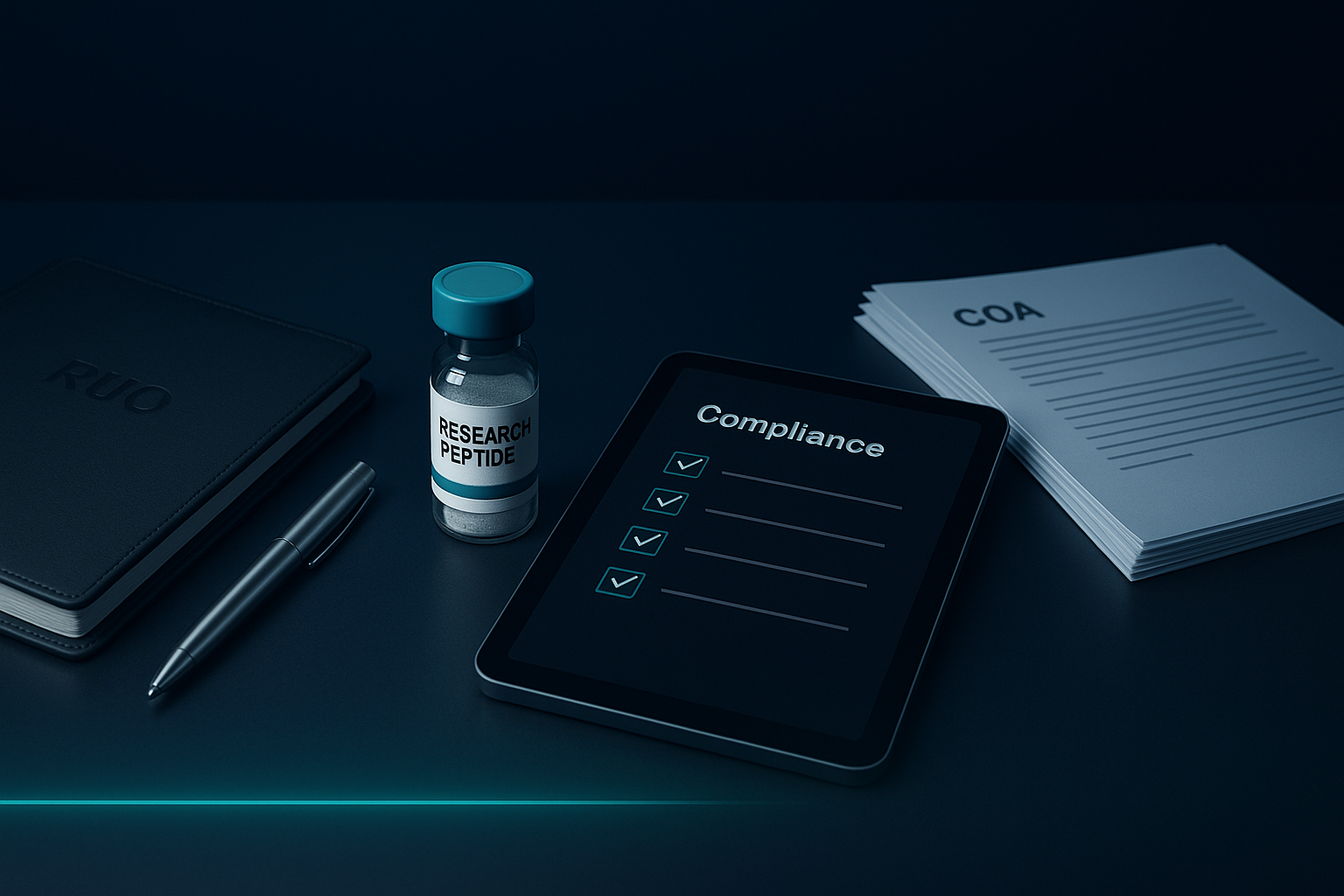
Documentation readiness means every batch of research peptides ships with pre-verified, audit-ready paperwork including batch-specific COAs, chain-of-custody records, RUO-compliant labels, and institutional verification packets, so clinics can submit complete compliance dossiers without delay. This framework rests on three pillars:
- Batch-specific COA with HPLC/MS data – each lot is tested so the certificate matches the exact vial in hand.
- Full chain-of-custody from synthesis to shipment – every transfer is logged, creating an unbroken record that satisfies institutional auditors.
- Institutional verification paperwork – pre-assembled packets containing the documents committees require (COA, proof of origin, RUO label statement).
Documentation standards extend beyond RUO; as Bachem notes, peptides used in diagnostics require certificates of analysis and traceability. Suppliers that cannot produce these records on demand create friction for clinic owners racing toward protocol approval.
YPB’s turnkey documentation infrastructure delivers this readiness from day one. For a deeper look at how documentation fits into the broader compliance picture, see the role of documentation in peptide compliance and quality assurance. Learn how the FDA regulates research peptides to see the full regulatory context.
Why Institutional Approvals Depend on Supplier Documentation
Institutional approvals from an IACUC or IRB do not happen on trust alone. The reviewing body needs documented proof that the research peptide meets every compliance checkpoint before a protocol can move forward. Four non-negotiable documentation elements are universally expected: (1) RUO labeling on both primary and secondary containers, (2) a Material Safety Data Sheet (MSDS) accompanying each shipment, (3) institutional documentation that confirms IRB or IACUC oversight of the research plan, and (4) a chain-of-custody record that links the specific batch of peptide directly to the approved protocol.
The burden of proof lands squarely on the purchasing institution, not the supplier. According to an analysis by ByrdAdatto (March 2026), the FDA holds the clinic or research site accountable for verifying that every material used in a study meets regulatory standards. If a supplier cannot produce batch-specific documentation on request, the institution bears the entire compliance risk.
Not all documentation carries the same weight. The table below distinguishes what is typically required from what is optional in an institutional review.
| Document Type | Required or Optional |
|---|---|
| Certificate of Analysis (COA) | Required |
| Material Safety Data Sheet (MSDS) | Required |
| RUO label on product | Required |
| Chain-of-custody documentation | Required |
| Stability data | Optional |
| Synthesis details | Optional |
| Impurity profiles | Optional |
The Cost of Documentation Gaps
When a supplier cannot produce batch-specific documentation on demand, the downstream effects hit the clinic in three concrete ways: delayed IACUC protocol approvals, increased institutional liability, and lost research time. Kensington Labs (2025) notes that regulatory enforcement actions frequently target a lack of chain-of-custody documentation and misrepresentation of research materials. A clinic that cannot trace a peptide back to its batch and COA operates without a defendable compliance record.
The operational cost is measurable. Waiting two to three weeks for a supplier to locate a COA or reissue an MSDS can cause a protocol to expire or force a researcher to restart the approval process from scratch. Those weeks of lost momentum translate directly into delayed projects and higher overhead. Clinics that cannot produce documentation on demand also face steeper scrutiny during audits, which increases the likelihood of findings.
For a practical guide on structuring your own compliance records, see how to document compliance efforts for legal protection.
Download Our Full 60+ SKU Catalog
White-label research peptides, wholesale pricing, and dropshipping details.
White-Label Opportunity – Documentation as a Business Differentiator
Documentation readiness creates a competitive moat for clinic owners building their own research peptide brands. When your compliance package is ready before the first order, you shorten the path to institutional approval and reduce friction with oversight boards.
Suppliers that provide Certificates of Analysis, batch records, and chain-of-custody logs as standard enable clinics to:
- Present a polished compliance package to institutional oversight boards without last-minute scrambling.
- Build brand trust through transparent documentation that research teams can verify independently.
- Reduce internal compliance staffing costs by relying on vendor-supplied records rather than generating everything in-house.
Many suppliers treat documentation as an afterthought and force bulk minimums that lock clinics into large inventory before they have an approval pipeline. That approach creates unnecessary risk and delays. A vetting checklist for peptide vendors emphasizes that lot-level traceability is a minimum requirement for serious research operations.
YourPeptideBrand provides pre-verified documentation – COA, batch record, and chain-of-custody – with every shipment, regardless of order size. No minimum order quantity means you can test the process with a single batch before scaling. This documentation readiness pairs directly with how third-party fulfillment protects compliance, ensuring every shipment arrives with the same paper trail.
Ready to Launch Your White-Label Research Peptide Brand?
Book a free call with our team. We will walk you through pricing, setup, and your first order.
COA / Quality – The Documentation Backbone
The Certificate of Analysis is the single most critical document in a research peptide supply. Without it, institutional reviewers have no evidence that the material matches the label claims. A complete COA must contain at least: peptide identity confirmed by mass spectrometry (MS), purity percentage with an HPLC trace, a unique batch number, the date of manufacture, an expiration date, method references (e.g., USP or in-house SOPs), and an authorized signature. These elements together create a traceable chain from synthesis to laboratory.
Traceability is a core component of quality assurance. Research published by Maple Research Labs notes that batch tracking with unique identifiers allows labs to verify the identity and purity of each lot and quickly isolate any issues if they arise. Without a full COA, that traceability breaks down.
For any lab buying research peptides, the COA is the first document an IACUC or IRB will request. Search our COA Library for batch-specific documentation to pre-verify your supply.
Research Guide – Institutional Approval Workflow
Getting a research peptide into a lab is not a one-step purchase. Institutions follow a defined five-step workflow that suppliers must be prepared to support.
Step 1: Protocol submission to IACUC/IRB with supplier documentation packet. The researcher submits the study protocol, including the supplier’s COA, material safety data sheet (MSDS), and any manufacturer certificates. Without a complete packet, the committee cannot initiate review.
Step 2: Institutional verification of supplier compliance documentation. The institution reviews the COA, batch records, and MSDS against its own purchasing and safety policies. This step confirms the supplier is a legitimate source with documented quality controls.
Step 3: Order placement with documented chain-of-custody. Once approved, the order is placed, and the supplier must provide a chain-of-custody record that ties the batch number to the shipping documents.
Step 4: Material receipt and inventory logging with batch number cross-reference. Upon arrival, the lab logs the vial into its inventory system, cross-referencing the batch number on the vial label with the COA. This prevents mix-ups and ensures every aliquot is traceable.
Step 5: Ongoing record retention (seven years per state frameworks like Texas). Institutions must maintain documentation of protocols reviewed by the IACUC, as outlined in OLAW/NIH recordkeeping requirements. For research peptides, COAs, MSDS, and batch records fall under the same retention schedule. Clinics that cannot produce these documents during an audit risk losing access to their approved protocols.
For a deeper comparison of what to look for in a supplier’s documentation, read our guide on how to audit your peptide brand for compliance.

Calculate Your White-Label Margins
See exactly how much margin you can make at your price point.
Frequently Asked Questions About Documentation Readiness
What documentation do clinics need to legally purchase research peptides in 2026?
Purchasing institutions must provide IRB registration, IACUC approval, or equivalent internal oversight documentation proving the facility operates under documented research protocols, according to the Real Peptides 2026 legal framework. Suppliers must verify and retain this documentation before fulfilling orders. The shipping address must match the verified institutional facility address. YourPeptideBrand provides batch-specific COAs for every product, supporting clinics in maintaining their compliance documentation.
Why is a batch-specific Certificate of Analysis essential for research peptide compliance?
A batch-specific COA provides documented evidence of identity, purity, and composition verified by third-party analytical methods such as HPLC and mass spectrometry. Research published in the Journal of Peptide Science (Elsayed et al., 2025) emphasizes that regulatory guidelines require documented quality control for peptide analysis. For research institutes, the COA links each vial to a specific manufacturing lot, creating an auditable chain that satisfies IACUC and IRB documentation requirements.
How does chain-of-custody documentation affect research peptide validity?
Chain-of-custody records track a research peptide from raw material receipt through synthesis, purification, testing, packaging, and final distribution. The Kensington Labs 2025 compliance review notes that regulatory enforcement in the peptide sector targets lack of chain-of-custody documentation. A complete chain-of-custody log enables researchers to trace every batch, confirm proper handling, and produce audit-ready records during institutional inspections.
What is the difference between research-grade and compound-grade peptide documentation?
Research-grade peptides require documentation confirming 95-98% purity verified by HPLC, RUO labeling, and chain-of-custody records, according to the Real Peptides 2026 framework. compound-grade peptides under 503B oversight require 99%+ purity, sterile manufacturing certification, endotoxin testing, and cGMP batch records. The documentation burden differs significantly, with compound synthesis costing three to five times more per milligram due to these additional requirements.
How long must research institutions retain peptide purchase records?
Federal regulations do not specify a single minimum retention period, but most state frameworks require institutions to retain peptide purchase records, protocol approval documents, and chain-of-custody logs for a minimum of seven years, as documented in the Real Peptides 2026 compliance analysis. These records must be producible on demand during FDA or state facility inspections. YourPeptideBrand’s digital documentation system supports long-term record retention for clinic compliance.
How does documentation readiness reduce institutional approval delays?
When a supplier provides pre-verified batch-specific COAs, complete chain-of-custody records, and properly labeled RUO products, clinics can submit all required documentation to their IACUC or IRB at the time of protocol application rather than chasing missing records. YourPeptideBrand includes compliance documentation with every shipment through its turnkey platform, accelerating the approval process compared to suppliers that require clinics to request and wait for individual documents.
What documentation differentiates YourPeptideBrand from suppliers that lack compliance readiness?
YourPeptideBrand provides batch-specific COAs, synthesis documentation, and chain-of-custody records for every product in its 60+ SKU catalog, with no minimum order quantities. Unlike suppliers that force bulk minimums and provide only generic documentation, YPB generates on-demand labeling with RUO-compliant artwork and maintains a searchable COA Library. Every shipment includes compliance documentation that links directly to the specific batch and lot number.
How can clinics use documentation readiness as a business growth tool?
Clinics that partner with documentation-ready suppliers can onboard new research peptides faster, satisfy institutional oversight requirements without repeated document requests, and differentiate their brand through demonstrated compliance rigor. YourPeptideBrand’s profit calculator helps clinic owners model how reduced documentation delays translate into faster revenue generation. The turnkey platform handles compliance documentation so clinic staff focus on research rather than paperwork.
Documentation readiness is the dividing line between clinics that secure approvals in days and those stuck in weeks of back-and-forth. YourPeptideBrand gives you a pre-verified suite of batch-specific COAs, chain-of-custody records, and on-demand RUO-compliant labels – all with zero minimums.
For clinic owners, building your own brand on top of this documented compliance infrastructure reduces institutional risk and accelerates research timelines from the first order.
Run the numbers with our Profit Calculator and see how documentation readiness directly improves your margins. Then schedule a compliance strategy call to discuss your specific documentation needs.
Speak With a Compliance Specialist
Book a free call to discuss your documentation readiness strategy and how YPB can support your clinic’s compliance needs.
Last updated: July 2026