For research use only. Not for human consumption, diagnostic, or potential wellness benefit.
The global user-generated content platform market reached $12.63 billion in 2026, growing at a 28.32% CAGR (Fortune Business Insights – UGC Platform Market Size 2026-2034). For RUO peptide brand entrepreneurs, this trend represents a strategic lever: UGC creators produce authentic, scalable content that builds trust without triggering platform compliance flags.
This article delivers a practical 4-step process for finding, vetting, briefing, and managing UGC creators specifically for research peptide brands operating under Research Use Only constraints. The goal is cost-efficient brand awareness with compliant content that sells the business opportunity, not a therapeutic outcome.
What Are UGC Creators and Why Do They Matter for Peptide Brands?
UGC creators are independent content producers paid to create authentic-looking videos and images for brands in ads, social feeds, and product pages. Unlike influencers, they are compensated for content quality, not audience size. For research peptide brands, UGC provides social proof without requiring efficacy claims.
According to Billo’s 2026 data, UGC drives 6.73x higher conversions than branded content and delivers $4 ROI for every $1 invested (via Billo). Meanwhile, 92% of consumers trust peer recommendations over brand messages, per Nielsen research cited by Billo and Influencer Marketing Hub.
For an RUO research peptide brand, this trust gap is critical. Buyers who see real researchers or clinic owners engaging with a product in a lab setting feel more confident than they would from a polished brand ad. UGC creators can demonstrate unboxing, handling, and storage of research peptide vials in a compliant way – no claims, just demonstration. That authenticity shortens decision cycles and reduces perceived risk for new buyers.
Pairing UGC with a strong brand framework is the next step. See Peptide Branding and Positioning Strategies for a deeper look at how to align creator content with your brand identity.
The UGC Creator Market: Benchmarks and Growth Data
Knowing the numbers behind user-generated content helps entrepreneurs budget with confidence. The table below compiles 2025-2031 market and performance data from multiple research firms.
| Metric | Value | Source |
|---|---|---|
| UGC platform market value 2025 | $9.85B | Mordor Intelligence via Fortune Business Insights |
| UGC platform market value 2026 | $12.63B | Mordor Intelligence via Fortune Business Insights |
| UGC platform market value 2031 | $43.92B | Mordor Intelligence via Fortune Business Insights |
| Average creator cost per deliverable 2026 | $198 | Billo |
| Conversion uplift overall | 6.73x | Billo |
| Conversion uplift on social posts | 10.38x | Billo |
| Consumer trust: peer over brand | 92% | Nielsen via Billo |
| Platform share for ecommerce marketers | Instagram 28%, Facebook 23%, TikTok 19%, YouTube 17% | Billo & Archive |

These figures support budgeting for UGC initiatives. The average cost per deliverable stays under $200, while overall conversion uplift of 6.73x and social-post uplift of 10.38x make the ROI clear. For clinic owners and store operators, combining UGC with targeted ad platforms such as Facebook can multiply returns. See our Beginner’s Guide to Facebook Ads for Peptide Stores for implementation steps.
Step 1: Finding UGC Creators for Your Research Peptide Brand
Finding the right UGC creators for a research peptide brand requires targeting platforms and people who understand compliance. Here are four practical sourcing channels:
- Creator marketplaces such as Billo, JoinBrands, and Cohley. These platforms let you set budgets and review portfolios before committing. Typical price ranges run $50 – $400 per video, depending on deliverables and usage rights. Look for creators with lab or science-themed prior work.
- Direct discovery on TikTok and Instagram using hashtags like #peptideresearch, #labcontent, and #researchsupplies. Scroll for accounts that produce sterile-lab or white-coat content rather than lifestyle shots. Message them with a brief that clearly states “research use only.”
- Existing customer outreach. If you supply clinics or research labs, ask permission to feature their in-house research setups. They already know the compliance boundaries and can produce authentic content.
- UGC agencies that specialize in regulated or B2B niches. They pre-vet creators for language compliance and handle contracts.
According to a 2026 guide by Hustler Marketing, most brands should maintain 5 – 10 active creators to avoid creative fatigue. For research peptide brands, focus on creators who can film sterile environments and label handling without making therapeutic claims. Never script delivery or serving size language. For additional guidance on compliant advertising, read our guide on How to Safely Advertise Research Peptides.

Step 2: Vetting Creators for Compliance and Brand Fit
A creator’s portfolio tells you everything. Scan each video and caption for therapeutic claims, medical language, or dosing references. One misplaced word can break RUO compliance. Flag any post that says “helps with X” or mentions human use. That content cannot be repurposed for your brand.
Assess visual style next. Lab settings, clinical shelves, and clean product displays reinforce a B2B positioning. A creator who shoots lifestyle content with beds or kitchen counters sends the wrong signal to clinic owners and bulk buyers.
Check audience demographics directly. Your ideal viewer is another business owner, not a retail consumer. Look for comments from practitioners or questions about bulk ordering. If the audience skews general, the fit is weak.
Request a sample video brief before committing. The brief should follow your compliance guidelines exactly. Use it as a test: can they write a script without banned language? If they slip on a sample, they will slip on the final deliverable.
Document every vetting decision in a centralized log. A compliance review process for marketing content keeps you audit-ready. According to Vidlo’s 2026 report, the biggest risk in UGC is unstructured content without rights management and compliance filtering (Vidlo Trends Report). Structured vetting turns that risk into a repeatable safeguard.
Explore the YPB Product Catalog
Once you know how UGC creators will present your research peptides, the next step is choosing which products to feature. Download the YPB product catalog featuring 60+ third-party tested research peptides to identify products you can feature in UGC campaigns.
Download Our Full 60+ SKU Catalog
White-label research peptides, wholesale pricing, and dropshipping details.
Step 3: Writing Compliant UGC Creator Briefs
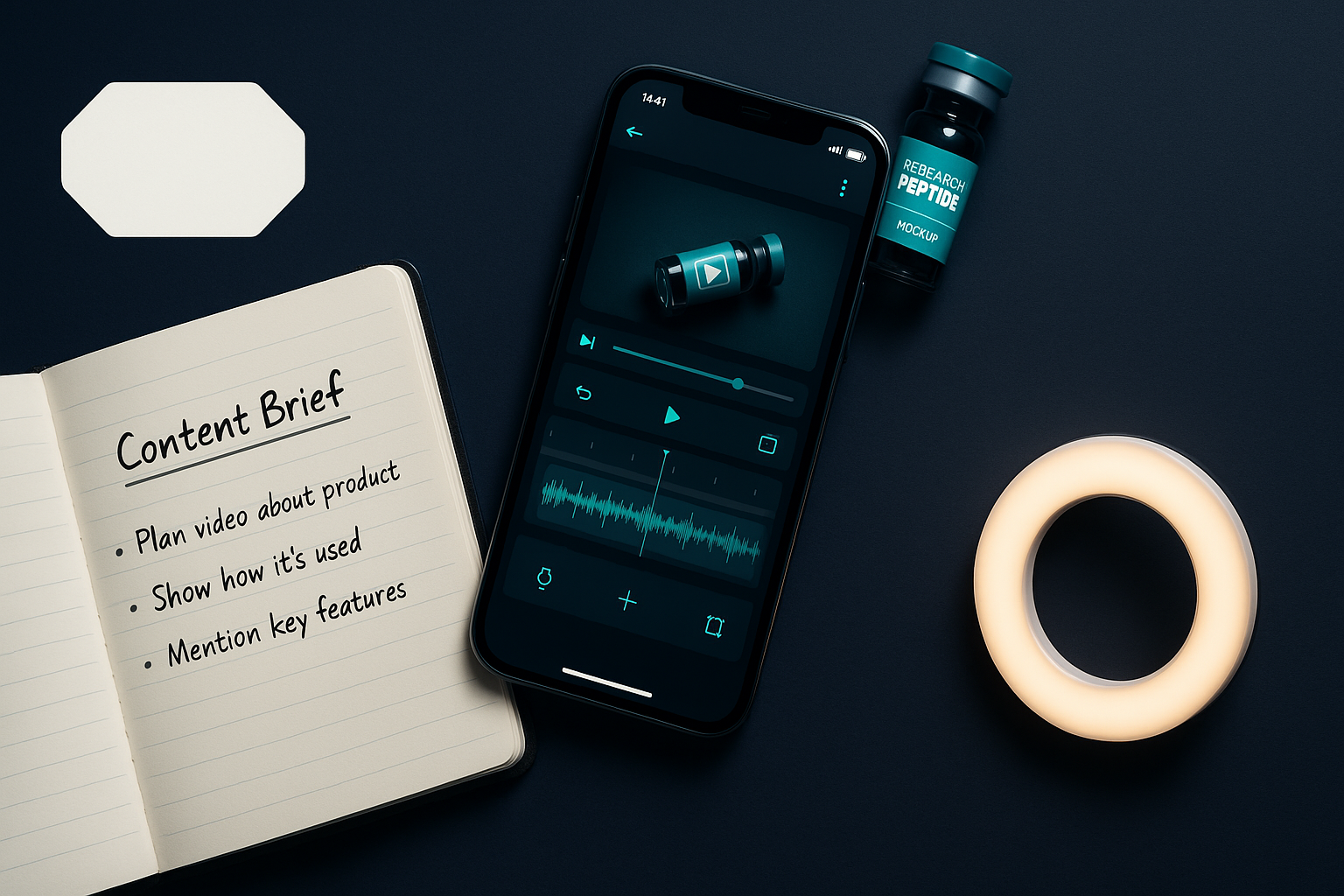
A well-structured brief keeps the creator on track and ensures every deliverable stays inside RUO boundaries. Per Hustler Marketing's 2026 guide, effective briefs include five components: product context, hook direction, content guidelines, format specifications, and tone.
Product Context and Prohibited Language
Start with the research peptide's status (RUO), its purity certification, and the batch-specific Certificate of Analysis URL. Then list forbidden language: no therapeutic claims, no dosing references, no human-use implications, and no outcomes like "treats" or "prevents." Provide a copy-paste list of banned verbs and phrases so the creator never accidentally crosses the line.
Hook Direction Ideas
Suggest hooks that work within RUO boundaries: a side-by-side unboxing comparing packaging quality, a quick lab-tour style overview of the vial and label, or a visual comparison of COA detail between suppliers. Keep every hook focused on product presentation and research-grade attributes, never on alleged effects.
Format Specifications
Mandate vertical 9:16 framing, 30 – 60 seconds duration, and a minimum of 1080p resolution. InVideo's AI UGC strategy guide confirms these specs drive the highest engagement on social platforms. Pre-write a short disclaimer that must appear as text on screen or in the caption: " " Attach this as a non-negotiable requirement in the brief.
Tone and Guidelines
Set a professional, science-forward, research-focused tone. No casual or "influencer" style. Every line in the script should sound like it could appear on a laboratory supplier's product page. Include a clear directive: never imply human application or dosing. Provide a pre-written script skeleton that the creator can adapt, with placeholders for the hook and visual description.
White-Label Opportunity: Why UGC and YPB Are a Natural Fit
YourPeptideBrand’s turnkey white-label platform gives entrepreneurs the product, packaging, and compliance infrastructure needed to launch their own brand. UGC provides the authentic content engine to promote it. Together, they close the gap between having a product and having a market presence.
Suppliers that force bulk minimums make UGC expensive and slow. YPB’s no-MOQ dropship allows ordering small test batches for UGC sampling without inventory risk. A creator can feature a single vial of a research peptide in a video and link directly to the order page, while the entrepreneur pays only for what ships.
The 60+ SKU catalog and the third-party tested Certificate of Analysis on every batch become natural content hooks. Creators can unbox custom-labeled packaging, show the COA, or compare research compounds on camera. Each piece of content reinforces credibility without the entrepreneur lifting a pin.
The rise of no-MOQ white-label platforms like YPB has made it possible for content creators to start their own research-peptide brands without upfront capital. For more on scaling that presence, see How to Use Paid Ads to Scale a Peptide Brand and Advanced TikTok Ad Strategies for Peptide Brands.
Step 4: Managing and Measuring UGC Campaign Performance
After content arrives from creators, the post-production workflow must be systematic. First, conduct a compliance review. Every caption, on-screen text, and audio mention must use correct RUO language (research peptide, research subjects). Flag any phrase that implies human dosing or potential wellness benefit.
Then secure rights management. Obtain a written license agreement specifying usage duration, exclusivity (e.g., category or platform), and permitted platforms (Instagram, TikTok, paid ads). Do not rely on verbal permission. Include a rejection queue for non-compliant content with specific feedback so creators can revise.
Organize assets in a cloud library with metadata tags (creator name, campaign, content type, approval status). Tagging by campaign phase (top-of-funnel, mid-funnel, bottom-of-funnel) enables efficient A/B testing and repurposing.
Performance tracking should focus on actionable KPIs: click-through rate, conversion rate, cost per acquisition, average order value. Vanity metrics (likes, shares) have less direct impact. Also track compliance pass rates — the percentage of submitted content that passes RUO review without edits. A high pass rate indicates well-briefed creators. Set benchmarks for each KPI based on historical campaign data. Use a dashboard that aggregates data from ad platforms, CRM, and the affiliate network to monitor these metrics in near real-time.
Per Vidlo’s 2026 report, leading teams map UGC formats to funnel stages: short-form video for discovery, UGC-style ads for consideration, video testimonials for conversion (source: Vidlo). Archive.com reports that brands using structured UGC tracking see improved cost efficiencies (source: Archive).
For maintaining brand trust, see The Role of Visual Consistency in Building Long-Term Trust.

Book a Strategy Call with YPB
A UGC strategy only works when your product supply chain is reliable and compliant. Book a Strategy Call with YPB to discuss how our white-label platform fits your UGC marketing plan, from on-demand labeling to direct dropship for your research peptide brand.
Ready to Launch Your White-Label Research Peptide Brand?
Book a free call with our team. We will walk you through pricing, setup, and your first order.
Using Third-Party COAs as UGC Content Anchors
A Certificate of Analysis (COA) from a third-party lab is more than a compliance document. It is a repeatable content asset for UGC creators. Every batch produced by YourPeptideBrand (YPB) ships with a batch-specific COA, giving creators a tangible prop they can feature in unboxing videos or side-by-side comparisons.
Creators can film themselves examining the COA insert, discussing purity verification (minimum 98% by HPLC), or contrasting documentation standards between suppliers. Because the content focuses on quality processes and documentation rather than biological outcomes, it is inherently compliant. As InVideo notes, documentation-based content performs well because it answers the viewer’s trust question without making claims outside the scope of research use.
YPB’s Certificate of Analysis Library gives creators a permanent, downloadable reference they can cite in their content. Suppliers that provide batch-specific COAs give creators more authentic material to work with. That authenticity translates into higher engagement from clinic buyers who value documented quality processes.
Calculate Your Profit Potential
Modeling customer acquisition cost by channel keeps your budget grounded in real numbers. The YPB Profit Calculator lets you compare UGC-driven CAC against other acquisition channels and see how different conversion rates shift your per-order margin before you commit spend.
Calculate Your White-Label Margins
See exactly how much margin you can make at your price point.
Frequently Asked Questions About UGC Creators for Research Peptide Brands
What are UGC creators and how do they differ from influencers?
UGC (user-generated content) creators are professionals paid to produce authentic-looking content for brands to use in ads, social media, and landing pages. Unlike influencers, UGC creators are not paid for their audience reach or follower count. According to InVideo's 2026 UGC guide, customers create content organically, while UGC creators are professionals who create authentic-looking content for brands. Both provide value but serve different strategic purposes.
How much does it cost to hire UGC creators for a peptide brand?
As of 2026, the average UGC creator commands $198 per deliverable, down 44% from the previous year according to Billo's 2026 UGC statistics. Costs vary by creator experience, deliverable type (video costs more than photos), and turnaround speed. Brands achieve roughly $4 ROI for every $1 invested in UGC, making it one of the most cost-efficient marketing channels available.
What platforms perform best for UGC campaigns targeting research professionals?
Instagram leads for ecommerce marketers at 28%, followed by Facebook at 23%, TikTok at 19%, and YouTube at 17%, according to Billo's 2026 UGC data. For RUO peptide brands targeting clinic owners and entrepreneurs, LinkedIn also performs well for B2B positioning. TikTok's algorithmic discovery allows niche RUO brands to appear in front of relevant viewers without large ad budgets.
How does UGC improve conversion rates compared to branded content?
UGC drives 6.73x higher conversions overall, with social posts featuring UGC reaching 10.38x higher conversion rates according to Billo's 2026 UGC statistics. Individual product pages with reviews and customer photos increase conversions by 74%. The mechanism is straightforward: buyers trust peer-generated content 9.8x more than influencer content and demonstrably more than brand messaging.
What compliance considerations apply when using UGC for RUO peptide brands?
All UGC assets for research peptide brands must pass a compliance review before publication. Brands should implement a moderated approval queue that scans every submission for prohibited language including therapeutic claims, dosing instructions, or any phrasing implying in vivo human outcomes. YourPeptideBrand recommends maintaining a documented review trail with RUO disclaimers on every public-facing UGC asset.
How can a new peptide brand find UGC creators with no existing customer base?
Brands without existing customers can source UGC creators through creator marketplaces like Billo, JoinBrands, and Cohley, or by directly pitching micro-creators on TikTok and Instagram who create content in adjacent health and wellness niches. Brands should target 5-10 active creators to avoid creative fatigue and enable scalable ad testing according to Hustler Marketing's 2026 UGC sourcing guide.
What YPB services support entrepreneurs launching UGC campaigns?
YourPeptideBrand provides a complete white-label infrastructure that lets brand owners focus on UGC marketing while YPB handles compliant sourcing, label printing, packaging, and dropship fulfillment with zero minimum order quantities. Entrepreneurs can use YPB's 60+ SKU catalog and third-party tested COAs as content hooks for UGC creator briefs. The Profit Calculator helps model content investment against potential returns.
How quickly can UGC creator campaigns deliver measurable brand awareness?
Paid UGC creator partnerships typically deliver results in 1-2 weeks, compared to 3-6 months for organic UGC building, according to InVideo's 2026 UGC guide. Brands should track click-through rate, conversion rate, average order value, and cost per acquisition as primary KPIs. Connecting UGC performance to funnel stages enables data-driven scaling of creator partnerships.
Ready to launch your compliant research peptide brand with UGC? Download our full product catalog to select research peptides for your creator campaigns, or book a call to discuss the complete white-label setup.
Launch Your Compliant Peptide Brand
Download our full product catalog of 60+ research peptides or book a free call to discuss your white-label setup.
Last updated: July 2026