
For research use only. Not for human consumption, diagnostic, or potential wellness benefit.
How Peptide Distributors Fit Into the Supply Chain
The global peptide therapeutics market was valued at USD 140.9 billion in 2025, according to Grand View Research (June 2026), and the synthesis market supporting it reached an estimated USD 1.02 billion. Between the laboratories that manufacture these compounds and the brands that sell them sits a critical but often invisible layer: the research peptide distributor.
These B2B intermediaries handle quality control, inventory, and logistics. For entrepreneurs building a branded RUO dropshipping business, a distributor like YourPeptideBrand provides a complete turnkey solution – no minimum orders, on-demand labeling, and direct dropshipping. Understanding where the distributor fits in the supply chain helps buyers evaluate whether to work through a distributor or source directly from a manufacturer.
The specific functions a distributor performs include batch verification, providing Certificates of Analysis, and managing packaging and shipping. These services lower the barrier to entry for new brands and reduce operational complexity compared to dealing with multiple manufacturers.
What Is a Research Peptide Distributor?
A research peptide distributor is a B2B intermediary that purchases synthetic research peptides in bulk from manufacturers, verifies quality through independent testing, manages inventory under controlled storage conditions, and sells finished product to brand owners, clinics, and research organizations.
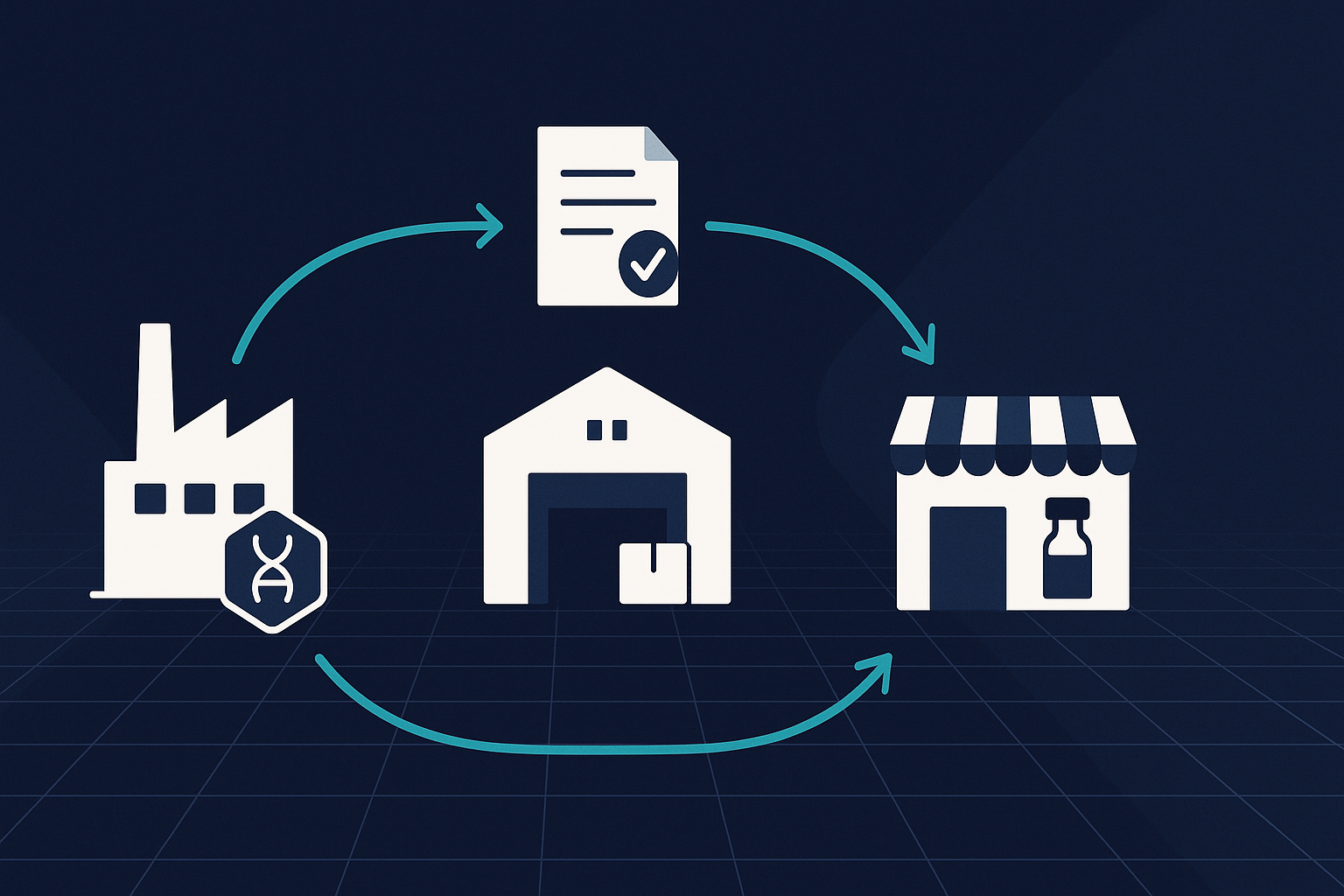
Most synthetic research peptides move through a three-layer supply chain. The manufacturer, often a contract development and manufacturing organization (CDMO) or active compound ingredient (API) producer, synthesizes the raw peptide. The distributor handles quality control, warehousing under cold-chain conditions, batch-level documentation, and logistics. The brand or reseller then markets the finished product to end customers. This structure lets manufacturers focus on synthesis while distributors manage compliance and fulfillment at scale.
A research peptide distributor is not the same as a retail vendor selling single vials directly to individuals. Distributors operate at wholesale volume, supporting clinic owners and entrepreneurs who build their own branded product lines. They supply batch-specific Certificates of Analysis (COAs), regulatory paperwork, and scalable fulfillment that retail channels cannot provide.
Intermediaries are central to the peptide industry. According to Mordor Intelligence (April 2026), CDMOs and CROs account for approximately 40% of the peptide synthesis market as outsourced partners, showing how dependent the industry is on specialized intermediaries for production, testing, and distribution.
Understanding this model is essential before reviewing the legal boundaries of research use only peptide sales, which govern how distributors and resellers can operate within RUO compliance standards.
The Peptide Supply Chain: Four Stages from Synthesis to End Buyer
The journey of a research peptide from raw chemicals to a buyer’s lab follows four distinct stages. Understanding each step helps clinic owners and entrepreneurs evaluate suppliers, plan inventory, and anticipate lead times. Below is a breakdown of the supply chain with typical durations based on industry practices.
| Stage | Key Activities | Typical Lead Time |
|---|---|---|
| 1. Raw Materials & Reagents | Fmoc-protected amino acids, resins, coupling reagents supplied by chemical manufacturers (e.g., Merck, Thermo Fisher, Biosynth per data from Precedence Research, Feb 2026) | 1 – 4 weeks (stock availability varies) |
| 2. Peptide Manufacturing | Solid-phase peptide synthesis (SPPS) dominates with 75.36% market share in 2025 (Mordor Intelligence); key manufacturers include Bachem, Lonza, PolyPeptide, AmbioPharm | 2 – 6 weeks per batch (chain length and purity level dependent) |
| 3. Distribution | Quality verification, COA generation, temperature-controlled warehousing, order fulfillment, labeling, compliance checks | 1 – 3 weeks (from receipt of finished peptide to ship-ready inventory) |
| 4. Brand Owners & End Buyers | Clinics, research labs, and entrepreneurs selling RUO products under their own labels; final order handling and shipping to research buyers | 1 – 5 business days (order processing + shipping) |
Stage 1: Raw Materials & Reagents
Peptide synthesis starts with Fmoc-protected amino acids, specialized resins, and coupling reagents. These chemicals are produced by major life-science suppliers like Merck, Thermo Fisher, and Biosynth. According to Precedence Research (Feb 2026), the quality and purity of these inputs directly affect synthesis efficiency and final product consistency. Lead times depend on supplier stock levels and custom order requirements.
Stage 2: Peptide Manufacturing
The most common method is solid-phase peptide synthesis (SPPS), which held a 75.36% market share in 2025, per Mordor Intelligence. Large contract manufacturers such as Bachem, Lonza, PolyPeptide, and AmbioPharm handle multi-kilogram scales. For smaller batches or custom sequences, specialized CDMOs fill the gap. Manufacturing lead time varies with peptide length, purity grade, and the number of purification cycles required.
Stage 3: Distribution
After manufacturing, the bulk peptide moves to a distributor. Here it undergoes quality verification, including HPLC and mass spectrometry analysis, leading to a Certificate of Analysis (COA). The material enters temperature-controlled warehousing, gets portioned into final packaging, and is labeled per RUO compliance standards. The distributor’s fulfillment system then prepares individual orders for brand owners. This stage typically takes one to three weeks from receipt of finished goods.
Stage 4: Brand Owners & End Buyers
Brand owners – clinics, research labs, and entrepreneurs – purchase labeled research peptides under their own brand names. They handle end-customer relationships and final order logistics. In a dropship model, the distributor ships directly to the research buyer, cutting out warehousing for the brand owner. Domestic shipping often completes this stage in one to five business days.
Distributor Value-Add: Quality Control and Batch Verification
A peptide distributor bridges the gap between bulk manufacturing and the end buyer by providing independent quality verification that individual manufacturers rarely offer per sale. The core service is independent analytical testing: high-performance liquid chromatography (HPLC) to quantify purity and mass spectrometry to confirm molecular identity. These results are compiled into a Certificate of Analysis (COA) that accompanies each batch.
The need for batch-specific COAs is underscored by a 2007 study in the Journal of Immunological Methods (PMID: 18077621) that found commercial synthetic peptides can contain cross-contaminating sequences arising from deleted or truncated by-products produced during synthesis. In immunological assays, such impurities can generate false-positive results, wasting time and compromising research conclusions. A distributor that provides independent HPLC/MS data per lot lets a research buyer verify identity and purity before any experiment begins.
A thorough COA includes at least four components: an HPLC chromatogram showing the main peak and any impurity peaks; mass spectrometry data confirming the observed molecular weight matches the theoretical value; a purity percentage (typically >95% for research peptides); and a lot number for traceability. Distributors that follow U.S. Good Manufacturing Practice (GMP) principles maintain audit trails under 21 CFR Part 211 standards, ensuring each step from raw material receipt to final release is documented and reproducible.
The value of outsourced quality services is reflected in market growth. Intelmarketresearch (July 2025) reported that the global peptide CDMO services market was valued at USD 3.9 billion in 2024 and is projected to reach USD 10.8 billion by 2032 (source). This expansion is driven in part by research organizations demanding independent batch verification rather than relying on a manufacturer’s in-house certificates alone. For the clinic owner or entrepreneur buying research peptides, a distributor that supplies lot-specific COAs from an external analytical lab provides a critical check against supply-chain variability and contamination risk.
Download Our Full 60+ SKU Catalog
White-label research peptides, wholesale pricing, and dropshipping details.
The White-Label Opportunity: How Distributors Enable Peptide Brands
In the white-label model, a brand owner orders research peptides with custom labels, proprietary packaging, and their own SKU codes. The distributor manages manufacturing, third-party testing, and shipping – all under the brand owner’s name. The brand owner never touches inventory or logistics.
Many peptide suppliers force bulk minimums before they will offer custom packaging. YourPeptideBrand takes a different approach. With no minimum order quantities, on-demand label printing, and direct dropshipping, a brand owner can start with a single order and scale without risk. Each shipment goes directly to the end customer displaying only the brand’s identity.
The financial opportunity is backed by real data. A 2026 industry report from Accio found that profit margins in peptide dropshipping can range from 40% to 80%, with B2B average order values between $1,500 and $8,000. These figures suggest strong revenue potential for both retail and wholesale channels.
In this arrangement, the entrepreneur owns the brand and the customer relationship outright. The distributor handles supply chain complexity – sourcing raw materials, compliance paperwork, quality control, and fulfillment. This lets the brand owner focus on marketing, sales, and customer retention.
The brand owner controls pricing, positioning, and customer support. The distributor remains invisible to the end customer, reinforcing the brand’s authority. Unlike traditional wholesale where the distributor’s name appears on the product, white-labeling creates a direct brand-to-customer relationship.
Every batch of research peptides is third-party tested with a Certificate of Analysis (COA) provided to the brand owner. This verification supports RUO compliance and gives the brand credibility with its customers, a key advantage when reselling to clinics or researchers.
Because orders are produced on demand, the brand owner can test different products and packaging variations without committing large capital. This reduces financial risk while still offering a full product line to customers. The low barrier to entry makes white-labeling accessible to clinics and entrepreneurs alike.
For a deeper look at the revenue model, read the case study on how B2B peptide suppliers create predictable revenue. If you are ready to start building your own brand, the guide to launching a product line under your peptide brand walks through each step.
Ready to Launch Your White-Label Research Peptide Brand?
Book a free call with our team. We will walk you through pricing, setup, and your first order.
Compliance and Labeling: What Research Peptide Distributors Must Get Right
Labeling and documentation are the backbone of RUO compliance. A distributor who skips these steps jeopardizes the entire supply chain. Without proper labels, a research peptide shipment can be misclassified, leading to regulatory action or downstream misuse.
Every vial or container must carry mandatory elements: batch or lot number, expiration date, manufacturer contact information, and any applicable hazard pictograms. These identifiers allow researchers to trace the product back to its origin and confirm its identity before use in an in vitro study. A distributor that omits this data creates a compliance gap that end users cannot fill on their own.
Chain-of-custody documentation is equally critical. Every shipment should include a Certificate of Analysis (COA), a safety data sheet, and a written declaration that the contents are RUO materials. Together, these documents prove the product was handled, stored, and shipped as a research compound rather than a consumable good. A buyer who receives a research peptide without a COA has no way to verify purity or batch integrity.
A 2017 regulatory review published in the AAPS Journal (PMID: 28027918) noted that research peptides are complex molecules and that quality characterization must go beyond simple purity claims. Distributors who rely on a single HPLC trace without full analytical data miss the point. Proper characterization includes amino acid analysis, mass spectrometry, and net peptide content determination.
Accurate labeling and complete documentation preserve the product’s RUO classification. When labels are vague or missing, the line between research use and unauthorized use blurs. A responsible distributor treats this as a non-negotiable operating standard, not an afterthought.
COA Transparency: Why Third-Party Testing Separates Reliable Distributors
A distributor that performs its own quality testing faces a clear conflict of interest: the same party that wants to sell the product also certifies its purity. Reputable distributors eliminate that conflict by providing pre-purchase access to batch-specific Certificates of Analysis from named, independent third-party labs using HPLC and mass spectrometry. This verifiable documentation lets a buyer confirm identity and purity without trusting the seller’s uncheckable claim.
Quality assurance extends beyond the vial. According to a guide published by PureTestedPeptides (February 2026), advanced distributors implement temperature monitoring systems, backup power supplies, and redundant storage facilities to maintain cold-chain integrity throughout storage and shipping. These measures prevent degradation that would make a pristine COA meaningless by the time the research peptide reaches the researcher.
Rather than relying on a single generic certificate, buyers can browse the COA Library for batch-specific verification before ordering. This transparent approach mirrors the industry-standard documentation chain that also covers compliant requirements for compliant peptide product labeling and the overall role of documentation in quality assurance. When every link in that chain is independently verifiable, the distributor’s reliability is no longer a matter of trust, but of evidence.
Calculate Your White-Label Margins
See exactly how much margin you can make at your price point.
Research Guide: Market Data and Trends Shaping Peptide Distribution
Several data points from recent market research highlight the growth trajectory of the peptide sector and what it means for distributors. The table below summarizes key figures across therapeutics, synthesis, and CDMO services.
| Sector | Current Data | Projected Data | Source |
|---|---|---|---|
| Global peptide therapeutics market | USD 140.9 billion (2025) | USD 294.6 billion by 2033 | Grand View Research |
| Peptide synthesis market | USD 1.02 billion (2025) | USD 1.84 billion by 2030 | Grand View Research |
| Peptide CDMO services market | USD 3.9 billion (2024) | USD 10.8 billion by 2032 | Intelmarketresearch |
| North America peptide therapeutics market share | 61.9% | – | Grand View Research |
| Solid-phase synthesis market share | 75.36% | – | Mordor Intelligence |
For peptide distributors, this growth signals an expanding base of downstream customers. As the market scales, more research organizations and branded resellers enter the space, each requiring consistent access to verified products. That drives demand for distributor services that reduce operational friction: quality verification via certificates of analysis, custom labeling and packaging, and on-demand dropshipping logistics.
The concentration of market share in North America and the dominance of solid-phase synthesis highlight regional and technical specialization. Distributors that align their inventory and compliance workflows with these realities can serve a broader customer base without taking on the overhead of in-house manufacturing.
Frequently Asked Questions About Research Peptide Distributors
What is a research peptide distributor?
A research peptide distributor is a B2B intermediary that purchases synthetic research peptides from manufacturers (CDMOs or API producers) and supplies them to brand owners, clinic operators, and entrepreneurs. According to an industry overview published by PureTestedPeptides.com (2026), distributors handle procurement, quality verification via HPLC/MS, cold-chain logistics, and regulatory documentation such as Certificates of Analysis.
How do peptide distributors verify product quality?
Reputable distributors test every incoming batch using high-performance liquid chromatography (HPLC) coupled with mass spectrometry (MS) to confirm identity and quantify purity. A 2007 study in the Journal of Immunological Methods (PMID: 18077621) demonstrated that peptides from suppliers can contain contaminating sequences that produce false-positive results, underscoring why batch-specific third-party COAs are a non-negotiable quality step in the distribution chain.
What is the difference between a peptide manufacturer and a distributor?
A manufacturer (CDMO or API producer) synthesizes peptides via solid-phase or liquid-phase methods at scale. A distributor purchases finished, lyophilized research peptides in bulk, performs independent quality testing, manages inventory in temperature-controlled warehousing, and handles order fulfillment. Distributors also often provide value-added services such as private-label packaging, custom labeling, and dropshipping.
Why are Certificates of Analysis important in peptide distribution?
A Certificate of Analysis (COA) documents a specific batch’s purity percentage, molecular identity via mass spec, and absence of contaminants. For research use only peptides, the COA is the primary quality document that brand owners and labs use to verify they received the correct compound. As noted in a 2017 regulatory review in the AAPS Journal (PMID: 28027918), peptides are complex molecules requiring rigorous quality characterization beyond simple purity claims.
What role do distributors play in research peptide labeling compliance?
Distributors ensure that every vial or package carries the required ‘For Research Use Only’ disclaimer, batch/lot number, expiration date, and manufacturer contact information. Proper labeling is a critical compliance function because it maintains the product’s RUO classification and prevents downstream misuse.
Can I launch a branded peptide line using a distributor instead of a manufacturer?
Yes. White-label distributors like YourPeptideBrand allow entrepreneurs to order research peptides with custom labels and packaging without buying directly from manufacturers. This model eliminates the need for minimum order quantities (MOQ = 0), in-house inventory, and manufacturing overhead. The distributor handles quality control, labeling, and fulfillment while the brand owns the customer relationship. Use the Profit Calculator at yourpeptidebrand.com/profit-calculator to estimate margins.
What should I look for when selecting a research peptide distributor?
Key criteria include: batch-specific third-party COAs with HPLC/MS data, temperature-controlled warehousing and cold-chain shipping, clear ‘Research Use Only’ labeling compliance, flexible MOQs for wholesale buyers, and transparent documentation for chain-of-custody. Suppliers like YourPeptideBrand that provide COA on every batch and on-demand dropship demonstrate reliability. Use the Profit Calculator to compare margin scenarios.
How does a B2B peptide distributor differ from a retail peptide vendor?
A B2B distributor sells exclusively to businesses (brand owners, clinics, research institutions) rather than to individual end-researchers. They offer tiered wholesale pricing, custom private-labeling, bulk inventory management, and dedicated account support. Unlike retail vendors that sell single vials, B2B distributors support recurring wholesale orders and can integrate with dropshipping platforms. YourPeptideBrand offers a 60+ SKU catalog, COA on every batch, and no minimum order quantities.
Research peptide distributors provide a critical link between manufacturers and resellers. They handle quality verification, compliance labeling, and white-label services that let clinic owners and entrepreneurs launch their own RUO brands without managing production. With no minimum order quantities, on-demand dropshipping, and batch-specific Certificates of Analysis, YourPeptideBrand streamlines that link.
Ready to Launch Your White-Label Research Peptide Brand?
Book a free call with our team. We will walk you through pricing, setup, and your first order.
Last updated: July 2026