
For research use only. Not for human consumption, diagnostic, or potential wellness benefit.
Why Traceability and Transparency Define Institutional Research Peptide Procurement
In institutional research procurement, the supplier’s documentation is the buyer’s primary verification layer. As of June 2026, the global push toward supply chain traceability has reached the RUO research peptide market, with procurement teams now treating batch-level documentation as a non-negotiable prerequisite rather than a value-add.
A MuseChem 2026 buying guide found that labs increasingly prioritize traceability because reproducibility expectations are higher and multi-site collaborations are more common.
Seven institutional requirements define supplier vetting, from COA depth to chain-of-custody protocols.
What Is Supplier Traceability in Research Peptide Procurement?
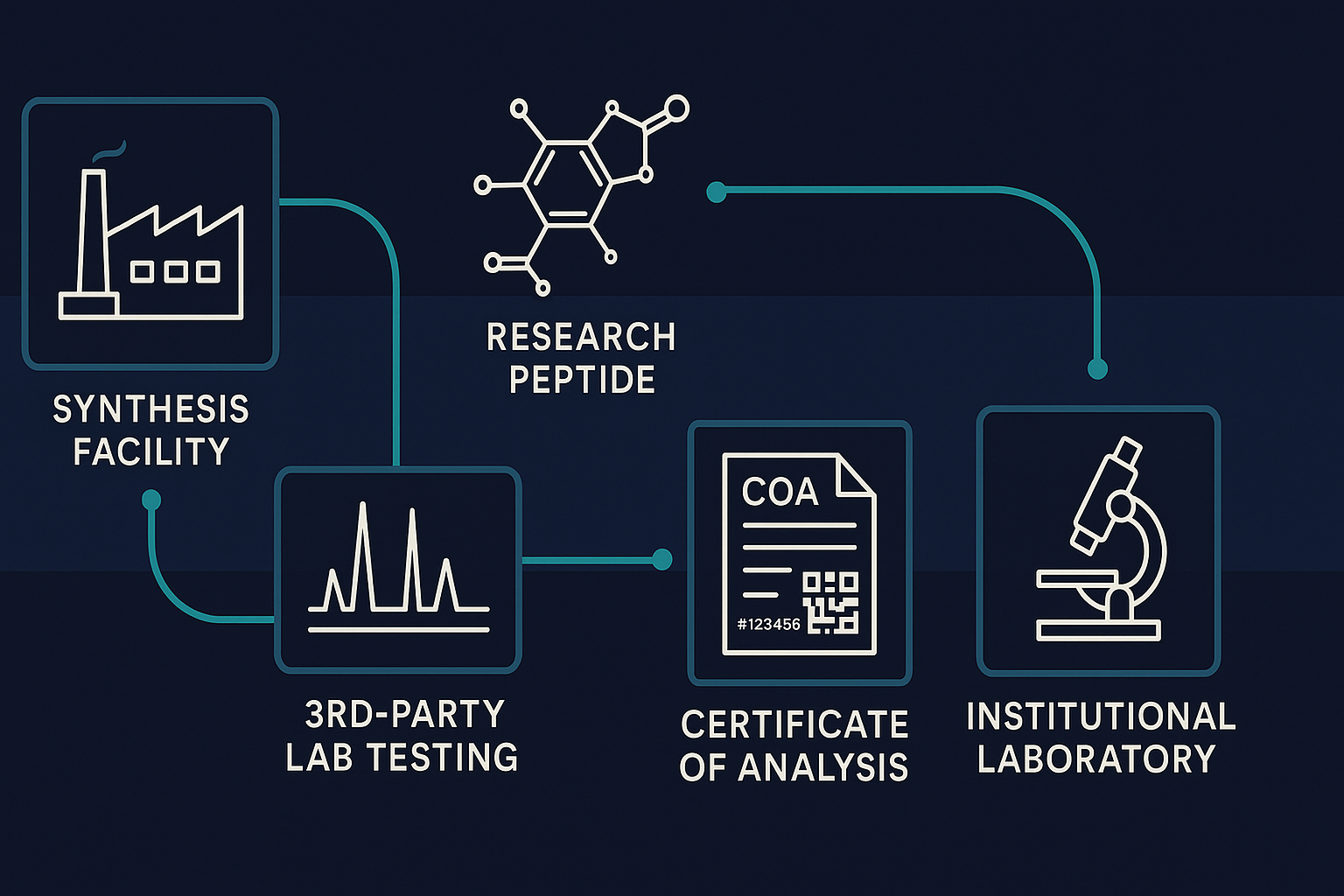
YourPeptideBrand defines supplier traceability as the documented chain of custody linking each batch of research peptides from third-party synthesis through analytical verification to labeled vial, with batch-specific COAs accessible via a public library.
Forward traceability tracks where a batch goes after leaving the supplier. Backward traceability traces a batch back to its synthesis and testing records. This distinction, drawn from the NetSuite framework on traceability versus visibility, matters because procurement teams often need both directions to satisfy institutional audit requirements.
7 Institutional Requirements for Traceable Research Peptide Sourcing

| Requirement | Why It Matters | How to Verify |
|---|---|---|
| Batch-Specific Certificate of Analysis (COA) | The COA must be tied to the exact batch received, not a generic document. Per Origin Research (June 2026), this is the single most important document a supplier provides. | Cross-reference the lot number on the vial against the COA. |
| Third-Party Laboratory Verification | Testing must be performed by an independent lab, not the supplier’s in-house QC. | Contact the named lab directly using contact information from the lab’s own website. |
| HPLC + Mass Spectrometry Data | HPLC purity alone is insufficient; orthogonal methods (HPLC + MS) are the analytical standard for identity confirmation. Per Origin Research, HPLC without MS cannot reliably distinguish target peptides from impurities with similar retention times. | Check the COA for both a purity percentage (HPLC) and a confirmation spectrum (MS). |
| Lot Number Traceability on Every Vial | Each vial must carry a unique lot number linking it to the manufacturing and testing record. This enables forward and backward tracing if quality issues arise. | Inspect the vial label for a lot number. Verify it matches the COA and purchase order. |
| Manufacturing Source Disclosure | The supplier should disclose whether synthesis occurs in-house or by a contract manufacturer, and whether that manufacturer operates under a quality management system consistent with ISO or cGMP principles. | Request a Supplier Qualification Questionnaire or manufacturing audit report. |
| Chain-of-Custody Documentation | Documented record of storage conditions, handling, and shipping from the synthesis facility to the end user. Per Verified Peptides (June 2026), this supports audit readiness and procurement accountability. | Request shipping temperature logs and handling records from the supplier. |
| Public or Accessible COA Library | COAs should be available for review before purchase, not hidden behind request forms. YPB provides a searchable COA Library where buyers can browse by compound and lot number. | Check the supplier’s website for a searchable COA library or database. |
Rigorous traceability standards are not just administrative overhead. A study published in Nature Communications (2021) found that poor-quality research peptides are a documented source of data irreproducibility in preclinical studies. When the identity or purity of a compound is unverified, experimental outcomes cannot be reliably attributed to the intervention being studied.
This is why understanding why sourcing from a US research peptide supplier matters for maintaining scientific rigor. Traceability is the backbone of reproducible results, providing verifiable evidence of a compound’s identity and handling from synthesis to laboratory.
For a deeper look into documentation standards, read our guide to how Certificates of Analysis build trust in the procurement process.
Download Our Full 60+ SKU Catalog
White-label research peptides, wholesale pricing, and dropshipping details.
How Poor Traceability Undermines Research Reproducibility
Reproducibility is the foundation of reliable scientific inquiry. When results cannot be repeated, the validity of the entire study comes into question. A 2017 article published in PMC (PMC5244822) highlighted that irreproducibility has become a pressing concern across multiple disciplines, wasting time, funding, and eroding trust in published data. One frequently overlooked contributor is the traceability of research materials, including research peptides.
A paper in the ACS Journal of Medicinal Chemistry (PMC4255677) stated flatly that “the reproducibility and interpretability of research data always hinge on the accuracy of the chemical characterization.” Without a clear chain linking a research peptide batch to its Certificate of Analysis (COA), the researcher cannot determine whether variability in results originates from the reagent itself or from the assay conditions. A study conducted with a batch of undocumented purity may yield outcomes that cannot be replicated using a different batch, even if the supplier intended the same product.
Missing documentation therefore introduces a hidden variable into the experimental design. If the purity, identity, or concentration of a research peptide is unverified, any observed effect could be an artifact of the reagent rather than a true biological response. This makes it impossible to distinguish between a compound’s activity and batch-to-batch inconsistency. Over time, this erodes the cumulative knowledge base that future studies rely on.
For clinics and entrepreneurs sourcing research peptides for their own work, traceability starts with the supplier. A vendor that provides clear batch-specific analytical data enables the researcher to confidently attribute results to the compound. Without that documentation, each new vial becomes a potential confound. For a deeper look at how to evaluate suppliers, see the bulk peptide buying guide. And for guidance on keeping records that protect your operation, read the article on documenting compliance efforts.
The Certificate of Analysis as the Backbone of Traceability
A Certificate of Analysis (COA) is the official record that links a specific batch of a research peptide to its synthesis and purity verification. For institutional procurement, the COA is the single document that proves traceability from manufacturer to end user. Without a complete, independently verifiable COA, the chain of custody is broken and compliance risk increases.
A proper COA for a research peptide includes more than a purity percentage. The document should display the batch number, manufacture date, and the analytical methods used — typically HPLC (high-performance liquid chromatography) and LC-MS (liquid chromatography-mass spectrometry). Numerical purity results, acceptance criteria, and the name or initials of the analyst who performed the test should all be present. Most critically, the COA should include raw data: the actual chromatogram and mass spectrum images, not just a summary table.
This distinction matters. A summary-only COA shows only the final purity number (e.g., “98.5%”) with no supporting evidence. A full-data COA provides the chromatographic trace and mass spectrum so that an independent reviewer can confirm the purity calculation and identify potential contaminants. According to Verified Peptides (June 2026), “At minimum, verify that the lab is independent of the vendor and that batch IDs are publicly traceable. Supplier transparency is the single best predictor of long-term reliability.”

YourPeptideBrand makes traceability practical through its browse the YPB COA Library, a searchable repository organized by compound name and lot number. Every COA is downloadable in full, with no gatekeeping or registration required. This allows labs to archive documentation for audit purposes without relying on vendor support.
For a broader view of the documentation standards that underpin traceable sourcing, see our RUO compliance overview for US laboratories. When every batch is traceable to a complete, independently verified COA, your research procurement meets the documentation standard that institutional compliance teams expect.
Turning Traceability into a Business Asset for Clinic Owners
For clinic owners building their own research peptide brand, documented traceability is not just a compliance checkbox – it is a competitive differentiator. When every batch links back to a specific Certificate of Analysis (COA), your brand carries a verifiable quality record that institutional buyers and research partners can trust.
Suppliers that force bulk minimums or hide COA access create unnecessary risk for brand owners. If a batch is questioned and the supplier cannot produce batch-specific documentation, the brand owner absorbs the doubt. By contrast, YourPeptideBrand’s model provides batch-specific documentation with no minimum order quantities, on-demand dropship, and custom labeling – so every unit you sell carries the same traceable standard as a large-scale order.
Research from Peptides Source (April 2026) found that long-term relationships with transparent suppliers facilitate consistent data quality over repeated acquisitions. When a clinic puts its own label on a research peptide, every batch’s COA becomes part of the clinic’s own quality record. That makes future procurement simpler and more defensible.
Traceability also strengthens your product pages and compliance posture. Learn more about building compliant product pages with traceable documentation and review compliant peptide product labeling requirements to see how batch records integrate into packaging and marketing materials.
When you control the label and the documentation trail, your research operation moves faster and faces fewer sourcing questions. Traceability becomes a tangible asset that supports growth – not just a record you file away.
Ready to Launch Your White-Label Research Peptide Brand?
Book a free call with our team. We will walk you through pricing, setup, and your first order.
Supplier Vetting Checklist: What Institutional Buyers Should Demand
A vetted supplier is the foundation of reproducible research. Institutional buyers need a repeatable process that covers every stage of procurement. The following checklist gives you a practical framework to assess any research peptide supplier before committing to a bulk relationship.
Pre-Purchase: Verify Before Order
- Request a batch-specific Certificate of Analysis (COA) before you place the order. A generic COA is not enough; the document must match the exact lot you will receive.
- Confirm the testing laboratory is independent from the manufacturer and the supplier. In-house testing alone does not qualify as third-party verification.
- Ask whether the lot number will be printed on each vial. Without a visible lot number on the container, it is impossible to trace a batch after receipt. If the supplier cannot print lot numbers on vials, that is a red flag.
Trial Order: Test the Process
- Place a small trial order for a single research peptide before committing to bulk quantities. This lets you evaluate packaging, shipping speed, and document accuracy with minimal risk.
- Inspect the shipment upon arrival. Cross-reference the lot number on each vial with the lot number on the COA. If they do not match, reject the batch and request documentation for the correct lot.
Documentation Review: Demand Full Data
- Check that the COA includes an HPLC chromatogram and mass spectrometry (MS) confirmation. Purity claims without these analytical methods are not verifiable.
- Verify the manufacture date and the expiration date. A research peptide that is near its expiration date may have degraded, even if its initial purity was high.
- Confirm net peptide content versus gross weight. Some suppliers report the total vial fill weight, which includes excipients. The COA should state the net content of the active research peptide.
Operational Transparency: Look Behind the Brand
- Does the supplier disclose the synthesis source? Ask whether the research peptide is manufactured in a GMP-compliant facility. Even if the product is labeled RUO, knowing the synthesis origin matters for consistency.
- Is there a physical US address that you can verify? A PO box or shared mailbox is not sufficient for institutional procurement.
- Are COAs publicly browseable on the supplier’s website? Open access to batch documentation indicates the supplier is confident in its quality control and willing to let you verify before purchase. Our peptide brand compliance audit guide goes deeper into what to look for during this review.
Ongoing Monitoring: Track Every Batch
- Maintain records for all batches used in your research. A simple spreadsheet with lot numbers, purchase dates, and COA links will save hours if a reproducibility issue arises later.
- Establish a system for flagging lot-to-lot variations. If two consecutive batches of the same research peptide show a difference in purity greater than 1%, investigate before using the second batch.
As Palmetto Peptides (May 2026) notes, “Most research labs establish a primary supplier relationship with one or two vetted suppliers for core purchases.” The checklist above gives you the criteria to select and maintain those relationships with confidence.

Calculate Your White-Label Margins
See exactly how much margin you can make at your price point.
Frequently Asked Questions About Research Peptide Supplier Traceability
What documentation should a research peptide supplier provide to prove traceability?
A complete chain-of-custody record and a Certificate of Analysis (COA) for each batch are essential. Research published in Nature Communications found that traceability documentation significantly reduces variability in in vitro studies. YPB provides a COA on every batch, accessible via its online COA Library.
How does batch-level COA testing support research reproducibility?
Batch-specific COA data allows researchers to verify purity and identity for each study. A study in Verified Peptides highlighted that lot-specific testing is a cornerstone of reproducible research. YPB tests every batch and makes each COA available to its members.
What role does chain of custody play in research peptide sourcing?
Chain-of-custody records track a peptide from synthesis to shipment, ensuring no tampering or mislabeling. Origin Research demonstrated that clear chain-of-custody protocols reduce cross-contamination risks. YPB’s on-demand dropship model maintains a documented chain from its facility to the end researcher.
How can a clinic verify that a supplier’s COAs are authentic?
Requesting independent third-party lab reports and cross-referencing batch numbers is advised. Research from Palmetto Peptides showed that cross-checking with the lab’s database helps confirm authenticity. YPB posts its COAs directly from the testing lab for member verification.
What are the risks of sourcing research peptides from suppliers with incomplete documentation?
Incomplete documentation can lead to unknown impurities, inconsistent concentrations, and compromised study results. A review in Nature Communications noted that undetected impurities are a major source of experimental error. Working with a supplier that provides full documentation, like YPB’s COA on every batch, mitigates this risk.
How does a supplier’s inventory management affect traceability?
Just-in-time inventory systems reduce the chance of batch mixing and improve traceability. Verified Peptides reported that batch-tracking systems with unique identifiers reduce mislabeling. YPB’s on-demand dropship model uses individual batch identifiers for each order.
What should a researcher look for in a supplier’s quality control documentation?
Look for documentation that includes HPLC and mass spectrometry data, as well as a clear batch origin. Origin Research found that multi-method characterization increases confidence in peptide identity. YPB provides method-specific data on its COAs for each batch.
Can a supplier with no minimum order quantities still maintain rigorous traceability?
Yes, traceability depends on proper batch documentation, not order size. Palmetto Peptides concluded that batch-level tracking is independent of scale. YPB offers no MOQ while maintaining a COA on every batch, allowing small orders without sacrificing traceability. The Profit Calculator helps model margin scenarios for such orders.
Build Your Brand with Traceable, Transparent Sourcing
For multi-location clinic owners and entrepreneurs, traceability is not optional. It is a prerequisite for credible research and a defensible brand. Every batch of research peptide you source should come with a clear chain of custody, a third-party Certificate of Analysis, and a supply partner that enforces strict quality controls.
The seven requirements covered here — from lot-level documentation to on-demand label traceability — form the operational backbone of a trustworthy research peptide program. Suppliers that force bulk minimums or ship without batch accountability introduce risk that no business can afford.
Whether you are sourcing for a multi-location clinic or launching your own research peptide brand, traceability starts with the right supply partner. Book a free strategy call or download the full catalog to see batch-level COA documentation in action.
Ready to Launch Your White-Label Research Peptide Brand?
Book a free call with our team. We will walk you through pricing, setup, and your first order.
Last updated: July 2026