
For research use only. Not for human consumption, diagnostic, or therapeutic use.
Core QC Metrics Clinics Scrutinize Before Placing an Order
Research Use Only (RUO) peptides are intended solely for in‑vitro or pre‑clinical investigations and are not approved for potential wellness benefit. Because downstream data integrity hinges on the material’s quality, clinics treat QC metrics as non‑negotiable gatekeepers before any bulk purchase.

Purity Assessment – HPLC/UPLC Chromatograms
High‑performance liquid chromatography (HPLC) or ultra‑performance liquid chromatography (UPLC) generates a chromatogram that quantifies the main peptide peak against impurities. Clinics typically demand a purity of ≥95 % as a baseline; anything lower raises red flags about synthesis efficiency or incomplete purification. The chromatogram image on the Certificate of Analysis (CoA) lets the buyer verify that the peak area meets this threshold.
Identity Verification – Mass Spectrometry
Mass‑spectrometry (MS) confirms the molecular weight and isotopic distribution of the peptide. A matching MS peak within a few ppm of the theoretical mass, coupled with the expected isotopic pattern, assures that the product is indeed the intended sequence. The CoA will list the observed m/z values and the reference mass, providing a quick cross‑check for clinicians.
Potency and Activity Assays
Beyond chemical identity, functional potency is measured through bioassays that mimic the peptide’s intended mechanism—such as receptor binding or enzymatic inhibition. Dose‑response curves generated in these assays reveal the effective concentration range and help labs design reproducible experiments. Suppliers often include assay results (e.g., EC₅₀ or IC₅₀ values) on the CoA, allowing clinics to gauge whether the material meets their experimental needs.
Sterility and Endotoxin Testing
For any material that will contact cell culture or animal models, sterility is paramount. USP <71> sterility testing confirms the absence of viable microorganisms, while the Limulus Amebocyte Lysate (LAL) assay quantifies endotoxin levels. Clinics look for endotoxin limits ≤0.5 EU/mL; values above this can compromise assay outcomes and trigger inflammatory artifacts.
Stability Data – Real‑Time and Accelerated
Stability studies document how a peptide retains its purity and activity over time under specific storage conditions. Real‑time data show performance at the recommended temperature (often –20 °C or –80 °C), while accelerated data simulate stress (e.g., 40 °C for 6 months) to predict shelf‑life. The CoA will list the expiration date, storage instructions, and any observed degradation pathways, giving clinics confidence in inventory planning.
How Each Metric Appears on the Certificate of Analysis
The CoA functions as a transparent scorecard. Purity is displayed as a percentage with the corresponding chromatogram image; identity is shown as exact mass and isotopic match; potency is listed with assay type and numeric EC₅₀/IC₅₀; sterility is marked “Pass/Fail” alongside the LAL result; endotoxin levels are expressed in EU/mL; and stability is summarized with expiration date and storage notes. By reviewing these sections, clinicians can quickly verify compliance without digging into raw data files.
Industry Standards & Further Reading
These QC parameters align with USP <1225> for analytical method validation, ICH Q1A(R2) for stability testing, and the FDA’s guidance on RUO reagents. For a deeper dive into the regulatory backdrop and best‑practice testing protocols, see the comprehensive review by the International Peptide Society here.
How Clinics Translate QC Data Into Buying Decisions
Typical Buyer Persona
Most purchasing decisions stem from two closely related personas: the multi‑location wellness clinic owner who balances cost, compliance, and brand reputation, and the research‑focused physician who demands data‑driven certainty for every batch. Both prioritize research subjects safety, regulatory adherence, and the ability to scale without compromising quality.
Step‑by‑Step Buying Journey
- Initial need identification. The clinic defines the trigger—whether a new research protocol, an internal formulation upgrade, or a resale opportunity. This stage produces a clear specification sheet that lists target peptide, serving size range, and intended use (RUO vs. internal).
- Supplier shortlist. Vendors are filtered by reputation, FDA RUO compliance, and documented audit trails. Clinics often rely on peer recommendations, industry forums, and past performance metrics to narrow the pool to three or four candidates.
- Deep dive into the Certificate of Analysis (CoA). The QC team scrutinizes purity, identity (mass spectrometry), sterility, and stability sections. Any deviation from the declared specifications raises an immediate question mark.
- Cross‑checking against internal SOPs and FDA RUO guidelines. Clinics compare the CoA data point‑by‑point with their standard operating procedures and the FDA’s “Research Use Only” guidance, ensuring that the product can be integrated without additional validation work.
- Risk assessment. Factors such as batch‑to‑batch variability, shipping temperature controls, and traceability of raw materials are evaluated. A risk matrix assigns a numeric score that determines whether the order proceeds, is paused for clarification, or is rejected outright.
Weighting of QC Metrics
Not all data points carry equal weight. Clinics assign “stop‑and‑ask” thresholds to high‑risk metrics, while “green‑light” thresholds apply to lower‑risk items. The table below illustrates a typical weighting schema.
| Metric | Stop‑and‑Ask Threshold | Green‑Light Threshold |
|---|---|---|
| Purity (HPLC) | < 95 % | ≥ 98 % |
| Sterility (Culture) | Any growth detected | No growth after 14 days |
| Endotoxin (LAL) | > 0.5 EU/mL | ≤ 0.1 EU/mL |
| Stability (30 days @ ‑20 °C) | Degradation > 5 % | Degradation ≤ 2 % |
| Identity (MS) | m/z shift > 5 ppm | m/z shift ≤ 2 ppm |
Common Red Flags That Halt an Order
- Missing or outdated endotoxin data.
- Purity below the 95 % stop‑and‑ask threshold.
- Stability data older than 12 months.
- Absence of a full sterility test report.
- Traceability gaps in raw‑material sourcing.
Price vs. QC Confidence
When a supplier offers a lower unit price but provides limited QC documentation, clinics often run a cost‑benefit analysis. The additional expense of a premium‑priced batch is justified if the CoA offers complete, up‑to‑date data and a clear audit trail. In practice, the perceived risk reduction from higher transparency outweighs modest price savings, especially for clinics that brand the peptide under their own label.
Real‑World Anecdote
One multi‑location wellness chain recently switched from a long‑standing vendor after a sterility failure slipped through an incomplete CoA. The batch showed no growth in the initial culture, but a follow‑up test revealed low‑level contamination that compromised research subjects safety. The clinic’s QC lead halted the order, demanded a full sterility report, and ultimately migrated to a supplier whose CoA included a third‑party sterility verification. Within three months, the new vendor’s transparent QC package helped the clinic maintain uninterrupted inventory while reinforcing research subjects trust.
Practical QC Checklist & Ordering Workflow for Clinics
Printable QC Checklist
- ☐ Purity ≥ 95 % (HPLC/UPLC report attached)
- ☐ Identity confirmed by MS (exact mass within ± 0.5 Da)
- ☐ Sterility test passed (USP <71> result)
- ☐ Endotoxin ≤ 0.5 EU/mL (LAL assay)
- ☐ Potency assay meets claimed activity range
- ☐ Stability data covering intended storage period
- ☐ Full CoA with batch number, expiration date, and signature
End‑to‑End Ordering Flowchart
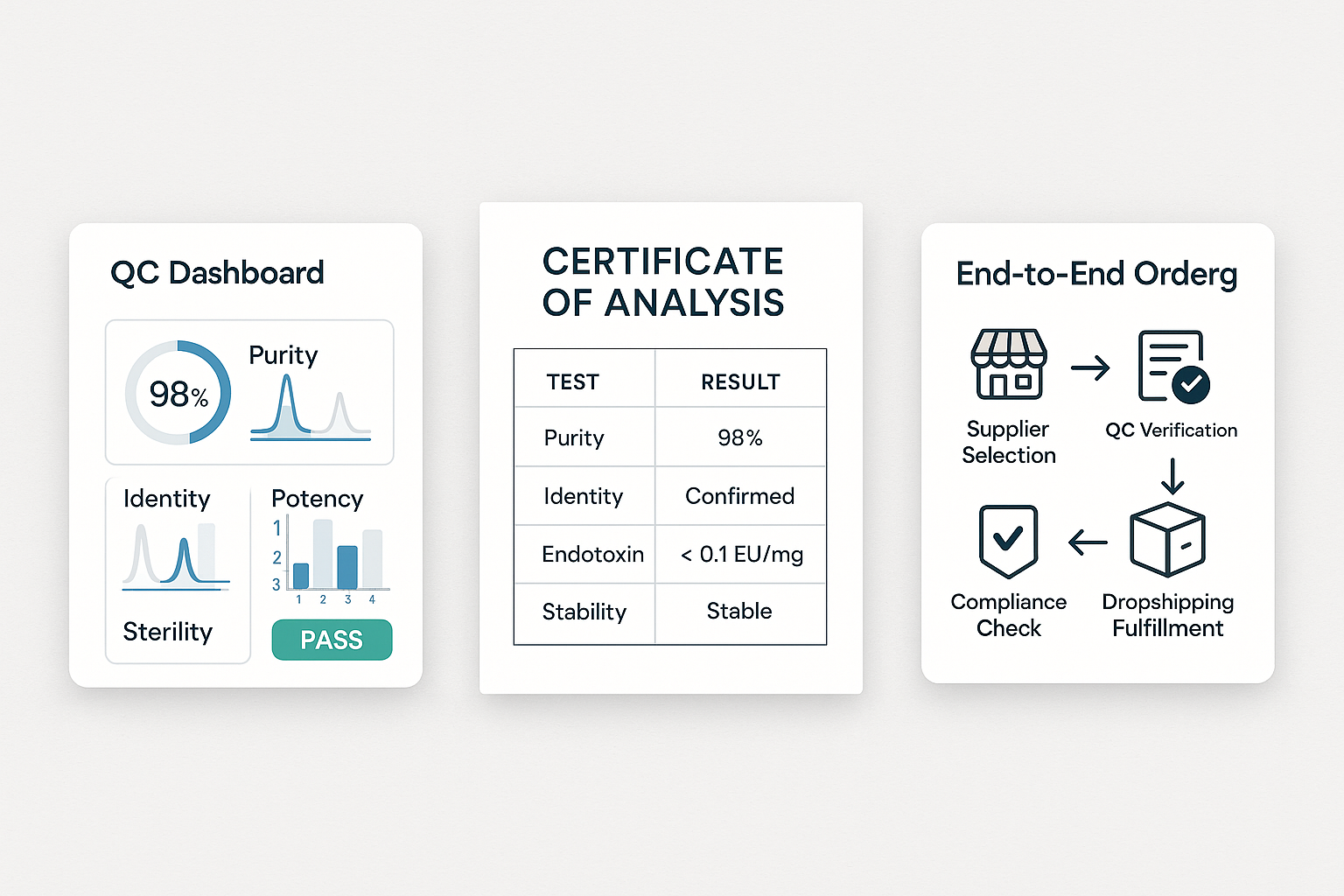
Reading the QC Dashboard at a Glance
Most white‑label portals present a dashboard that aggregates the five core metrics from the checklist. Knowing what each visual cue means saves time and reduces the risk of accepting sub‑standard material.
| Metric | Dashboard Indicator | What to Look For |
|---|---|---|
| Purity | Bar gauge (0–100 %) | Value ≥ 95 %; any dip below triggers a red flag. |
| Mass‑Spec | Peak list with exact mass | Peak within ±0.5 Da of theoretical mass; multiple peaks suggest impurities. |
| Potency | Curve plot vs. reference standard | Curve overlay within the declared activity window (usually ±10 %). |
| Sterility | Check‑mark or cross | Check‑mark = USP <71> passed; cross = repeat test required. |
| Endotoxin | Numeric readout (EU/mL) | Value ≤ 0.5 EU/mL; higher values demand a new batch or additional purification. |
Integrating QC into Your Clinic SOPs
Embed the checklist into your standard operating procedures by creating a dedicated “QC Log” in your electronic health record or inventory system. Each incoming batch should trigger a new log entry where the full CoA, HPLC report, and MS spectrum are uploaded as PDFs. Assign a compliance officer to verify that every checkbox is marked before the batch is entered into inventory. Finally, schedule quarterly audits to ensure that archived reports remain searchable and that expiration dates are monitored automatically.
Leveraging White‑Label Partners
When you work with a white‑label supplier, request that their QC package mirror the printable checklist verbatim. If a vendor provides a CoA that omits endotoxin data or stability testing, use the “additional data request” template in your SOP to ask for batch‑specific results. Many partners will gladly share raw chromatograms or a supplemental stability study, especially when you reference the checklist as a contractual requirement.
Document every request and response in the same QC Log mentioned above. This creates a paper trail that satisfies both internal governance and external auditors, should a regulatory inspection ever occur.
Quick FAQ
- What if a batch fails one metric? Pause distribution immediately, quarantine the material, and contact the supplier for a root‑cause analysis. Most reputable partners will issue a replacement batch at no extra cost, provided you supply the failed QC report as evidence.
- How often should I request a repeat QC analysis? For high‑volume clinics, schedule a repeat analysis on at least 10 % of each shipment. If you notice trends—such as a gradual purity decline—escalate to a full batch re‑test every three months.
Partner with a Trusted White‑Label Provider for Seamless QC Assurance
Quick recap of the three core QC metrics
Before any peptide order, clinics should verify (1) purity – typically ≥ 98 % as confirmed by HPLC or UPLC, (2) identity – established through mass spectrometry matching the expected molecular weight, and (3) stability – documented under defined storage conditions and time‑frames. These metrics protect research subjects safety, preserve research integrity, and keep your practice aligned with FDA RUO guidelines.
How a reliable supplier streamlines the checklist
A trusted white‑label partner delivers a pre‑validated QC dashboard that aggregates purity, identity, and stability data for every batch. Comprehensive Certificates of Analysis (CoAs) are attached to each shipment, eliminating the need for clinics to request separate documentation. Transparent stability data, including real‑time degradation curves, are accessible through a secure portal, allowing you to confirm shelf‑life without manual calculations.
Why YourPeptideBrand’s white‑label solution stands out
- On‑demand label printing & custom packaging: Your clinic’s branding appears on every vial, bolstering credibility and research subjects confidence.
- Direct dropshipping with zero minimums: Order exactly what you need, when you need it, and avoid costly inventory buildup.
- Full compliance support: YPB handles FDA RUO documentation, ethical sourcing records, and provides guidance on permissible marketing claims.
- Ongoing QC updates: Batch‑specific reports are refreshed in real time, and any deviation triggers an automatic alert within the portal.
Take the next step toward compliant growth
Schedule a free QC consultation with our specialists to review your current sourcing workflow and identify gaps. Explore the YPB ordering platform to experience seamless order placement, instant access to batch CoAs, and the ability to launch a private peptide line under your own brand.
Ready to eliminate guesswork and focus on research subjects outcomes? Contact us today for a personalized walkthrough, and visit our resource hub for case studies, compliance checklists, and detailed white‑paper guides.