
For research use only. Not for human consumption, diagnostic, or potential wellness benefit.
How Clinics Define Acceptable Quality in Research Peptide Supply
A clinic orders 10 mg vials from two research peptide suppliers. Both claim 98% purity. One provides a batch-specific third-party Certificate of Analysis with an HPLC chromatogram, mass spectrometry data, and endotoxin results. The other sends a single-page PDF with no lab name. Which one meets the institutional threshold?
The practical quality standards clinics use are measurable and repeatable: minimum 98% purity by HPLC, identity confirmation via mass spectrometry, batch-specific third-party COAs, and full traceable documentation from synthesis through testing.
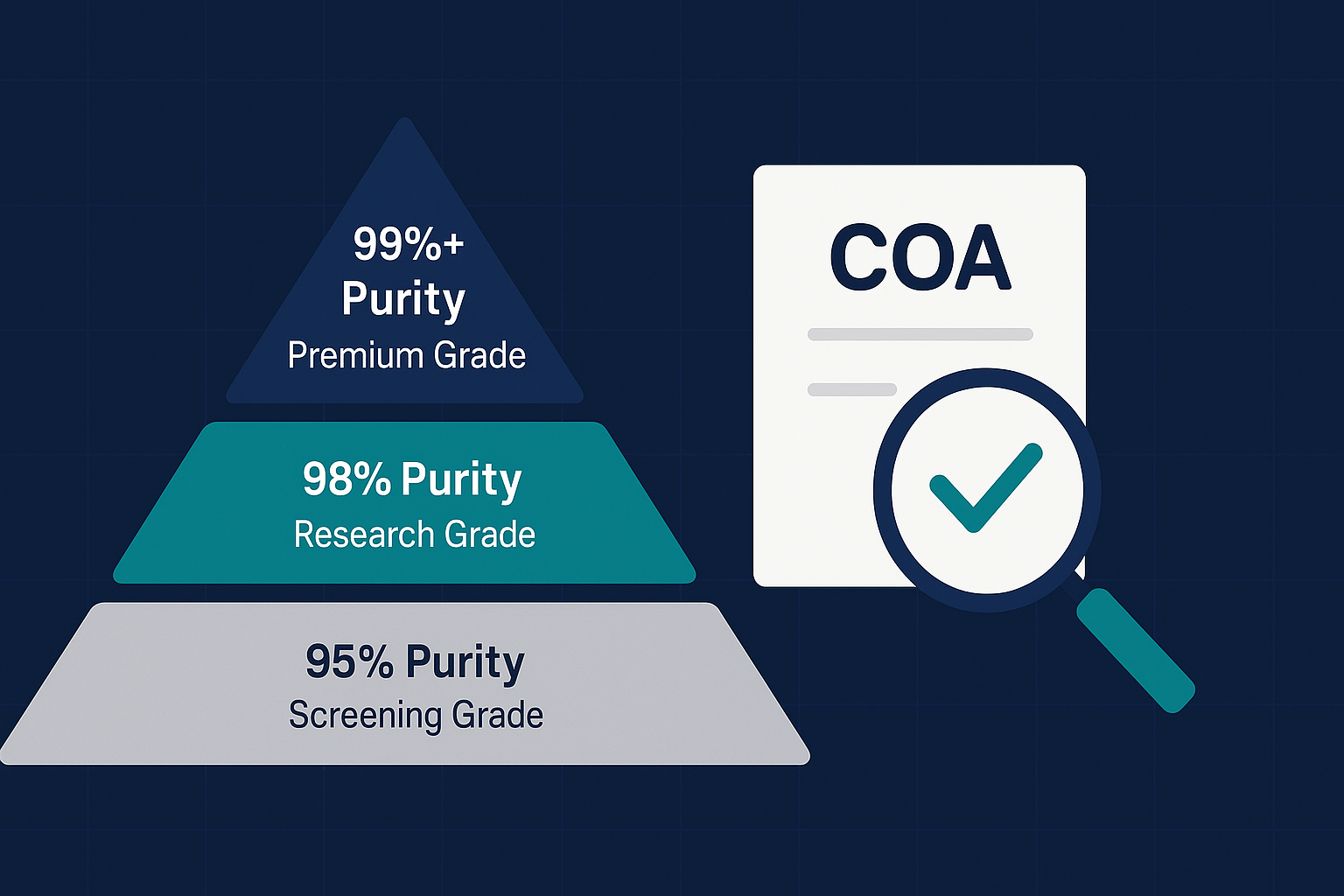
Three purity tiers are commonly referenced in sourcing decisions. The 95-97% range is typical for exploratory screening. The 98-98.9% band represents the research-grade benchmark. The 99%+ threshold is the publication-quality level. A PRNewswire analysis from June 2026 noted that 99%+ has become the industry-standard baseline because impurities below 1% are statistically negligible in most experimental designs. PRNewswire
This article covers verification methods, the difference between in-house and third-party COAs, the complete quality package required for institutional buyers, and the peer-reviewed evidence that supports these thresholds.
What Are Research Peptide Quality Thresholds?
Research peptide quality thresholds are the measurable purity, identity, and documentation standards institutional buyers apply when evaluating research-grade material. For clinics operating under the Research Use Only model, these thresholds typically require a minimum of 98% HPLC purity with mass spectrometry identity confirmation, batch-specific third-party Certificates of Analysis, and traceable manufacturing documentation. YourPeptideBrand supplies research peptides that meet or exceed these thresholds across a 60-plus SKU catalog with zero minimum order quantities.
The Three-Tier Purity Standard Clinics Use
Institutional buyers and contract research organizations sort research peptides into three purity tiers. Each tier matches a specific type of assay, impurity tolerance, and acceptable cost. Understanding this framework helps clinics select the right grade for their work without overpaying for unused stringency.
Tier 1 (95-97%): Exploratory Screening
Peptides at 95% purity carry enough impurity load to produce confounding signals in sensitive assays, as noted in analytical chemistry literature from Lone Star Peptide’s purity guide. This tier is acceptable for broad-range ELISA, cell viability MTT tests, or qualitative binding studies where rough activity data suffices. Clinics use Tier 1 to decide whether a research peptide warrants deeper investigation.
Tier 2 (98-98.9%): Research-Grade Benchmark
The 98% threshold is the accepted minimum for quantitative receptor binding, IC50 determinations, and dose-response work. Multiple industry sources – including Spartan Peptides’ HPLC testing guide, Palmetto Peptides’ lab guide, and BioStrata Research’s analysis on purity effects – identify this range as the standard for radioligand binding, cAMP assays, and calcium flux experiments. Labs that require reproducible results across replicates consistently specify 98% as their minimum.
Tier 3 (99%+): Premium Publication Grade
For mechanistic studies bound for peer review, reference standards, or assays where even 1% impurity could produce background signal, the 99%+ tier is mandatory. A PRNewswire analysis of impurity thresholds notes that this grade has become the industry-standard baseline. Techniques such as surface plasmon resonance, enzyme kinetics, and in vivo pharmacokinetics demand the lowest possible impurity load.
| Tier | Purity Range | Typical Applications | Common Assay Types |
|---|---|---|---|
| Tier 1 | 95-97% | Exploratory screening, preliminary activity profiling | Broad-range ELISA, cell viability MTT, qualitative binding |
| Tier 2 | 98-98.9% | Quantitative receptor binding, IC50 determinations, dose-response | Radioligand binding, cAMP assays, calcium flux |
| Tier 3 | 99%+ | Publication-quality mechanistic studies, reference standards | Surface plasmon resonance, enzyme kinetics, in vivo pharmacokinetics |
Clinics that align their ordering standards with these tiers avoid two common mistakes: using insufficiently pure material in sensitive work or over-specifying purity for simple screening. For additional context on how purity interacts with regulatory labeling, see the overview of laboratory compliance for RUO peptides and the explanation of FDA RUO classification.
Mechanism of Quality Verification: HPLC + Mass Spectrometry
High-performance liquid chromatography (HPLC) answers the question "how pure is it?" by physically separating the components of a research peptide sample. The instrument passes the sample through a column under high pressure, and a UV detector (typically set at 214 – 220 nm) measures the absorption of each eluting compound. The area under the main peak, expressed as a percentage of total peak area, gives the purity value. HPLC catches truncation sequences (short fragments from incomplete synthesis), oxidized variants, and other process-related impurities that absorb UV light.
Mass spectrometry (MS), most commonly ESI-MS or MALDI-TOF, answers a different question: "is it the right compound?" Rather than separating components, MS measures the exact molecular weight of each ionized molecule. A mass shift of even a few daltons can indicate a missing amino acid, an unintended modification, or an incorrect sequence. While HPLC quantifies purity, MS confirms molecular identity and flags covalent changes that HPLC may not resolve.
Research published in Reference Standards for Synthetic Peptide Therapeutics (PMC10338602) confirms that reverse-phase HPLC paired with electrospray ionization mass spectrometry is the established gold standard for peptide quality assessment in analytical laboratories. Neither method alone provides a complete picture; together they offer orthogonal confirmation of both purity and identity.
| Method | What It Detects |
|---|---|
| HPLC | Truncation sequences, oxidized variants, process impurities, purity percentage |
| Mass Spectrometry | Molecular identity, mass shifts from modifications, confirmation of sequence |

In-House vs. Third-Party COAs: Why It Matters to Clinics
A Certificate of Analysis (COA) is only as reliable as the lab that issued it. In-house COAs come from the manufacturer’s own quality-control lab, creating an inherent conflict of interest: the same organization that profits from selling the batch also decides whether it passes. For clinics sourcing research peptides for in-house studies, that arrangement undermines the documentation’s credibility.
Third-party COAs are generated by independent, accredited laboratories such as Janoshik Analytical. These labs have no financial stake in the sale, so their results represent objective quality verification. A 2026 quality-verification guide from Durham Peptides states: “only third-party COAs should count as quality verification” for research-grade work.
For clinics building a branded white-label line, providing third-party COAs to institutional buyers and research partners signals that every batch meets documented purity and composition standards. Without independent testing, the chain of evidence is broken.
For a deeper look, see YPB’s guide to working with third-party testing labs and the comparison of in-house versus outsourced peptide testing models.
For clinics ready to source research peptides with documented quality thresholds, the next step is reviewing available options.
Download Our Full 60+ SKU Catalog
White-label research peptides, wholesale pricing, and dropshipping details.
The White-Label Opportunity: Turning Quality Thresholds into Market Position
Clinics that enforce rigorous quality thresholds immediately separate themselves from suppliers that cut corners on documentation. When every batch ships with a verifiable third-party COA showing confirmed purity and mass spec verification, the clinic’s brand becomes synonymous with research-grade reliability.
YourPeptideBrand’s turnkey platform makes this positioning accessible by providing batch-specific COA documentation, custom labeling, and direct dropship fulfillment with zero minimum order quantities. For a deeper look at purchasing strategies, see the guide to bulk peptide buying. For more on compliant product pages, read about building FDA-compliant product pages for research peptides.
Quality documentation functions as a competitive advantage, not a compliance burden. Clinics that invest in transparent documentation build trust with their research clients, turning what others treat as overhead into a clear market position.
Ready to turn quality thresholds into a market advantage? Book a Strategy Call to discuss your white-label approach.
Ready to Launch Your White-Label Research Peptide Brand?
Book a free call with our team. We will walk you through pricing, setup, and your first order.
COA / Quality – What a Complete Quality Package Includes
A Certificate of Analysis (COA) is only as useful as the data it contains. Institutional buyers evaluate a quality package against six documentary components. When each is present, the batch can be assessed objectively. When one is missing, the document is incomplete.
- HPLC chromatogram with peak integration and calculated purity percentage. A single purity number means little without the trace showing how it was derived. The chromatogram must include the main peak, any impurity shoulders, and the integration method used.
- Mass spectrum showing observed vs. theoretical molecular weight. Identity confirmation requires matching the measured mass to the peptide’s expected mass within an acceptable tolerance (typically +/- 1 Da for small peptides).
- Third-party lab name, accreditation, and verification key. The lab should be independent from the supplier, accredited to a recognized standard (e.g., ISO 17025), and provide a check code that allows the certificate to be verified on the lab’s portal.
- Unique batch/lot number matching the vial label. Traceability requires that the vial you hold can be linked directly to the specific COA. If the numbers don’t match, the documentation chain is broken.
- Date of testing within 12 months. Research peptides degrade over time regardless of storage conditions. A COA older than 12 months does not reflect current batch quality.
- Supplementary data where applicable. For parenteral-grade research peptides, an endotoxin LAL assay, bioburden counts, and residual solvent analysis (by GC) should accompany the core COA.
The USP general chapter on peptide standards (referenced in PMC10338602) provides the documentary framework for what constitutes a defensible quality specification. Clinics that adopt this framework reduce their exposure to substandard material.
Suppliers that provide a complete quality package make it possible for buyers to verify each batch independently. Reviewing the raw data is a routine step in responsible sourcing. For access to a collection of verified documentation, browse the COA Library to see how these components appear in practice.
Understanding the role of Certificates of Analysis in peptide sales helps clinic owners distinguish documentation that meets standards from paperwork that does not. Combined with established quality assurance practices for RUO peptides, these six components form the baseline for defensible quality control. The role of documentation in peptide compliance extends beyond a single COA to include batch tracking, supplier audits, and chain-of-custody records.
Research Guide: Peer-Reviewed Evidence on Research Peptide Quality and Reproducibility
A growing body of published research connects research peptide purity to experimental reproducibility. A 2025 review in the Journal of compound and Biomedical Analysis notes that batch-to-batch purity variation directly impacts dose-response accuracy and the reproducibility of published findings (referenced via the Spartan Peptides HPLC testing guide). This connection makes purity verification a non-negotiable step for any clinic procuring research peptides for in vitro or in vivo studies.
Batch-to-Batch Purity and Experimental Reproducibility
Purity variation between lots introduces an uncontrolled variable that can shift results. When a lab switches suppliers or batches, an impurity profile change may alter observed binding kinetics or cell response. The 2025 review emphasizes that without documented purity data from each batch, published dose-response curves lose their foundation. Consistent purity across batches is the baseline for any reproducible research protocol.
The USP Framework as Procurement Criteria
The US Pharmacopeia (USP) 2023 peptide monograph framework defines four required quality attributes: identity, purity, safety, and potency. Regulatory authorities enforce these attributes for compound-grade materials, and clinics that purchase research peptides can adopt the same framework as procurement criteria. Identity confirms the correct amino acid sequence and molecular weight. Purity measures the percentage of target compound against total peptide content, typically reported as a percentage by HPLC. Safety verifies absence of residual solvents, trifluoroacetic acid, or endotoxins that could skew biological assays. Potency confirms that the compound exhibits expected biological activity in a validated cell-based or receptor-binding assay. Each attribute should be verified per batch using documentation from an independent third-party laboratory.
Applying USP-style checks to each incoming research peptide lot helps clinics minimize variability. Cross-referencing batch data against these attributes flags inconsistencies early. For practical examples of how quality failures affect experimental outcomes, see the guide on common laboratory errors that compromise research results.
The Peptigrity blog on peptide purity standards provides additional context for setting acceptable thresholds for each attribute, reinforcing the same quality principles described in the USP framework.
Understanding quality thresholds is the first step. The next is understanding the business impact. A few percentage points of margin spread can decide whether a research peptide line is sustainable. Use the profit calculator to model margins at your target pricing and volume before you commit. See exactly how your target price shifts your bottom line.
Calculate Your White-Label Margins
See exactly how much margin you can make at your price point.
Frequently Asked Questions About Research Peptide Quality Thresholds
What HPLC purity percentage do clinics consider acceptable for research peptides?
Clinics generally use a three-tier standard. Peptides at 95-97% HPLC purity are acceptable for exploratory screening assays where rough activity data suffices. The research-grade benchmark is 98% or higher by reversed-phase HPLC, which is considered the minimum for quantitative receptor binding studies, IC50 determinations, and most cell-based assays. For publication-quality mechanistic work and sensitive in vivo studies, many institutional buyers require 99% or higher (Spartan Peptides, HPLC Testing Guide, 2026).
Why must mass spectrometry accompany HPLC on a Certificate of Analysis?
HPLC measures purity percentage but cannot confirm molecular identity. A sample could show 99% purity by HPLC while containing a different compound if a contaminant elutes at the same retention time. Mass spectrometry (ESI-MS or MALDI-TOF) confirms the observed molecular weight matches the theoretical mass of the intended peptide sequence within acceptable tolerance, typically plus or minus 0.1% (Palmetto Peptides, COA Lab Guide, 2026). A complete COA must include both methods.
What is the difference between in-house and third-party COAs for research peptides?
An in-house COA is generated by the manufacturer’s own quality control lab, introducing a potential conflict of interest. A third-party COA is issued by an independent accredited laboratory such as Janoshik Analytical, with no financial stake in the product’s sale. Institutional buyers typically require third-party COAs as the minimum documentation standard, since they provide unbiased verification of purity and identity data (Durham Peptides, How to Verify Peptide Quality, 2026).
What specific data points should a clinic verify on a research peptide COA?
A valid research-grade COA must include the compound name and amino acid sequence, a unique batch or lot number, the full HPLC chromatogram with labeled retention time and calculated purity percentage, mass spectrometry data showing observed versus theoretical molecular weight, the analytical conditions used (column type, detection wavelength, gradient), and the testing laboratory name with a verification key or QR code. A COA reporting only a single purity number without supporting chromatogram or MS data does not meet research-grade standards (Spartan Peptides, 2026).
What common impurities appear in research peptides and why do they matter?
The most common impurities are truncated or deletion sequences from incomplete solid-phase synthesis, oxidized residues (methionine oxidation adds +16 Da), racemized amino acids from harsh coupling conditions, and residual trifluoroacetate counterions from HPLC purification. Each impurity type can independently confound bioactivity measurements. A 98% pure preparation contains 2% impurity load, which at nanomolar assay concentrations may produce measurable background signal in sensitive receptor-binding or cell-based assays (Lone Star Peptide, Purity Percentages Guide, 2026).
How does YourPeptideBrand help clinics verify research peptide quality before ordering?
YourPeptideBrand provides batch-specific Certificates of Analysis for all 60+ research peptide SKUs through a publicly accessible COA Library. Each COA documents HPLC purity at 98% or higher, mass spectrometry identity confirmation, and the analytical methods used. Clinics can download and review COAs before purchasing, matching batch numbers to inventory. YPB maintains zero minimum order quantities, allowing clinics to verify quality on small test orders before scaling to bulk volumes.
What documentation standards should a clinic expect from a white-label peptide supplier?
Clinics sourcing research peptides for a white-label brand should expect batch-specific COAs from third-party accredited labs, documented batch records linking raw material lots to finished vials, RUO labeling compliance with visible “For Research Use Only” disclaimers, and stability data supporting expiration dating. Suppliers that force bulk minimums or charge extra for COA documentation do not meet institutional procurement standards. YourPeptideBrand includes COA documentation with every batch at no additional cost.
How can a clinic estimate the business impact of using verified high-purity research peptides?
Clinics that build a reputation for verified 98%+ purity research peptides can command premium pricing and secure repeat institutional contracts. Lower-purity material creates experimental variability that leads to batch rejections, refunds, and reputational damage. YourPeptideBrand’s Profit Calculator lets clinics model margins at their target pricing and volume, accounting for the cost of quality-verified material versus the risk of failed batches from unverified suppliers.
Building a brand around verified quality thresholds starts with a conversation. Book a call to discuss how YourPeptideBrand can support your clinic’s research peptide needs with no minimums, custom labels, and batch-specific COAs.
Ready to Launch Your White-Label Research Peptide Brand?
Book a free call with our team. We will walk you through pricing, setup, and your first order.
Last updated: July 2026