
For research use only. Not for human consumption, diagnostic, or potential wellness benefit.
How Research Buyers Validate QA Without Visiting the Lab
Clinic owners and health entrepreneurs sourcing research peptides cannot always inspect manufacturing facilities in person. Remote QA verification is now an essential competency for any buyer who needs to trust a batch without a plane ticket.
Buyers can validate quality through Certificates of Analysis (COAs), independent lab databases, and batch-traceable documentation without travel. These tools replace onsite audits when used correctly.
A 2025 Peptide Alliance survey found that 38% of RUO peptide vendors lack a formal SOP for mass-spectrometry validation, and 22% do not consistently attach reference data to their COAs (YourPeptideBrand, 2026). That gap makes independent verification critical.
Five remote verification methods – from reading HPLC chromatograms to cross-referencing lab accreditation databases – provide the tools any buyer needs.
What Is Remote QA Verification for Research Peptides?
Remote QA verification is the set of document-based and database-driven methods buyers use to confirm that a research peptide batch meets specified purity, identity, and safety standards without physically inspecting the supplier's facilities. YourPeptideBrand supports remote verification by providing lot-specific COAs through a searchable COA Library, independent third-party testing documentation, and QR-code-linked batch records for every SKU in its 60+ research peptide catalog. This approach eliminates the need for costly site audits while still giving buyers verifiable, objective data about the batch they intend to purchase.

Core principle: independent analytical data, not facility tours, determines batch quality. Remote QA relies on four document types: batch-specific COAs, third-party lab reports, chain-of-custody records, and supplier registration credentials. A 2026 guide from Peptidepedia notes that a complete research-grade COA must include peptide identity, batch number, testing methods, results (HPLC purity, mass spectrometry identity), and a verification reference number. Suppliers with public, searchable COA databases allow buyers to verify documentation before ordering. For a broader framework, see our resource on quality assurance practices for RUO peptides.
COA and Quality: The Foundation of Remote Verification
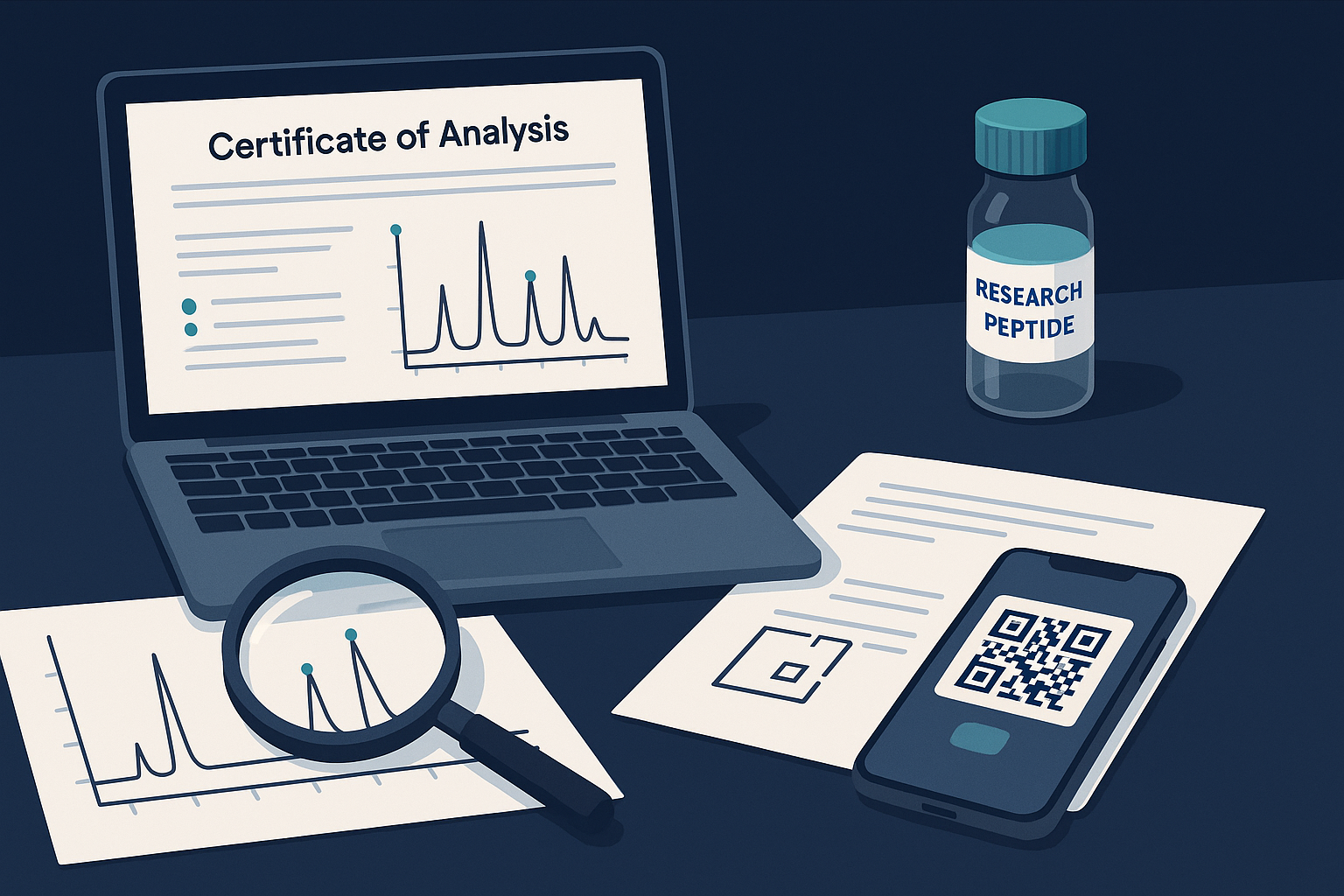
The Certificate of Analysis (COA) is the primary document through which a supplier communicates quality data about a batch of research peptide. It provides a standardized record of the tests performed and the results obtained, allowing buyers to remotely assess whether the material meets their specifications without needing to visit the lab.
High-performance liquid chromatography (HPLC) purity tells buyers what fraction of detected material corresponds to the target compound’s peak. Mass spectrometry confirms whether the compound at that peak has the correct molecular identity. Both are necessary. A COA documenting 99% HPLC purity without supporting mass spectrometry data is incomplete and does not confirm molecular identity – a point emphasized in the Palmetto Peptides (2026) lab guide on verifying research peptide purity (how to verify peptide purity lab guide).
A 2025 survey by the Peptide Alliance (Common Peptide Testing Methods, YPB, 2026) reported that organizations integrating third-party certification saw a 15% increase in repeat orders. This indicates that transparency directly influences buyer confidence and repeat purchasing behavior.
To fully validate a COA, cross-reference batch numbers: the vial label must match the COA lot number exactly. Testing labs often provide verification keys that buyers can use on the lab’s site to confirm the document has not been altered. Buyers should routinely browse the COA Library for batch-specific documentation as part of their remote verification process.
How to Read a Certificate of Analysis Remotely
A Certificate of Analysis (COA) is only useful if the buyer can interpret it correctly. For research peptide purchases made entirely online, the COA replaces the ability to inspect the product in person. Knowing which numbers matter and which red flags to spot is a skill that separates informed buyers from those who rely on trust alone.
Five data points define a verifiable COA for research peptides. HPLC purity percentage – research-grade standard is 98% or higher, with the chromatogram attached to confirm the peak is clean. Mass spectrometry (MS) confirmation where the observed mass should match the theoretical mass within 1 Dalton (Da). The batch/lot number must match the number printed on the vial label. The testing date must be current – a COA more than six to twelve months old may not reflect the batch shipped. The lab name and accreditation – ISO 17025 is the recognized standard for third-party testing competence.
The table below contrasts a complete vs. incomplete COA for research peptides.
| Complete COA | Incomplete COA |
|---|---|
| HPLC purity percentage plus full chromatogram | Purity percentage only, no chromatogram |
| Mass spectrometry (MS) with observed and theoretical mass | No MS identity data |
| Endotoxin results (if applicable) | Endotoxin results absent |
| Named third-party lab (e.g., ISO 17025 accredited) | Lab name omitted or vague |
| Batch number and testing date present | No batch number or testing date |
Buyers can further verify COA authenticity using independent portals such as verify.janoshik.com by entering the unique report key listed on the document. This step confirms the document has not been altered and matches the lab’s original record.
For deeper guidance on the commercial and compliance value of these documents, read about the role of Certificates of Analysis in peptide sales. You can also access batch-specific documentation through the COA verification tool for batch-specific documentation.
Sources: PeptideDeck (2026) – how to read a peptide COA; Chameleon Peptides (2026) – how to verify peptide purity.
Analytical Methods Behind the COA: HPLC and Mass Spectrometry
Reverse-phase high-performance liquid chromatography (RP-HPLC) separates research peptide components based on their differential affinity for a stationary phase and a mobile phase. A stated purity percentage indicates the proportion of UV-absorbing material detected that corresponds to the target peptide peak. HPLC measures sample cleanliness but cannot confirm identity.
Mass spectrometry (ESI-MS) fills that gap by measuring the peptide’s mass-to-charge ratio. Analytical chemistry standards show that when the observed molecular weight matches the theoretical value, identity is effectively confirmed. These two techniques are complementary, not redundant.
Endotoxin testing via the limulus amebocyte lysate (LAL) assay detects bacterial endotoxins, while heavy metals screening uses inductively coupled plasma mass spectrometry (ICP-MS). A comprehensive six-panel COA includes results from all these methods, giving buyers a full picture of batch quality. For a deeper look at these techniques, see our overview of common peptide testing methods explained.
According to a quality verification guide (Durham Peptides, 2026), confirming both purity and identity through orthogonal methods is the standard for rigorous research material documentation. Understanding these analytical steps helps buyers assess whether a COA is thorough or incomplete (Durham Peptides, 2026).
White-Label Opportunity: Remote QA as a Brand Asset
For clinic owners building a branded research peptide line, remote QA verification is not just a purchasing step – it is a competitive differentiator. Brands that display batch-specific Certificates of Analysis (COAs) publicly signal transparency, reducing the evaluation loop for research buyers. Studies in consumer psychology show that visible quality metrics trigger trust responses similar to personal recommendations (IPA Laboratories, From Claims to Confidence).
YourPeptideBrand’s white-label model embeds QA documentation into every layer: each batch is tested by an independent cGLP-certified laboratory, the resulting COA is attached to the product’s digital dossier, and QR codes on labels link directly to the verification record. No minimum order quantities.
Suppliers that force bulk minimums cannot match this level of integrated transparency. By building FDA-compliant product pages with COA links, your brand turns a logistical requirement into a marketing advantage. Research buyers see the evidence before they buy – that is why the “Role of COAs in Peptide Sales” (YPB, 2026) remains the most-read internal resource in our member library.
Red Flags in Remote Supplier QA
Several warning signs indicate inadequate quality assurance practices when vetting a research peptide supplier remotely. Catching these red flags early saves time and protects the integrity of your research. The most reliable method is reviewing batch-specific documentation before making a purchase.
- Supplier refuses to provide a COA before purchase. This is a disqualifying issue. As noted by Durham Peptides (2026), any supplier unwilling to share a Certificate of Analysis upfront is hiding something. Legitimate vendors publish COAs or send them on request without delay.
- COA lists purity percentage but includes no chromatogram or mass spectrometry data. A simple purity number without raw data (HPLC chromatogram, MS spectrum) is unverifiable. Beacon Point Labs emphasizes that independent third-party testing should include full analytical data, not just a summary number.
- COA batch number does not match the vial label. A mismatch means the certificate belongs to a different production run. Without batch-matching, the reported purity is irrelevant to the product you receive.
- Testing lab is not named or not verifiably accredited. An anonymous lab or one without ISO 17025 accreditation cannot be trusted. Durham Peptides (2026) notes that reputable labs disclose their credentials and allow verification.
- Supplier uses the same generic COA for multiple batches. Each production batch requires independent testing. A COA from a batch manufactured months or years ago provides no assurance of current quality. Batch-specific documentation is essential.
Ready to build your own research peptide brand with full QA transparency? Book a Strategy Call for Your White-Label Brand.
Building a Supplier Audit Framework and Third-Party Lab Partnerships
A systematic remote audit framework removes guesswork from supplier qualification. Every clinic owner or entrepreneur buying research peptides should apply the same checklist before committing to a volume order. This ensures batch integrity without stepping foot in a facility.
The checklist includes:
- Verify supplier registration and facility inspection status within the last 24 months. Confirm that the operation is current and has passed a third-party audit.
- Request batch-specific Certificates of Analysis (COAs) for every compound. Each COA must show HPLC purity, MS identity confirmation, and endotoxin data. Cross-reference batch numbers against vial labels.
- Confirm RUO labeling on all finished vials. The label should state “For research use only” and not imply human use.
- Validate the testing lab’s credentials through independent accreditation databases such as A2LA or ILAC. A lab following ISO 17025 provides reliable results.
- Request a pre-qualification sample and verify the COA before any volume commitment. Log batch records and link them directly to their COAs.
This process mirrors the how to audit your peptide brand for compliance approach, and the role of documentation in peptide compliance and quality assurance underpins every step. Batch records that are logged and tied to COAs create a verifiable chain.
Ready to see what margins look like with no MOQ and on-demand dropship? Calculate Your Research Peptide Margins
Third-Party Lab Partnerships as an Extra Verification Layer
Some clinic owners take remote verification further by partnering directly with independent testing labs. Accredited labs that follow ISO 17025 provide unbiased evaluations that supplement a supplier’s routine testing. Buyers can send random samples for independent analysis, ensuring no bias in the reported data. As IPA Laboratories (2025) notes, third-party testing moves a product from mere claims to verifiable confidence.
Organizations like Sports Technology Labs have built entire programs around this principle, and the same logic applies to research peptides. YourPeptideBrand routes every batch to an ISO-accredited lab before inventory release, and the COA is attached to the product’s digital dossier. This gives buyers an additional layer of objective data they can rely on. For a deeper look at setting up your own lab partnerships, see how to work with third-party testing labs for research peptides.
Frequently Asked Questions About Remote QA Verification for Research Peptides
What is the difference between HPLC purity and mass spectrometry identity confirmation on a peptide COA?
HPLC (High-Performance Liquid Chromatography) measures what percentage of the sample is the target research peptide versus impurities, with 98% or higher considered research-grade. Mass spectrometry (MS) confirms the molecular weight matches the intended peptide sequence, verifying identity. According to analytical chemistry standards, both tests are needed: HPLC alone cannot confirm identity, and MS alone cannot quantify purity against impurities (Palmetto Peptides, 2026).
How can a buyer verify that a Certificate of Analysis is authentic without visiting the lab?
Buyers can use independent verification portals such as Janoshik’s verify.janoshik.com by entering the unique key from the COA to pull the original lab report (Chameleon Peptides, 2026). Buyers should also cross-reference the batch number on the COA with the batch number printed on the vial, confirm the lab is named and accredited (e.g., ISO 17025 certified), and contact the lab directly using independently obtained contact information to validate the report (Peptidepedia, 2025).
What HPLC purity percentage should a clinic owner look for in research peptides?
For most research applications, 98% purity or higher by reverse-phase HPLC is the accepted research-grade standard (PeptideDeck, 2026). Peptides below 95% purity may contain synthesis byproducts, truncated sequences, or degradation products that could confound experimental outcomes. Some suppliers like YourPeptideBrand provide 6-panel COA testing with verified purity of 98% minimum, including quantitative assay and heavy metals screening.
Why do some COAs include endotoxin data and others do not?
Endotoxin testing (LAL assay) requires separate reagents and methodologies from HPLC and mass spectrometry, adding to testing cost. Some suppliers omit it, perceiving it as less relevant for research chemicals than for injectable compound. However, for any research involving biological systems, endotoxin data is highly relevant, and its absence should be considered an incomplete COA (Palmetto Peptides, 2026). YourPeptideBrand includes endotoxin testing in its standard 6-panel COA protocol.
Can a research peptide be 99% pure by HPLC yet still be the wrong compound?
Yes. HPLC measures the cleanliness of a sample but does not confirm what the sample actually is. A different compound with similar chromatographic behavior could show high purity on HPLC while being structurally incorrect. This is why mass spectrometry confirmation is essential: MS verifies the molecular weight matches the intended sequence (Durham Peptides, 2026). A complete research-grade COA must include both HPLC purity data and MS identity confirmation (Peptidepedia, 2025).
What documentation should a clinic owner request for remote QA verification of a peptide supplier?
Brands can request batch-specific Certificates of Analysis (COAs) that include HPLC purity percentage, mass spectrometry identity confirmation with observed versus theoretical mass, endotoxin analysis results, heavy metals screening, and a clear batch or lot number that matches the vial. YourPeptideBrand provides lot-specific COAs for all 60+ research peptides through a searchable COA Library, accessible remotely before purchase. No minimum order quantities apply.
How does YourPeptideBrand support white-label clinics with remote QA transparency?
YourPeptideBrand provides every batch with an independent third-party COA from a cGLP-certified laboratory, covering a 6-panel protocol: qualitative identification, percent purity (98% minimum), quantitative assay, heavy metals, TAMC, and TYMC. COAs are accessible through a public COA Library and include batch-specific verification keys. This enables clinic owners to verify QA documentation remotely and share it with their own research clients, building brand trust without on-site lab visits.
Can a clinic launch a branded research peptide line without visiting manufacturing facilities?
Yes. YourPeptideBrand’s turnkey white-label model allows clinic owners to launch branded research peptide lines remotely with zero minimum order quantities. Every batch ships with a lot-specific COA that is verifiable through independent databases. On-demand label printing, custom packaging, and direct dropshipping eliminate the need for facility visits while maintaining full QA documentation. Brands that integrate third-party certification report higher repeat order rates (Common Peptide Testing Methods, YPB, 2026). The Profit Calculator at yourpeptidebrand.com/profit-calculator helps model margins.
Conclusion: Own Your Brand with Remote QA Confidence
Remote QA verification is achievable without lab visits. By reviewing batch-specific Certificates of Analysis (COAs), cross-referencing independent databases, and applying a systematic audit framework, clinic owners and entrepreneurs can confidently source research peptides from suppliers that provide transparent documentation. These steps eliminate guesswork and ensure that every product meets purity and identity standards before it reaches your lab.
Whether you are building a white-label brand or expanding your clinic’s research capabilities, YourPeptideBrand supports your business with no minimum order quantities, on-demand dropshipping, and batch-specific COAs for every product. Run your numbers with the Profit Calculator or download the full catalog to see how you can own your brand from start to finish.
Last updated: July 2026