
For research use only. Not for human consumption, diagnostic, or potential wellness benefit.
How Regulatory Changes Will Shape Future Peptide Niches
The global peptide therapeutics market reached an estimated USD 140.9 billion in 2025 and is projected to hit USD 164.0 billion in 2026 (Grand View Research). Within that broad market, the research-use-only (RUO) research peptide segment is undergoing its most significant regulatory transformation in a decade. The July 2026 Pharmacy Compounding Advisory Committee (PCAC) review of peptides for compounding, combined with supply-chain professionalization, is creating distinct winners and losers.
For entrepreneurs launching white-label research peptide brands, this regulatory flux acts as a competitive filter: compliant operators gain market share as non-compliant vendors exit the space. Understanding the specific shifts and their impact on niche profitability is essential for anyone building a sustainable RUO business.
This article analyzes three areas: the regulatory changes affecting research peptide labeling and distribution, how those changes reshape the profitability of individual niches, and the turnkey infrastructure that allows new entrants to capitalize on today’s window of opportunity.
What Are Regulatory Changes Doing to the Research Peptide Market?
Regulatory changes in the research peptide sector refer to the ongoing professionalization of labeling, testing, and distribution standards for Research Use Only (RUO) compounds. As of 2026, these shifts are driving non-compliant vendors out of the market while creating predictable, quality-backed supply chains that reward compliant operators. YourPeptideBrand supports entrepreneurs with turnkey infrastructure built for this new compliance environment, and understanding the legal boundaries of Research Use Only peptide sales is essential for long-term success.
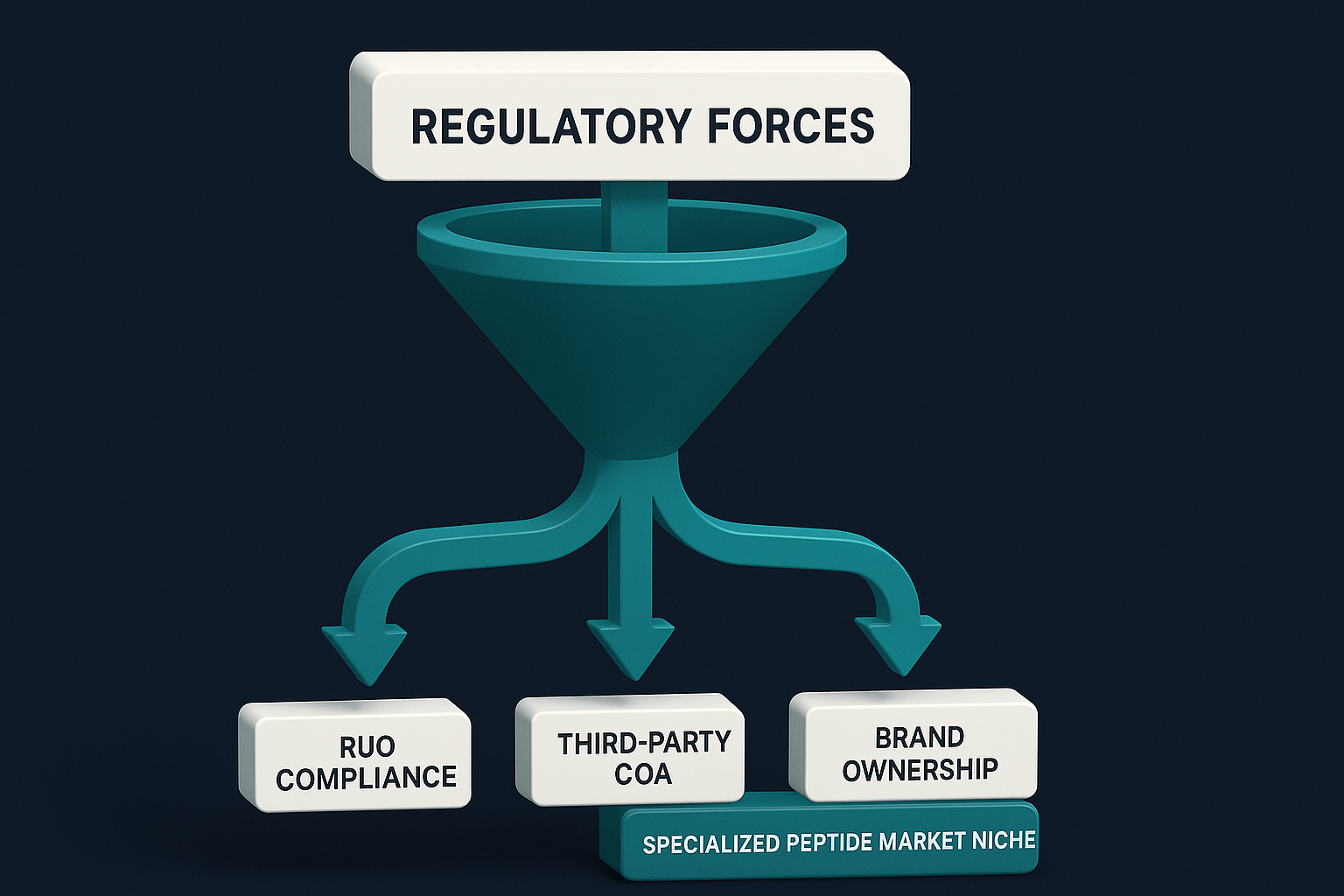
The Regulatory Landscape: Three Forces Reshaping the Sector
Three converging regulatory forces are altering the competitive dynamics of the research peptide supply chain. Each carries distinct implications for clinic owners and entrepreneurs building a branded RUO business. Understanding these forces allows buyers to anticipate market shifts and choose partners with compliant infrastructure.
Force 1: PCAC Review and 503A Bulk List Expansion
The Pharmacy Compounding Advisory Committee (PCAC) has scheduled a July 23-24, 2026 meeting to review BPC-157, TB-500, and Epitalon for inclusion on the 503A bulks list. This process, covered by Pharmacy Times in June 2026, signals increasing official scrutiny of peptide substances. While the 503A review directly affects compounding pharmacies, not the RUO segment, it demonstrates that regulatory bodies are paying closer attention to research peptide supply channels. For RUO buyers, the practical takeaway is that sourcing from vendors with rigorous third-party testing and transparent COA documentation will become a baseline expectation.
Force 2: Supply Chain Professionalization
The RUO segment is absorbing regulatory pressure that is forcing permanent professionalization of the supply chain. Peptide Supply reported in June 2026 that Strate Labs closed under the weight of these pressures. This consolidation eliminates vendors operating with minimal compliance and concentrates volume among suppliers that maintain batch-level documentation and consistent quality control. For a clinic owner or entrepreneur, the narrowing field means that due diligence on a supplier’s manufacturing and testing practices is no longer optional. Suppliers that cannot demonstrate a clear audit trail will exit the market, leaving compliant sourcing partners with greater capacity and stability.
Force 3: Payment Processing Standards
Regulatory clarity is gradually reducing risk for payment processors serving the research peptide sector. Unison Payment Solutions noted in March 2026 that compliant sellers face easier processing as the regulatory environment becomes better understood. For RUO businesses, this translates to fewer merchant-account declines and lower transaction friction. The shift rewards suppliers that maintain clear labeling, disclaimers, and documentation, because processors can verify legitimacy against a known compliance framework. This trend favors brands that prioritize transparent operations from the start.
For a deeper look at how the federal framework applies to research peptide sourcing, see our breakdown on how the FDA regulates research peptides.
How Regulatory Pressure Filters the Market
Non-compliant operators face accumulating barriers as enforcement tightens. Payment processors freeze merchant accounts after warning letters, credit-card acquirers flag websites making implied health claims, and institutional buyers avoid suppliers that lack batch-specific Certificates of Analysis or any verifiable chain-of-custody documentation. Reputational damage compounds quickly when a single letter or social-media post links a brand to unsubstantiated human-use statements.
Compliant suppliers enforce RUO labeling on every product page, provide third-party COAs linked to each batch, and maintain chain-of-custody records that satisfy institutional purchasing departments. These steps are not optional marketing; they are the baseline documentation that research institutions and multi-location clinics require before placing an order. A BioPharma Dive commentary from April 2026 noted that market forces are already shifting transactions toward trusted, documented channels even before formal rule changes take effect.
The result is a self-reinforcing cycle. As more institutional buyers demand COA-backed product, the market share of compliant suppliers grows, which in turn sets higher default expectations for every new entrant. Sellers that fail to meet those standards lose access to the buyers that drive the majority of volume and recurring revenue. The red flags regulators look for on peptide websites overlap almost entirely with the features institutional buyers already avoid: vague labeling, missing documentation, and health-claim language. Regulatory pressure and buyer behavior converge on the same standard, making compliance the most efficient path to sustainable growth.
White-Label Opportunity: Why Compliance Creates Profitable Niches
Regulatory tightening acts as a high barrier to entry that protects early-moving, compliant brands. Non-compliant vendors exit the space, leaving unmet demand from clinics and entrepreneurs who need reliable, documented research peptides.
A Grand View Research forecast projects an 8.7% compound annual growth rate through 2033. That growth is not automatic – it rewards suppliers with the full compliance infrastructure: proper RUO labeling, batch-specific Certificates of Analysis, and packaging that meets institutional expectations.
YourPeptideBrand’s white-label model is built for this environment. Zero minimum order quantities mean you never tie up capital in inventory. On-demand dropshipping lets you start with a single order. Custom labels carry compliant disclaimers. Custom packaging meets the presentation standards that research buyers expect. The catalog covers 60+ research peptides, each third-party tested with a COA.
Compare that to suppliers that force bulk minimums. They push you to guess demand months ahead and load up on product that may not move. With an on-demand model you match supply to real orders, eliminating inventory risk while still offering a full catalog to your clients.

For more on how compliant brands use online channels to capture this demand, read how digital marketing is adapting to peptide industry changes.
Market Data: The Numbers Behind the Shift
| Metric | Value | Source |
|---|---|---|
| Global peptide therapeutics market 2025 | USD 140.9B | Grand View Research |
| 2026 projected | USD 164.0B | Grand View Research |
| 2033 projected | USD 294.6B | Grand View Research |
| CAGR 2026-2033 | 8.7% | Grand View Research |
| North America market share 2025 | 61.9% | Grand View Research |
| In-house manufacturing share 2025 | 64.8% | Grand View Research |
The total peptide market exceeds USD 140 billion in 2025 and is on pace to nearly double by 2033. That scale means there is room for specialized niches even as overall competition grows.
North America commands 61.9% of the market, and a large majority (64.8%) of production stays in-house. That domestic concentration matters because regulatory enforcement in the U.S. has intensified faster than in other regions. Suppliers that already operate compliant, vertically integrated manufacturing facilities are best positioned to absorb new labeling and recordkeeping requirements without disrupting their supply chains.
The regulatory shift will accelerate a split between compliant players and the rest. As the FTC and FDA tighten rules around purity claims and third-party testing, buyers will gravitate toward suppliers with documented COAs and no-MOQ dropship models. The niches that survive and grow will be the ones served by partners who treat compliance as a core operational requirement, not an afterthought.
Book a Compliance Consultation to discuss how these market shifts affect your research peptide supply chain.
COA / Quality: The New Market Standard
For institutional buyers in 2026, a Certificate of Analysis is no longer a differentiator. It is the baseline. Any research peptide supplier that cannot provide a batch-specific COA will lose consideration before the conversation starts.
A proper COA includes more than a single purity number. It should contain an HPLC chromatogram demonstrating 98%+ purity, a Mass Spectrometry confirmation of the molecular weight, a unique batch/lot number traceable to each vial, and the contact information of an independent testing lab. Without these components, the document is not a reliable quality record.
As Loti Labs (May 2026) discussion on evolving regulatory requirements points out, the batch-specific COA is the only empirical proof that a research peptide has the correct molecular sequence. Buyers who skip this verification accept unquantified risk.
For clinic owners and entrepreneurs building an RUO brand, documentation is the primary layer of credibility. Review the COA Library to see how published certificates compare across suppliers. Understanding the role of documentation in peptide compliance and implementing sound quality assurance practices for RUO peptides are essential to meeting the 2026 standard.
Research Guide: Published Studies on Peptide Mechanisms
Entrepreneurs and researchers need to track the published literature that shapes market demand for specific research peptides. A 2025 review in Signal Transduction and Targeted Therapy systematically maps the expanding pipeline of peptide-based candidates across oncology, metabolic, and regenerative applications, highlighting over 80 compounds that have reached various stages of preclinical investigation (Xiao W, et al., 2025). The authors note that the structural diversity and high specificity of research peptides make them attractive probes for studying receptor-ligand interactions in vitro.
Another comprehensive analysis in Molecules (Rossino G, et al., 2023) outlines key hurdles in peptide-based compound development, including short half-lives and metabolic instability, while emphasizing the growing toolkit of chemical modifications that improve stability in biological assays (Rossino G, et al., 2023). These challenges create a continuous demand for high-purity research peptides that can yield reproducible data in pre-clinical models.
A rapidly expanding body of in vitro and in vivo studies focuses on compounds like BPC-157 and TB-500. Research published in wound-healing and angiogenesis journals has explored their effects on cell migration and vessel formation in controlled laboratory settings. This steady output of mechanistic work drives the sustained research interest that makes these peptides a staple in laboratory supply catalogues.
For clinic owners and brand builders, staying current with the peer-reviewed literature is not an academic exercise – it informs which research peptides to stock and how to position them for a research audience.
Try the Profit Calculator to estimate how demand for these research peptides translates into margins for your brand.
Compliance Best Practices for New Peptide Brands
Regulatory attention on the research peptide space is increasing. Entrepreneurs launching branded RUO lines must build compliance into every operational layer from day one, not bolt it on later. The following practices form a baseline that aligns with current FDA and FTC expectations for research-use-only labeling.
Every product label and marketing material must carry the phrase “For Research Use Only” in clear, readable type. This applies to vial labels, outer packaging, product detail pages, email campaigns, and social media graphics. A single omission on a single piece of collateral can draw regulatory scrutiny.
Provide a batch-specific Certificate of Analysis (COA) from an independent third-party lab with every shipment. The COA should identify the batch, test date, and results for purity, identity, and any relevant impurities. Buyers in clinical research settings expect this documentation; regulators do too.
Use institutional-grade disclaimers on every website page, not just the footer. Product pages, blog posts, category headers, and checkout pages should each contain a standalone research-use-only notice. This reduces the chance of accidental consumer-facing claims and strengthens your compliance posture.
Avoid any language that implies human therapeutic, diagnostic, or health outcomes. Even hedged phrases like “supports recovery” or “promotes regulation” are red flags. Every claim must be framed strictly around in vitro or in vivo research applications. For detailed guidance, see our guide on how to build an FDA-compliant product page for peptides.
Maintain chain-of-custody documentation for every batch. Record who handled the material, when, and under what conditions. This paper trail protects you in an audit and signals to institutional buyers that your operation is serious about quality.
For a broader framework covering labeling, advertising, and recordkeeping, review the full FDA and FTC compliance guide for research peptide brands. These two resources together provide a practical compliance checklist for any new brand.
Frequently Asked Questions About Regulatory Changes and Research Peptide Niches
What is the RUO designation for research peptides?
Research Use Only (RUO) is a standard labeling classification that distinguishes research-grade peptides intended for laboratory investigation from compound-grade compounds intended for research use only. As of 2026, RUO peptides are legally permitted for in vitro and animal model studies when sold with explicit ‘For Research Use Only’ labeling, a Certificate of Analysis, and no therapeutic claims. YourPeptideBrand supplies all products under this compliant RUO framework.
How does the July 2026 PCAC meeting affect research peptide availability?
The Pharmacy Compounding Advisory Committee (PCAC) meeting scheduled for July 23-24, 2026, under docket FDA-2025-N-6895, is reviewing peptides including BPC-157 and TB-500 for potential addition to the 503A Category 1 bulks list, according to Pharmacy Times (June 2026). This process specifically governs compound compounding for research use only, not the RUO research supply chain. RUO procurement for laboratory research remains unaffected by the PCAC outcome.
Why are Certificates of Analysis critical for research peptide compliance?
A Certificate of Analysis (COA) provides batch-specific documentation of peptide identity via Mass Spectrometry and purity via HPLC, typically at 98% or higher purity. As regulatory scrutiny on the research peptide sector has increased in 2026, third-party COAs have become the standard evidence that a supplier operates within the RUO framework. YourPeptideBrand provides a downloadable COA for every batch across its catalog of 60+ research peptides.
What market trends are driving demand for research peptides in 2026?
The global peptide therapeutics market was valued at USD 140.9 billion in 2025 and is projected to reach USD 164.0 billion in 2026, according to Grand View Research (June 2026), with a CAGR of 8.7% through 2033. North America held the largest regional share at 61.9% in 2025. This growth reflects expanding research into peptide mechanisms across oncology, metabolic, and regenerative compound applications.
Are research peptides still legal to purchase in 2026 for laboratory use?
Yes. Purchasing research peptides for laboratory investigation, in vitro cellular assays, and animal model studies remains legal provided the supplier operates within the Research Use Only framework. A 2026 analysis by Loti Labs confirmed that RUO procurement is distinct from compound compounding regulations. Vendors must carry compliant labeling, provide third-party COAs, and ship exclusively for research purposes.
What makes a white-label peptide brand profitable under 2026 regulations?
Regulatory tightening creates a competitive moat for compliant white-label brands. Brands that embed RUO labeling, batch-specific COAs, and proper documentation gain preferred access to payment processors, retain institutional buyers, and avoid the compliance failures shutting down non-compliant vendors. YourPeptideBrand enables entrepreneurs to launch with zero minimum order quantities, on-demand dropshipping, custom packaging, and full documentation support. For margin projections, use the Profit Calculator.
How do zero-minimum-order models reduce risk for peptide entrepreneurs?
Zero-MOQ white-label models eliminate the capital risk of pre-purchasing large inventory batches. Brands order only what their customers request, and the supplier handles labeling, compliance, and fulfillment on demand. This model lets entrepreneurs test niche demand for specific research peptides without committing thousands of dollars to bulk orders. YourPeptideBrand provides this infrastructure with full COA-backed quality assurance.
What differentiates a compliant research peptide supplier from a non-compliant one?
Compliant suppliers maintain three critical elements: batch-specific third-party Certificates of Analysis (HPLC and Mass Spectrometry), explicit ‘For Research Use Only’ labeling on all containers, and documented institutional verification for shipments. Non-compliant suppliers typically skip COA documentation, market products with implied health claims, or ship to residential addresses. YourPeptideBrand provides full compliance infrastructure including COA Library access and RUO-compliant packaging.
Conclusion: Launching Your Compliant Research Peptide Brand
Regulatory changes are reshaping the research peptide market, compressing margins for suppliers that ignore labeling and documentation. That creates a clear window for brands that enforce RUO standards, provide Certificates of Analysis, and maintain clean traceability. The segment is growing, and compliant white-label suppliers are positioned to capture it.
YourPeptideBrand removes the traditional barriers. With zero minimum order quantities, on-demand dropshipping, custom packaging, and a catalog backed by third-party COAs, you can launch a compliant brand without inventory risk. You own the customer relationship and the label.
Ready to start? Download the full catalog or Schedule Your Brand Launch Call to discuss your private-label research peptide line.
Last updated: July 2026