For research use only. Not for human consumption, diagnostic, or potential wellness benefit.
Educational video content is the single highest-ROI channel for building trust with clinic buyers and research professionals. A well-produced video about research peptide mechanisms, proper handling protocols, or COA interpretation can differentiate a white-label brand from dozens of competitors.
The barrier is not cost. As of 2026, 90% of successful educational content creators use equipment totaling under $500, according to surveys cited by Teachery. This guide breaks down the four essentials: camera, audio, lighting, and setting up a space, plus editing and distribution.
Content marketing studies show educational assets can boost conversion rates by 30-50% compared with generic product pages. Building an educational niche in peptides starts with understanding what equipment actually matters for the return.
What is the minimum equipment needed?
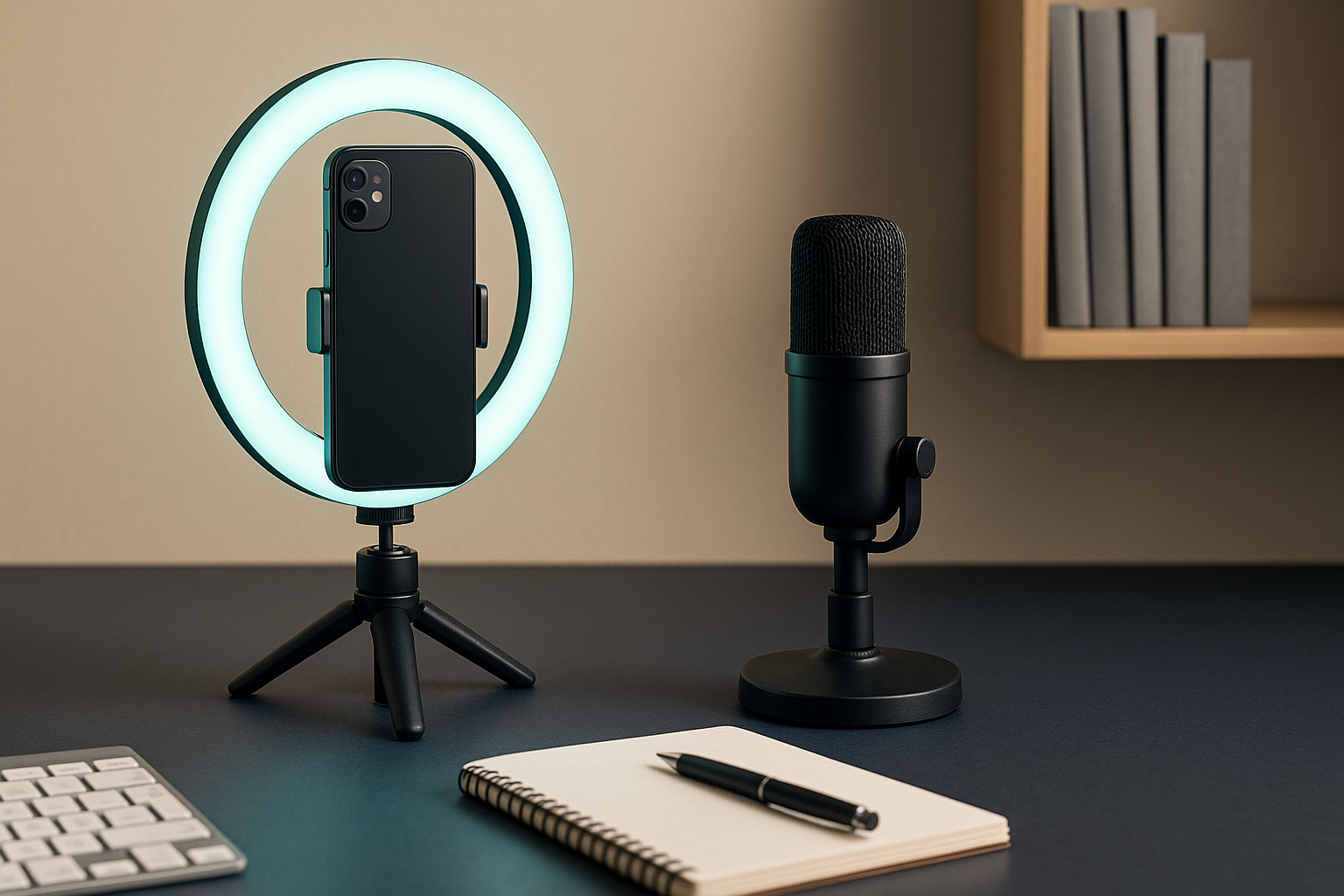
Three items: a smartphone or webcam, an external microphone, and a light source. Total cost: $120-$200. A modern smartphone shoots 4K (Wirecutter 2026), audio is the critical investment, and natural window light is free. A $25 lavalier mic solves audio the same day, and a $40 ring light extends that to any time of day.
That setup covers the core production trifecta. The microphone is non-negotiable – viewers forgive slightly soft video but click away from bad sound. The light eliminates shadows and gives a professional look that makes research peptide handling footage easier to follow.

Camera, Audio, and Lighting on a Budget
Viewers will click away from a poorly lit or muffled research peptide explanation regardless of the science. Here is exactly where to put your budget for camera, audio, and lighting to hold their attention and present your findings with professional credibility.
Smartphone vs. Webcam vs. Mirrorless
Most clinic owners already carry a 4K camera in their pocket. A modern smartphone (iPhone 15 or Samsung Galaxy S24) shoots 1080p or 4K video that covers 90% of talking-head research peptide content, notes the InfluenceFlow 2026 Content Creation Equipment guide. The highest-ROI move is often to use the phone you already own and put the cash into sound and light.
For desk-based recording, a dedicated webcam simplifies the workflow. The Logitech C920 HD Pro Webcam (~$70) remains a standard pick, noted by ProductiveBlogging for its reliable plug-and-play setup.
For interchangeable lenses and a larger sensor for shallow depth-of-field, the Sony ZV-1 or ZV-E10 ($500 – $800) are the entry-level mirrorless options. A standard rule in content creation is to invest roughly 20% in the camera body and 80% in audio and lighting. A great microphone and a soft light source improve perceived quality more than a camera upgrade ever will.
Audio – The Most Important Investment
Audio quality determines viewer retention. Viewers tolerate average video far longer than bad audio. If your research peptide educational video sounds distant or echoey, the credibility of the explanation drops.
| Tier | Mic Model | Price Range | Best Use Case |
|---|---|---|---|
| Lavalier (Wired) | BOYA BY-M1 | $15 – $25 | Quick interviews, simple talking-head shots |
| USB Desk | FIFINE K669B | $30 – $35 | Desk-recorded script reads, voiceovers |
| Wireless Lavalier | SYNCO P1X | $20 | Cable-free movement, camera not near desk |
| Mid-range Wireless | DJI Mic Mini | $99 (2 transmitters) | Multi-subject interviews, high mobility |
The TechEd Publishers guide on cheap YouTube equipment highlights the BOYA BY-M1 as a top budget lavalier. Engadget’s mobile mic guide also confirms this class of wired lavaliers as the reliable starting point for phone-based creators. For a USB desktop option, the FIFINE K669B was reviewed by Tech Times in Dec 2025 as a solid entry point. If you need wireless freedom, the SYNCO P1X at ~$20 eliminates cable trips. For a mid-range upgrade with reliable transmission, the DJI Mic Mini (~$99, dual transmitters) is recommended by Swarmify.
Acoustics matter just as much as the mic. Recording in a small room with soft furniture, or even inside a closet full of clothes, creates a dead acoustic space that makes any microphone sound better. This “closet studio” trick is a standard recommendation from the InfluenceFlow guide for creators on a zero budget.
Lighting – Three Setups Ranked by Budget
Free: Face a large window with indirect sunlight. This creates a natural softbox effect that flatters the face and avoids the harsh shadows of overhead office lights. ProductiveBlogging lists this as the first step for any online course creator.
Budget: A Neewer Ring Light with a tripod ($40 – $80) provides even, front-facing light for standard talking-head videos. It also adds a catchlight to the eyes, increasing viewer engagement.
Intermediate: Two Godox SL60 softbox lights ($200 – $400) allow for a three-dimensional lighting setup (key light, fill light, backlight). A Times Higher Education guide on professional video notes that one well-placed softbox transforms production quality more than any single camera upgrade.
Browse the Full Research Peptide Catalog
See all 60+ third-party tested research peptides available for your clinic brand today.
Setting Up Your Recording Space and Leveraging the White-Label Opportunity
Creating a Professional-Looking Background Without a Studio
Start with a clean, distraction-free background. A plain wall, a simple bookshelf with a few non-clinical books, or a solid-colored curtain works well. Avoid anything that could suggest therapeutic imagery, like medical posters or anatomy charts. The goal is to keep the viewer focused on your face and the scientific content, not the surroundings.
Frame yourself so the camera lens is at eye level. You can stack books under a laptop or buy a basic tripod for $15 – $30. Your face should fill roughly one third of the frame. Place the camera close enough that you can look directly into the lens – that creates the illusion of eye contact with the viewer. Avoid looking at your own face on the screen; it breaks the connection.
Sound quality matters as much as video quality. In an empty room, hard surfaces create echo and reverb. Hang a heavy blanket, a rug, or a moving pad on the wall behind the camera. This absorbs reflections and cleans up the audio dramatically. Below is a quick reference table.
| Do | Don’t |
|---|---|
| Use a plain wall or simple bookshelf | Record in front of a cluttered area or medical imagery |
| Position window light in front of you | Use backlight that silhouettes your face |
| Hang a blanket or rug to kill reverb | Record in a completely empty room |
These setup tips come from established online course production advice, such as the Podia video recording guide, which emphasizes simple, low-cost adjustments that dramatically improve perceived quality (Podia).
Why Educational Video Content Builds a Profitable Peptide Brand
Educational content turns your video library into a long-term lead-generation asset. Each video that explains a research peptide’s mechanism, proper handling, or legal labeling standards positions you as a trusted source. Unlike paid ads that stop working the moment you stop spending, a well-produced video can attract qualified visitors for years.
YourPeptideBrand’s white-label model makes this content strategy viable from day one. With no minimum order quantities and on-demand dropshipping, you can create videos about research peptides you intend to stock without having to pre-purchase inventory. Custom labels and packaging are printed only when a customer orders, so you never tie up cash in boxes of vials. Suppliers that force buyers to order 500 or 1,000 units per SKU make video marketing risky – you have to predict demand before you have an audience. YPB’s zero-inventory approach removes that financial pressure, letting you build a content library and grow your brand at your own pace.
Beyond the logistics of inventory, video content helps you differentiate your brand in a market where many sellers rely on generic product pages. A consistent educational series builds trust and authority, which directly supports building a content strategy for your peptide brand. When viewers see your face and hear your voice explaining the science behind a research peptide, they are far more likely to remember your brand when they are ready to buy.
Ready to turn your peptide knowledge into a profitable brand?
Book a free strategy call with YourPeptideBrand to learn how to launch your own white-label research peptide line in days, not months.
Keeping Your Research Peptide Videos Compliant
Every research peptide educational video must include the RUO disclaimer: spoken at the intro and displayed as on-screen text. This frames the content for research use only. Skip the disclaimer, and the video signals the wrong use case to viewers.
Banned language includes any suggestion of potential wellness benefit, administration protocols for humans, or clinical outcomes. Use “research peptide” consistently. Refer to “research subjects” or “in vitro studies” rather than “research subjects” or “users”. Never describe dosing, reconstitution volumes, or injection methods.
When citing research, always use hedged attribution: “studies suggest”, “research published in [journal] found”. Never invent statistics. Visual elements such as infographics of peptide structures, purity data, or lab protocols are allowed. Avoid imagery of human consumption, medical settings, or injection demonstrations.
You can feature the YourPeptideBrand COA Library in videos discussing quality control. Showing a real Certificate of Analysis adds credibility without crossing into therapeutic claims.

What to Cover in Your Research Peptide Educational Videos
Structure each video to answer one specific question. Start by defining the research peptide and its molecular classification. Explain the mechanism of action using peer-reviewed sources. Summarize relevant lab findings with dates and journal names. Finally, discuss proper handling and storage based on published guidelines.
For long-form content, aim for 5-12 minutes. Short-form clips work best at 60-90 seconds. Topic ideas that perform well: “Understanding Certificate of Analysis Reports”, “How to Properly Reconstitute Lyophilized Research Peptides”, “The Role of BPC-157 in Cellular Research Studies”, “Comparing Serum Biomarkers in Research Models”.
Always cite sources with PubMed IDs or journal names. If you need guidance on identifying which audience to target with these videos, see our guide on defining your ideal customer persona. That step ensures your video topics match the questions real researchers actually ask.
Calculate Your Profit Potential
See how your research peptide brand margin works with no minimum order quantities. Use the YourPeptideBrand Profit Calculator to estimate per-unit costs and retail pricing in seconds.
Getting Your Educational Videos in Front of Qualified Buyers
A well-produced video has no value if the right researchers never see it. Distribution is the step that turns production effort into inbound inquiries. Each platform serves a different stage of the buyer’s research process.
YouTube for Long-Form Research Content
YouTube remains the primary search engine for how-to content. Detailed walkthroughs of handling protocols, reconstitution steps, or storage best practices perform well here. Titles should include the specific research peptide name and the problem it addresses in the lab. A consistent upload schedule signals authority to the algorithm.
TikTok and Instagram Reels for Short-Form Findings
Short-form video is effective for quick tips, lab setup tours, or highlighting a specific data point from a recent study. Clinics and entrepreneurs using these platforms to share bite-sized educational content often see higher engagement. For those ready to scale, structured advertising on TikTok can accelerate reach. TikTok advertising for peptide brands offers a direct path to testing audience response.
LinkedIn for Professional Audience Building
LinkedIn is an underused channel for RUO content. Posting short clips or case-study style videos there puts your brand in front of clinic owners and healthcare practitioners who are actively researching business opportunities. The professional context of the platform aligns well with the B2B nature of the white-label model.
Email Marketing and Product Page Embedding
Email lists built on opt-ins have high conversion potential. Including a video thumbnail in a campaign can lift open rates compared to text-only sends. On the website side, embedding a relevant educational video directly on a product page helps visitors understand the compound without leaving the page. This tactic supports both SEO and conversion goals. For deeper strategy on integrating video into a broader ad spend, read about scaling a peptide brand with video ads.
Consistency matters more than production polish. One video in research protocols builds an audience faster than one perfect video per quarter. The landscape of digital marketing adaptation in the peptide industry shows that steady educational output creates the highest long-term asset value for a brand owner.
Frequently Asked Questions About Budget Video Equipment for Research Peptide Content
What is the minimum budget needed to start creating research peptide educational videos?
A usable setup can be assembled for under $150. A smartphone with a 4K camera, a simple ring light, and a basic lavalier microphone cover the technical essentials. The focus should be on clear audio and stable framing rather than expensive gear.
Can I use a smartphone for professional-looking research peptide content?
Yes. Modern smartphones record in 4K and can produce excellent results when paired with good lighting and an external microphone. The choice of camera matters far less than the clarity of the information presented.
What lighting setup works best for a small lab or office space?
A single LED panel or ring light placed at 45 degrees to the subject eliminates harsh shadows. Desk lamps with daylight bulbs can also work. Soft, even light ensures the research peptide vials and labels are legible on camera.
Do I need expensive editing software to create effective educational videos?
No. Free tools like DaVinci Resolve (for desktop) or the editing suites built into TikTok and Instagram are sufficient for cutting clips, adding text overlays, and adjusting audio levels. The goal is clarity, not cinematic effects.
How do I ensure my video content stays compliant with RUO labeling standards?
Always refer to the compounds as “research peptides” and reference “research subjects” or “in vitro studies”. Avoid any language that implies human consumption or potential wellness benefit. Review every script for terms like “treats” or “cures” before recording.
What is the ideal length for an educational research peptide video?
It depends on the platform. Long-form explainers of 5-15 minutes work well on YouTube and embedded product pages. Short-form clips of 30-60 seconds are better for TikTok, Instagram Reels, and LinkedIn feeds. Match the length to the viewer’s intent on that platform.
How does video content help a white-label research peptide business grow?
Educational videos build authority and trust. When a potential client sees a brand owner explaining handling protocols or citing published research clearly, they are more likely to inquire about wholesale or dropship partnerships. Video accelerates the relationship-building cycle.
How does YourPeptideBrand support partners in marketing with video?
YourPeptideBrand provides a full catalog of 60+ research peptides, each with a Certificate of Analysis, which can be featured in educational content. Because there are no minimum order quantities, partners can test video-driven demand for specific compounds without financial risk. The brand owner retains full control over their customer relationships and marketing strategy.
Ready to Launch Your Own Research Peptide Brand?
Book a call with the YourPeptideBrand team to discuss your private-label or dropshipping setup. You will get a walkthrough of the catalog, the no-MOQ model, and how to structure your video-first marketing approach.
Last updated: July 2026