
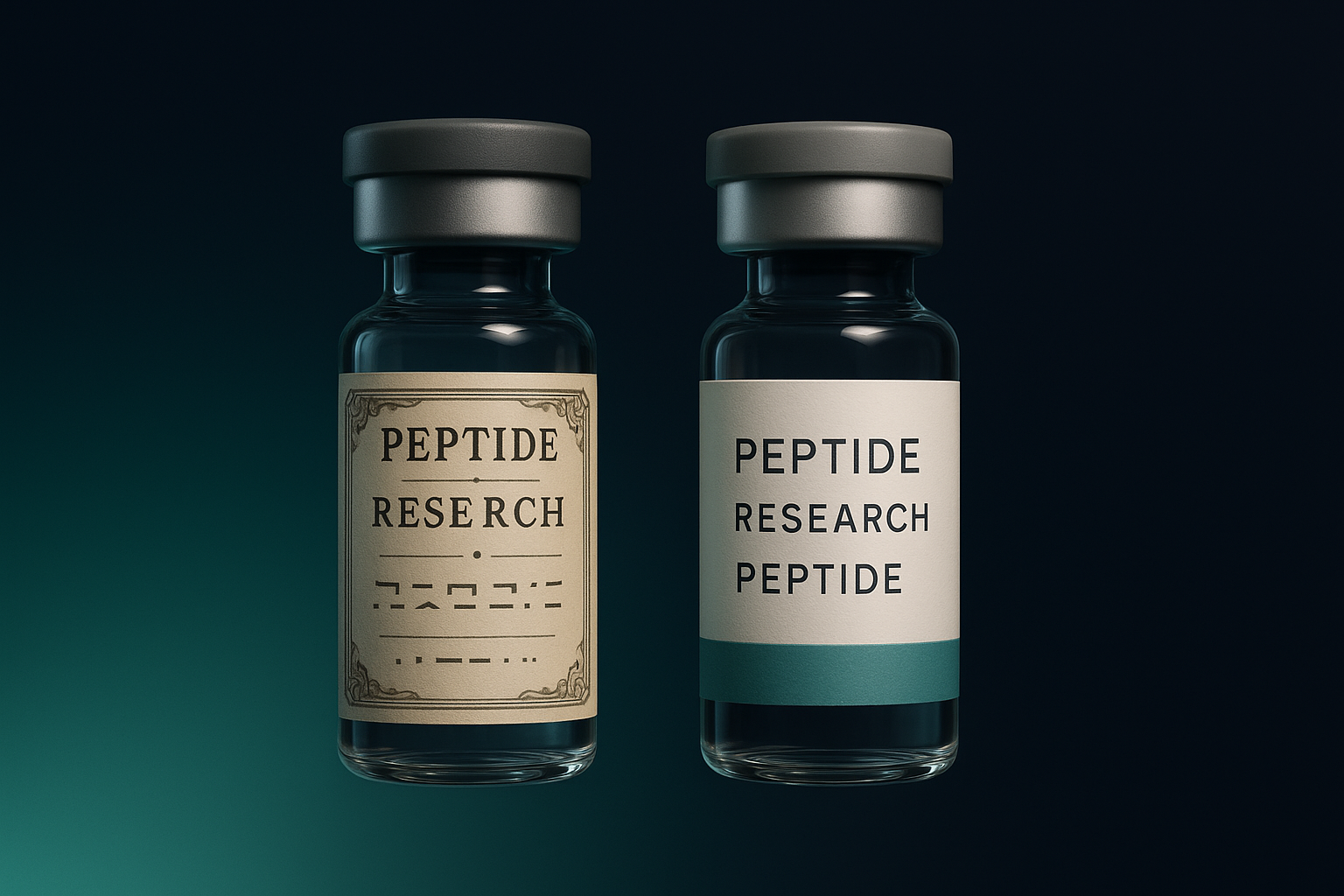
For research use only. Not for research use only, diagnostic, or potential wellness benefit.
How to Rebrand Your Research Peptide Company Successfully
Most supplement rebrands fail not because of a logo or color scheme, but because the organization behind it was not ready for the change. According to Pure Branding’s 2025 analysis, leadership consistently underestimates the organizational shift required to make a rebrand stick. For research peptide companies, that shift comes with an extra layer of risk: compliance.
Rebranding a research peptide company means updating brand identity, messaging, and positioning while keeping every label, claim, and customer communication inside RUO guidelines. The visual refresh is the easy part. The hard part is making sure the new brand does not introduce a compliance gap that erodes the trust built with clinic owners and entrepreneurs who rely on your labels and Certificates of Analysis (COAs).
Every element of the rebrand – from packaging copy to your website’s tone – must be reviewed against the same regulatory framework that governed your old brand. One misstep, such as replacing “For research use only” with a more consumer-friendly phrase on the label, can trigger a compliance failure that damages your reputation faster than any design flaw.
This guide provides a step-by-step framework for rebranding your research peptide company successfully. It covers how to update visuals, tone, and positioning without sacrificing regulatory compliance or customer confidence. The focus is on the organizational and operational changes that make a rebrand real, not just the surface-level design decisions.
Why Rebrand a Research Peptide Company?
The research peptide market is no longer a small corner. Each year more entrepreneurs and clinic owners enter the space, and buyers routinely compare multiple suppliers before committing. Differentiation is critical – a brand that looks like dozens of others will be overlooked, regardless of product quality.
Several signs indicate a rebrand may be overdue. Generic visuals are the most obvious: a logo that could belong to any RUO vendor, stock photography, or a color scheme that mirrors half the competition. A shift in business model – from raw powder supplier to white-label partner – demands an identity that reflects the new value proposition. An outdated company name that does not clearly communicate research-only positioning or compliance can confuse potential buyers and raise doubts.
Branding directly affects trust in the research peptide industry. Since buyers cannot inspect the product physically, the brand’s professionalism signals the level of quality control behind it. An identity that feels generic or dated can suggest lower standards, even when the research peptides themselves are sound.
Peptide industry trends for 2025 emphasize differentiation and professionalism as baseline expectations. A rebrand is not a vanity project – it is a direct response to a more competitive, more discerning market. If any of these signs describe your current brand, evaluating your positioning now can prevent lost opportunities later.
The Compliance Foundation: Why RUO Must Stay Central
A rebrand changes visuals, tone, and positioning, but it must not alter the core labeling standard. Research Use Only (RUO) is that standard. The intended-use doctrine evaluates the total presentation of a product: labeling, website copy, social media posts, and packaging collectively signal how the product is meant to be used. If a rebrand shifts the aesthetic but drops or weakens the RUO language, the total presentation becomes ambiguous.
Brands that update their look without refreshing compliance language create risk. A compliance officer or inspector reading a new label alongside old terms can interpret the change as an attempt to reposition the product for non-research use. The fix is simple: every new asset – product page, brochure, social graphic, PDF – must carry a clear RUO disclaimer.
A 2025 CMSWire survey found that 74% of US customers rated quick resolution of queries as very important in building trust. In the research peptide space, the most common queries concern legality and intended use. Answering those questions directly with a visible, consistent RUO statement resolves the query before it is asked, reinforcing trust without requiring a support ticket.
For a deeper look at how labeling and marketing language intersect with legal boundaries, read legal boundaries of RUO peptide sales. For a detailed breakdown of how to structure compliant copy across all channels, see the FDA and FTC compliance guide for research peptide brands.
The 6-Step Rebranding Framework for Research Peptide Companies
A structured approach keeps a research peptide rebrand from drifting into cosmetic changes that miss the label-compliance fundamentals. This framework moves from audit to launch in six intentional steps.
Step 1: Audit Current Brand Assets
Pull every touchpoint your customer sees: logo, product labels, shipping packaging, your website, and any social media profiles. Look for inconsistencies in font usage, color shades, and compliance language. Identify any label that lacks a proper RUO disclaimer or uses wording that implies human application. This baseline prevents you from carrying old errors into the new design.
Step 2: Define New Positioning
Decide who you serve first. A clinic owner buying research peptides in bulk has different priorities than an entrepreneur building a dropship brand. Your positioning can target one or both, but the messaging and visual tone should match that choice. For more on targeting, see peptide branding and positioning strategies.
Step 3: Update Visual Identity
Revise the logo, color palette, and typography to reflect the new positioning. Keep it simple and legible on small vial labels. A clean sans-serif font and a two-color palette reduce printing complexity and remain professional across applications.
Step 4: Revise Compliance Copy
Every new asset needs correct, consistent RUO language. Run every piece of copy through a compliance check: product descriptions, label text, website About and FAQ pages. Replace any phrase that could be read as suggesting human use. This step is non-negotiable for avoiding supply chain interruptions.
Step 5: Redesign Labels and Packaging
Work with a supplier that prints on demand so you can test new label designs without ordering thousands of units. YPB supports on-demand label printing and custom packaging, letting you iterate until the design meets both your brand and compliance standards before scaling.
Step 6: Launch and Communicate the Change
Send a brief email or post to existing customers explaining what changed and why (better clarity, stronger compliance, updated look). Include a comparison of old versus new labels so they recognize the new packaging when it arrives. Silence creates confusion; a short announcement builds trust.

For guidance on selecting a brand name that supports this framework, read how to choose a name for your peptide brand.
Visual Identity Refresh: What Changes and What Stays
Visual consistency is the single strongest trust signal a research peptide brand can send. Buyers who see mismatched logos, clashing colors, or inconsistent packaging across a website and physical labels immediately question quality control. The elements you keep must be as deliberate as the ones you change.
Lock down three constants before changing anything else. Standardize on a clinical color palette (navy base with teal accents), commit to one clean sans-serif typeface, and apply the same logo lock-up across every touchpoint – labels, packaging inserts, and your site. These form the visual anchor buyers recognize shipment after shipment. What changes is anything extraneous: outdated badge shapes, inconsistent icon styles, or unused secondary colors that dilute the core identity.
A 2025 Blacksmith Agency report found that 81% of consumers need to trust a brand before they will consider buying from it. That trust begins with a consistent look; every time a label varies from the website, the buyer’s confidence erodes slightly. Small inconsistencies accumulate into a reputation problem that is harder to fix than a color mismatch.
For deeper guidance, read the role of visual consistency in building trust and see why minimalism in peptide brand design works better than busy layouts.

Download Our Full 60+ SKU Catalog
White-label research peptides, wholesale pricing, and dropshipping details.
Brand Voice and Messaging: Tone Without Therapeutic Claims
A rebrand often pulls a company away from generic supplier language toward a more authoritative educational tone. That shift must happen without slipping into impermissible claims. The standard for research peptides is strict: the brand voice stays factual, labeling every product as a research peptide and framing all references around in vitro studies or research subjects.
Eliminate verbs like treats, cures, heals, prevents, and reverses completely. Replace them with language grounded in laboratory contexts: “in vitro testing suggests,” “research published in [journal] observed,” “studies indicate.” Every piece of copy should pass a simple test: would a reader understand that this material is for research use only, never for research use only?
A 2025 analysis from Northwestern University found that 87% of consumers would pay more for products from brands they trust (Northwestern University 2025 analysis). Trust is built on consistency and clarity. In the RUO space, that means publishing every Certificate of Analysis, using the same terminology across all channels, and never hinting at off-label or human application.
Messaging consistency carries into the brand tagline. A tagline that defines your brand reinforces the educational positioning. For a deeper look at crafting a compliant tagline, see how to create a tagline that defines your brand. The tone is not “softer” – it is more precise, more documented, and more aligned with what researchers actually need to know.
Packaging and Label Redesign: On-Demand Without Inventory Waste
Rebranding a research peptide line usually means throwing away boxes and labels printed with your old logo. That sunk cost makes many clinic owners postpone a refresh. A white-label model that prints labels on demand per order eliminates that waste entirely. When you update your brand identity, the new labels simply start shipping on the next drop-ship order. No minimums, no landfill.
Every compliant research peptide label must carry specific static elements regardless of brand updates: the RUO disclaimer in a prominent font, a batch or lot number, an expiration date, and the phrase “Not for research use only.” Keeping these in your label template means you can change colors, logos, and background graphics without re-reviewing regulatory line items. Your label design stays flexible, but the required warnings stay fixed.
Custom packaging boxes, bottles, and inserts reinforce the new identity beyond the label. A cohesive look across vials and shipping materials signals professionalism to your research clients. For a deeper walk-through, read our guide on how to create custom packaging for your research peptide brand.
The same principle applies to the label itself. Audit every field before you redesign: is the RUO statement large enough? Is the lot number clearly positioned? Our checklist on what to include on a compliant peptide label covers each required element so you can swap visual assets without reopening compliance gaps.
Ready to Launch Your White-Label Research Peptide Brand?
Book a free call with our team. We will walk you through pricing, setup, and your first order.
Website Rebuild: Aligning Digital Presence with New Brand
A rebranded research peptide company needs a website that mirrors the updated visual identity across every page. Logos, color palettes, typography, and layout must remain consistent, but trust is built through more than aesthetics. The Edelman Trust Barometer 2025 Special Report found that brand trust depends on consistent experiences and transparency at every touchpoint. One broken element – a stale product page or missing disclaimer – erodes confidence.
Every product page for a research peptide must maintain full RUO compliance. The copy should describe the peptide for in vitro or in vivo investigation only, using chemical names and research-oriented language. Clear disclaimers stating the product is for research use only must appear near product descriptions. Each page should include a direct link to the third-party Certificate of Analysis (COA) for that batch, allowing buyers to verify purity and identity without additional outreach.
Client reviews can add social proof, but they must be moderated to remove any mention of human use, dosing, or potential wellness benefits. A review that suggests a research peptide has health benefits would violate labeling standards and undermine the trust Edelman reports as essential. Cross-linking to pages like building FDA-compliant product pages helps keep the site aligned with regulatory best practices while the rebrand rolls out.
COA Transparency: The Trust Anchor During Rebranding
In the RUO research peptide market, a third-party Certificate of Analysis is the single most powerful trust signal a brand can display. When a clinic or entrepreneur rebrands, every visual and copy change introduces risk: returning customers and new prospects must immediately recognize that the product integrity remains intact.
Keeping COA visibility front and center during a rebrand eliminates that doubt. Link every product page directly to the COA Library so visitors can verify batch purity with one click. YourPeptideBrand provides a COA on every batch produced, with third-party purity verification posted for each lot. The documentation stays accessible even if the label or packaging changes.
During a rebrand, do not bury the COA in an FAQ or footer. Feature it prominently on product pages and in your brandʼs knowledge base. Buyers who check the COA before ordering convert at higher rates because the proof of quality is transparent and instant. Browse the COA library for batch verification to see how YPB documents every research peptide lot.
Calculate Your White-Label Margins
See exactly how much margin you can make at your price point.
Launching the Rebrand: Communications Strategy
A rebrand succeeds or fails on how well you explain it. Research peptide buyers are skeptical of sudden visual changes without context. A phased rollout minimizes disruption and preserves trust built over previous orders.
Phased Rollout Plan
Start with an email to existing buyers 2 to 3 weeks before launch. State the change and the reasoning. Update digital assets first – website, social media profiles, and any storefronts. On the next inventory cycle, switch to new labels on all research peptide shipments. Give yourself up to 60 days to phase out old packaging entirely. This gradual shift prevents confusion and lets repeat customers adjust.
Explain the “Why” Behind the Change
A 2025 ResearchGate study found that rebranding is most effective at enhancing visibility when consumers understand the rationale. For a research peptide brand, the reason might be clearer positioning, updated compliance language, or expansion into new product categories. Spell out the benefit to the buyer – better labeling, more consistent packaging, easier ordering – not just the cosmetic changes.
Once the messaging is set, align every channel. For a deeper look at updating your digital presence across channels, see our guide on how digital marketing is adapting for research peptide businesses.
Measuring Rebrand Success: KPIs for Research Peptide Brands
A rebrand is an investment. Tracking the right metrics tells you whether the new positioning is working or if adjustments are needed. For research peptide brands, several key performance indicators matter most.
Start with website traffic change and bounce rate. A successful rebrand should attract more qualified visitors and keep them engaged. If bounce rate rises, the new messaging may be confusing or misaligned with audience expectations. Product page conversion rate is another critical number; it shows whether the updated visuals and copy drive orders.
Repeat order rate and average order value reflect customer loyalty and upsell success. Higher repeat orders indicate that existing customers trust the rebranded identity enough to return. Customer survey scores on brand perception provide direct qualitative data. Ask buyers specifically about trust, professionalism, and clarity of the research peptide brand message.
Track label compliance audit results. Every batch should pass third-party testing and display proper RUO labeling. A rebrand that improves compliance rates signals stronger operational standards.
A 2026 report by Capital One Shopping found that 55% of consumers remain loyal to brands they fully trust even after mistakes. For research peptide brands, trust built through consistent, compliant branding can sustain customer relationships through product or packaging changes.
Frequently Asked Questions About Rebranding Your Research Peptide Company
How does a rebrand affect my existing client relationships?
A rebrand can strengthen client confidence if you communicate changes transparently. Focus on explaining why the update improves labeling clarity, packaging, or brand consistency. Longstanding clients often view a professional rebrand as a sign of maturity. For research-use-only suppliers serving clinics and entrepreneurs, maintaining your commitment to third-party testing and the same product catalog minimizes confusion. Introduce the new look with a straightforward notification rather than a sudden change.
What elements of my research peptide brand should I update first?
Start with your logo, label design, and packaging, then move to your website copy and product descriptions. Your Certificate of Analysis (COA) templates may need updating to match the new branding. Because each batch is third-party tested, ensure the COA retains the same technical accuracy. Updating your domain or email addresses can be done later to avoid service interruption. Prioritize elements that directly affect how researchers and clinic owners perceive your brand.
Do I need to re-register my business if I change my brand name?
Business registration varies by state. If you change your legal entity name, you must update your registration and possibly your reseller certificate. A DBA (“doing business as”) filing is often sufficient for a brand name change without altering the underlying corporate structure. Consult a business attorney to ensure compliance with local requirements. Your relationship with suppliers like YourPeptideBrand should remain unaffected as long as your account details align.
How long does a typical rebrand take for a research peptide supplier?
Timing depends on the scope. Updating digital assets alone can take two to four weeks. If you redesign labels and packaging, expect four to six weeks to finalize proofs, print, and ship. A complete repositioning including website overhaul may require two to three months. Communicate with your white-label partner about timelines; YourPeptideBrand’s on-demand printing model allows you to test new labels on small batches before committing to a full rebrand.
Will a rebrand affect my search engine rankings?
A rebrand can impact SEO if you change your domain or page URLs. Plan 301 redirects from old pages to new ones to preserve link equity. Update your Google Business profile, social media handles, and directory listings. Your product page titles and descriptions should keep the same core keywords to maintain relevance. Ranking dips are temporary if you manage redirects and content updates carefully. Monitor your positions on research peptide terms during the transition.
How do I price my research peptides after a rebrand?
Rebranding is an opportunity to reassess your pricing strategy, but you must consider market rates and your costs. If you added value through new packaging or labeling, you may adjust prices accordingly. A profit calculator can help you model different scenarios. Because your margin depends on volume and your supplier’s pricing model, work with your partner to understand how changes in branding costs affect your bottom line. Keep testing to validate demand.
Should I update my Certificate of Analysis with the new branding?
Yes. Every COA should carry your current brand name and logo to reinforce trust. The technical content – batch number, testing date, purity data – must remain unchanged. Request updated COA templates from your supplier that match your new labeling. This ensures researchers see a consistent brand identity across the product and its documentation. COA consistency also helps differentiate your brand from suppliers that reuse generic certificates.
Can I keep some products with old packaging while others get new branding?
It is possible but not ideal. A phased rollout can reduce waste: use up old stock for low-volume research peptides while introducing new packaging for high-demand products first. Set a clear cutoff date to switch fully. Communicate the transition to buyers so they know which batches carry the new label. Avoid mixing old and new packaging for the same product because it can cause confusion in research settings.
Rebrand With Confidence: Your Next Steps
Rebranding a research peptide company is achievable when you prioritize compliance, visual consistency, and transparent communication.
YPB enables rebranding with no minimum order quantities, on-demand label printing, custom packaging, and third-party COAs on every batch.
For entrepreneurs: run the numbers with the profit calculator and download the catalog.
For clinic owners: book a call about bulk rebranding and label customization.
Ready to Launch Your White-Label Research Peptide Brand?
Book a free call with our team. We will walk you through pricing, setup, and your first order.
Last updated: July 2026