
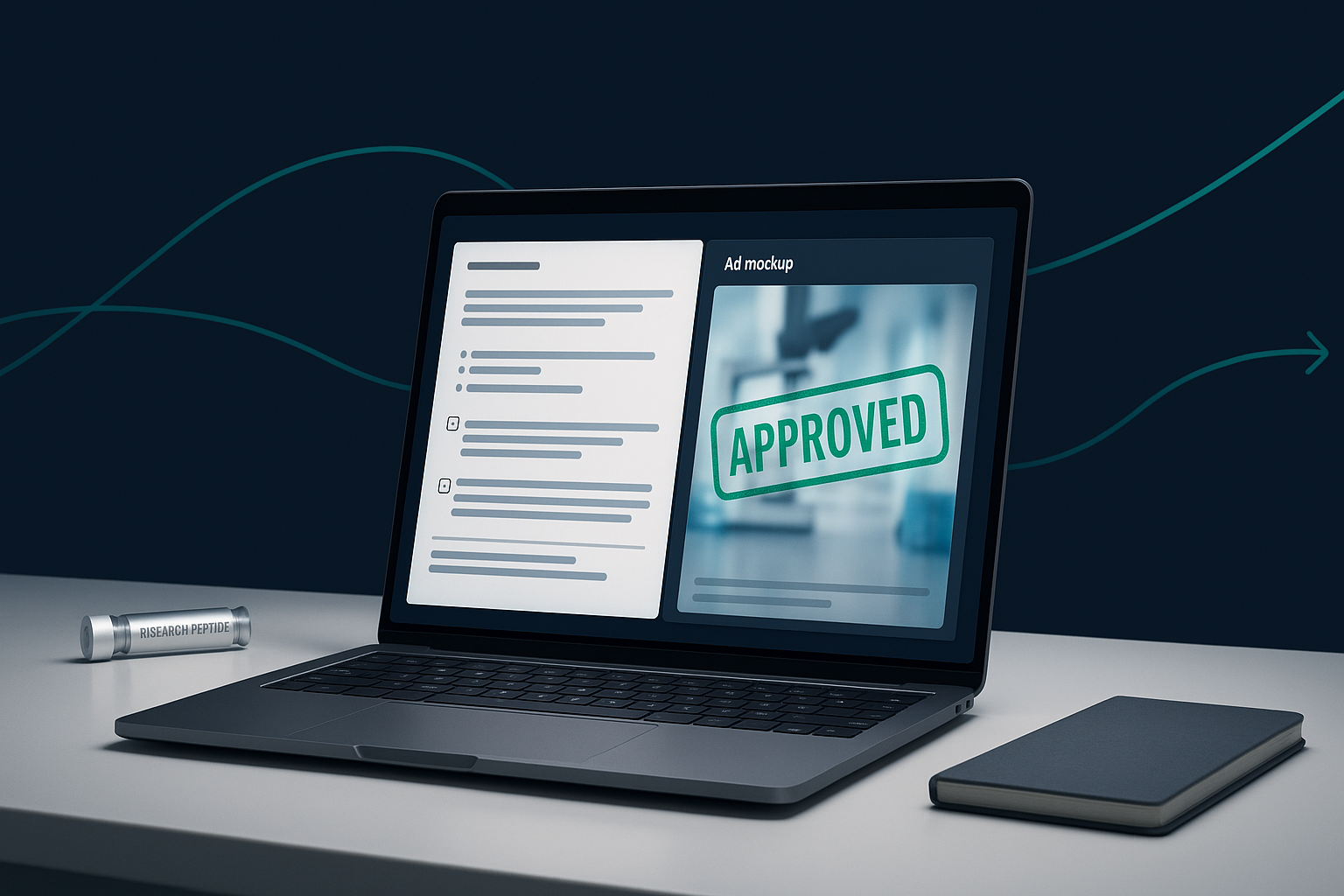
For research use only. Not for human consumption, diagnostic, or potential wellness benefit.
Entrepreneurs launching Research Use Only research peptide brands often hire freelancers to produce ads for Meta, Google, and TikTok platforms. Freelance copywriters, video creators, and designers can bring speed, niche creative skills, and lower overhead compared to full-service agencies. But a single non-compliant headline – a phrase that implies human use or potential wellness benefit – can trigger an immediate account suspension before the campaign gains any traction. The risk is real: most freelancers have zero experience with RUO labeling rules or the strict compliance requirements that apply to research peptide advertising. Without a structured collaboration process, each new creative asset becomes a liability rather than an advantage.
What Is Freelancer Collaboration in Research Peptide Advertising?
Freelancer collaboration in research peptide advertising refers to the process of hiring independent ad creators – copywriters, video producers, UGC creators, and designers – to produce promotional assets for a Research Use Only (RUO) peptide brand. YourPeptideBrand (YPB) recommends treating every freelancer as an extension of your compliance team, not just a creative resource.
The appeal of freelancers is clear. They offer specialized skills on demand, often at lower cost than agencies, and can turn around assets quickly for fast-scaling brands. But the same independence that makes freelancers valuable also creates compliance gaps. A freelancer who writes for supplement brands or cosmetic products is accustomed to benefit claims and direct consumer language. Research peptide advertising prohibits those approaches entirely. The FTC advertising and marketing basics emphasize that claims must be truthful and substantiated – but for RUO peptides, the standard is even stricter: any claim about human use is prohibited by default.
Most freelancers do not know what RUO means or why “this research peptide supports cellular repair” is a dangerous phrase. They may inadvertently write copy that implies human consumption, potential wellness benefits, or clinical outcomes. One such line in an ad headline can flag automated content review systems across Meta, Google, and TikTok, leading to rejections or bans that affect the entire ad account.
According to Advertising Week’s insights on freelancer collaboration, clear guidance and feedback loops are critical for successful freelance partnerships. In the research peptide space, that guidance must include a compliance briefing upfront: a written set of prohibited words, required RUO statements, and examples of acceptable versus unacceptable copy. Without this, the freelancer operates in the dark and the brand owner accepts unnecessary risk.
Building a repeatable briefing-and-review process is not optional for peptide ad projects. It is the difference between a campaign that scales safely and one that ends with a suspended account and lost investment. The following sections break down how to write a compliance-focused brief, review creatives for red flags, and build a feedback loop that trains freelancers over time.
Why RUO Compliance Changes How You Brief Freelancers
Compliance is the line between a clinic that scales and one that gets a warning letter. Most RUO sellers get the labeling wrong. When you brief a freelancer, the default assumption is that they know the rules for research peptides. They don’t. The legal framework for RUO advertising is strict, and the burden of proof falls on the brand owner.
The FTC truth-in-advertising standard applies to every claim in an ad. A claim must be substantiated by competent and reliable scientific evidence. For a research peptide, that means you cannot suggest a human therapeutic outcome. Every headline, caption, and visual must stay inside the boundaries of research use only. If your freelancer writes that a peptide “supports cellular repair” in a way that implies a health benefit, the ad is non-compliant. The FTC applies this standard aggressively to dietary supplements and research compounds sold in the gray market (peptidelaws.com, March 2026).
Platform policies add another layer. Meta and Google prohibit direct advertising of research peptides. Only neutral educational content that describes the compound without a call to action to buy can be promoted. If a freelancer creates a carousel ad with a “Shop Now” button and a peptide name, the ad will be rejected. If it gets through, the ad account is at risk. Wallid.co’s advertising compliance guide for peptide sellers notes that platforms use automated text scanning and image recognition to flag restricted substances (wallid.co).
Consequences for non-compliance are severe. Ad account bans are common. Payment processors like Stripe and PayPal will freeze accounts linked to prohibited ads. In some cases, legal exposure includes FTC cease-and-desist orders or state attorney general actions. A single bad brief to a freelancer can cascade into a business shutdown. That is why the creative brief must act as a legal guardrail before a freelancer opens a design tool.
For a full breakdown of platform-specific restrictions and safe ad formats, read our guide: How to Safely Advertise Research Peptides.
Step 1: Write a Compliance-First Creative Brief
A creative brief is not a style guide. It is a compliance document. Most brands brief on visual mood boards and brand colors. In the research peptide space, the brief must start with legal boundaries and approved language. If the freelancer gets the brief right, the first draft is often the final draft. If the brief is vague, you burn hours on revisions and risk non-compliant content going live.
Simple.io’s marketing approval workflow research shows that compliance review is most effective when it happens before creative work begins, not after. When legal requirements are embedded into the brief itself, rejection rates drop and brand safety improves (Simple.io, retrieved July 2026). The same principle applies to influencer content. Influencers Time recommends a pre-flight compliance checklist where product claim accuracy is mapped directly to an approved claim document before the creator starts filming (Influencers Time, May 2026).
Critical Elements of an RUO Creative Brief
Every brief you send to a freelancer, UGC creator, or agency partner must contain these five elements:
- Approved Claim Library. Write out the exact headlines, captions, and CTAs the freelancer is allowed to use. No synonyms. No rewriting. The research language must be verbatim. This eliminates the risk of a freelancer inventing a phrase that sounds “better” but implies human use.
- Prohibited Terms List. Include a blocklist of terms that trigger platform review or violate RUO labeling. Terms like “therapeutic”, “anti-aging”, “serving size”, “cycle”, “heal”, and “repair” must be banned from all ad copy and captions.
- Platform-Specific Disclosure Instructions. Meta branded content requires a paid partnership label. TikTok requires an RUO disclaimer overlay on the video. The brief must include the exact text for the disclaimer and the placement rules.
- COA Data and Lab Reference. If the ad references purity or structural identity, attach the Certificate of Analysis (COA) from the specific batch. YourPeptideBrand provides a COA on every batch. The freelancer must understand that claims of purity are substantiated by this document, not by marketing slogans.
- Visual Mockup Requirements. Specify that imagery must show laboratory settings: vials, gloves, research equipment, sterile environments. Banned visuals include human injection, before-and-after body shots, or any imagery that suggests human consumption.
The goal is to eliminate ambiguity. A freelancer who receives a compliant brief can produce on-spec content from the first draft. UGC Roster’s guide on briefing creators for FDA compliance emphasizes that creators need explicit guardrails on product claims and visual representation to avoid regulatory risk (UGC Roster).
For a deeper look at how to set up ad accounts and targeting parameters that align with these compliance rules, read the Beginner’s Guide to Facebook Ads for Peptide Stores.
Download Our Full 60+ SKU Catalog
White-label research peptides, wholesale pricing, and dropshipping details.
Step 2: Vet Freelancers for RUO Compliance Knowledge
Not every freelance copywriter or designer understands the Research Use Only boundary. An ad that reads well for a consumer product can get your account suspended if it implies human use. The screening process needs to test for RUO fluency, not just creativity.
Start with a targeted question during the interview: ask the candidate to describe how they would frame a research peptide ad without using human-use claims. A strong answer avoids words like “treats,” “therapy,” or “research subjects” and instead focuses on in vitro or in vivo research applications. A weak answer defaults to consumer wellness language.
Review their portfolio for compliance signals. Look for ads that market laboratory reagents, lab equipment, or other B2B research supplies. Freelancers who have worked with compound or biotech clients often understand labeling restrictions. Portfolios heavy on supplements, cosmetics, or fitness products may indicate a need for more onboarding.
Request a sample brief response before hiring. Give the candidate a mock ad specification for a research peptide product and ask them to write a headline and body copy. This step reveals whether they default to claims like “supports muscle growth” instead of “used in research studies investigating cellular repair.” The upfront test saves hours of revision later.
Platforms like Fiverr and Upwork give you access to a wide talent pool, but RUO knowledge varies dramatically. A freelancer who has never worked with a regulated category may need extra guidance. Advertising Week (April 2024) reported that both freelancers and companies point to a need for clear guidance, better onboarding, and thorough briefing to close the compliance gap. The takeaway: vetting is the first line of defense.
YourPeptideBrand helps partners identify qualified creative partners through compliance consulting. If you are unsure what to look for in a portfolio or a sample response, the team can review candidate materials and flag red flags before you commit. This support fits into a larger Google Ads Compliance Checklist for Peptide Brands that covers ad copy, landing pages, and creative assets.
Step 3: Build a Structured Review and Approval Workflow
A single pair of eyes is rarely enough when RUO compliance is on the line. A structured multi-stage workflow catches issues before an ad goes live and prevents last-minute scrambling. Design a process with at least five stages.
- Freelancer submits first draft. The freelancer uploads the initial copy and design into a shared approval platform or project management tool. All assets are timestamped and versioned automatically.
- Brand marketing review for messaging alignment. Your internal marketing lead checks that the ad matches your brand voice, audience, and campaign goals. This step focuses on clarity and positioning, not yet on compliance.
- Compliance/legal review for RUO claim verification. A designated reviewer scans every line for human-use claims, banned terms, and proper framing (“research subjects” vs. “research subjectss”). The reviewer also confirms that the ad references in vitro or in vivo studies where applicable.
- Platform policy check. Before sending the asset to the ad platform, run it through a checklist for the specific network (Google Ads, Meta, etc.). Platform policies change quarterly; the checklist must be updated accordingly.
- Final sign-off. Only an authorized approver (brand owner or senior marketing manager) gives the green light. No ad goes live without this final signature.
Simple.io’s marketing approval workflow guide (retrieved July 2026) notes that mandatory compliance checklists prevent content from being bypassed under deadline pressure. When every team member knows they must pass through each gate, shortcuts become harder to justify. The guide also recommends that the compliance review start at the creative brief stage, not after the ad is designed. Early involvement reduces rework.
External stakeholders like freelancers can be included in approval workflow platforms with secure, read-only or comment-level access. This keeps the entire team aligned without exposing internal strategy documents. Popular tools like Monday.com, Asana, or specialized approval software support this structure.
For a deeper breakdown of building a similar process from the ground up, see the How to Build a Compliance Review Process for Marketing Content guide. It walks through templates for checklists, approval roles, and audit trails.
Ready to Launch Your White-Label Research Peptide Brand?
Book a free call with our team. We will walk you through pricing, setup, and your first order.
The White-Label Opportunity: Compliance as a Competitive Advantage
Building an RUO brand on proper compliance isn’t just about avoiding fines – it’s a direct business advantage. Sophisticated buyers like clinics and research institutions prioritize sellers who clearly label their products for research use only and maintain clean ad copy. A brand that invests in correct RUO framing attracts these higher-value customers and sidesteps the constant cycle of platform appeals and payment processor shutdowns that plagues sellers who cut corners.
Many suppliers force bulk minimums and slap generic labels on vials, treating compliance as an afterthought. That approach works until an ad gets flagged or a processor freezes funds. Brands that build compliance into every step – from the product page to the social media post – scale faster because they don’t waste time scrambling to fix violations after the fact. The difference shows up in both customer trust and operational stability.
YPB’s no-MOQ, on-demand dropship model lets you test ad creatives with a single vial before scaling. You can validate a research peptide’s demand without committing to hundreds of units that might not move. When compliance is built into your workflow, you scale in a way that doesn’t invite risks later. Non-compliance can bring fines ranging from $10,000 to over $200,000 per violation – a number that makes the cost of doing it right look trivial by comparison.
Step 4: Document Everything With a Compliance Audit Trail
An audit trail is the final safety net. When a platform asks to see proof that your ad was compliant at the time it ran, you need a record that goes beyond “I’m pretty sure researchers observed the right disclaimer.” Without documentation, a simple inquiry can turn into a multi-day scramble that costs billable hours and – if you miss the deadline – account suspension.
Every compliance audit trail should capture these elements:
- Version history of every creative draft (design files, copy revisions, final layout).
- Reviewer comments and timestamps showing who approved what and when.
- The final approved asset (screenshot or PDF with date stamp).
- The landing page URL at the time of ad submission – pages change, so archive a snapshot.
- The UTM-tagged live URL that drives traffic from the ad.
A NetSuite marketing compliance guide emphasizes that documenting approval processes protects against enforcement actions by giving you “proof of compliance intent.” That documentation can be the difference between a warning and a permanent ban.
Because many RUO buyers want to verify quality independently, include links to documented product data in your audit trail. YPB’s COA Library provides batch-specific certificates that you can reference in both your ad copy and your compliance records. For deeper guidance on structuring the landing pages that go into the trail, see our guide on How to Build an FDA-Compliant Product Page for Peptides.
Calculate Your White-Label Margins
See exactly how much margin you can make at your price point.
Frequently Asked Questions About Collaborating With Freelancers on Peptide Ad Projects
What compliance elements must a creative brief include for research peptide ads?
A compliance-first creative brief for research peptide ads must include the exact Research Use Only disclaimer language, a list of approved claim phrases sourced from legal review, a list of prohibited terms (treats, cures, heals, therapy, research subjects, dosing), platform-specific disclosure requirements (e.g., Meta’s paid partnership label), and an approved claim library that maps to specific 3rd-party tested COA data.
How should brands vet freelancers for peptide ad compliance knowledge?
Brands should assess freelancers on their understanding of RUO advertising restrictions before hiring. According to a 2024 Advertising Week report on freelancer collaboration, clear guidance on regulatory requirements and better onboarding are top priorities for effective marketing partnerships. Ask candidates to explain how they would frame a research peptide ad without making human-use claims.
What is the recommended approval workflow for freelance-generated peptide ads?
A structured marketing approval workflow routes content through sequential stages: creative review for brand alignment, compliance review for RUO claim verification, and final sign-off. A 2026 Simple.io guide on approval workflows notes that mandatory compliance checklists at each stage prevent content from being bypassed under deadline pressure.
Why is an audit trail critical for peptide ad projects with freelancers?
An audit trail documents who reviewed what, when, and what changes were made before an ad went live. For RUO peptide brands operating under FTC truth-in-advertising standards and platform-specific ad policies, a timestamped record of every approval action provides defensible evidence that compliance checks were completed.
How often should peptide brands update their freelancer creative brief templates?
Brief templates should be reviewed at minimum quarterly or whenever a major platform policy update occurs. As noted in a 2026 Influencers Time compliance guide, TikTok, Meta, and YouTube update their advertising policies multiple times per year. A brief that was compliant when written may not be compliant after a policy change.
How does YourPeptideBrand help entrepreneurs launch a peptide brand without inventory risk?
YourPeptideBrand provides a turnkey white-label solution with no minimum order quantities. Entrepreneurs can order custom-labeled research peptides on demand, and YPB handles direct dropshipping. This model eliminates inventory storage costs and lets brand owners focus on marketing and compliance rather than supply chain logistics.
Can entrepreneurs use YourPeptideBrand’s COA data in their ad creative briefs?
Yes. YourPeptideBrand provides batch-specific Certificates of Analysis (COA) for every product in its 60+ SKU catalog. Entrepreneurs can reference 3rd-party tested purity data in their approved claim libraries, giving freelancers factual, verifiable information to use in compliant ad copy.
What is the business case for white-label research peptides over bulk purchasing?
Suppliers that force bulk minimums create financial risk for new brands. YourPeptideBrand’s on-demand model removes that barrier. Entrepreneurs can launch with a single vial order, test ad creatives, and scale orders only after validating demand. The Profit Calculator on the YPB website helps estimate potential margins using real cost data.
Investing in a proper freelancer collaboration process – from compliance-first briefs to thorough audit trails – protects your ad accounts and builds a brand that attracts serious buyers. With no-minimum-order-quantity, on-demand dropshipping from YourPeptideBrand, you can test ad creatives with minimal risk while maintaining full control over research peptide compliance.
Ready to launch your compliant RUO research peptide brand? Download the catalog or book a call to get started.
Ready to Launch Your White-Label Research Peptide Brand?
Book a free call with our team. We will walk you through pricing, setup, and your first order.
Last updated: July 2026
What Is Freelancer Collaboration in Research Peptide Advertising?
Freelancer collaboration in research peptide advertising refers to the process of hiring independent ad creators – copywriters, video producers, UGC creators, and designers – to produce promotional assets for a Research Use Only (RUO) research peptide brand. YourPeptideBrand (YPB) recommends treating every freelancer as an extension of your compliance team, not just a creative resource.
Entrepreneurs launching RUO research peptide brands often turn to freelance ad creators for ads on Meta, Google, and TikTok. Agency retainers run thousands per month, and in-house creative teams are a luxury few startups can afford. Freelancers offer speed, niche platform expertise, and lean overhead – three advantages that make them a go-to resource for early-stage brand building.
But one non-compliant headline can trigger an account suspension before the campaign gains traction. Meta and Google enforce strict policies on claims made in advertising, and the FTC advertising and marketing basics guidelines apply whether you manage creative in-house or through a contractor. When a freelancer does not understand RUO labeling standards – that “research peptide” is required and “treats” is banned – a single line of ad copy can burn an entire ad account.
This guide covers how to brief, review, and approve freelance-generated ad creatives safely. The core principle: treat each freelancer as a compliance risk until they prove otherwise. Advertising Week freelancer collaboration insights show that clear briefs and structured feedback loops significantly reduce rework and misaligned output. In the research peptide space, that same structure doubles as a compliance firewall.
The unique compliance risk arises because most freelance copywriters and video producers have zero experience with RUO language guardrails. They are used to writing for supplements, wellness, or e-commerce – categories where “supports,” “boosts,” and “optimizes” are acceptable. In RUO advertising, any claim that implies a human benefit is a red flag. Without a detailed brief that spells out these restrictions, a freelancer will default to general wellness language that gets flagged by platform moderators within hours.
Speed compounds the problem. Freelancers often work on tight turnarounds, and the pressure to deliver fast leaves little time for self-review. A quick search for “peptide ads banned” shows dozens of entrepreneurs who lost accounts because they approved a freelancer’s first draft without a dedicated compliance pass. The collaboration process must embed review steps that catch these errors before the ad goes live.
Lower overhead is a real benefit, but it comes with a trade-off: freelancers lack the insurance and legal buffers that agencies carry. When a freelancer produces non-compliant copy, the brand owner bears 100% of the enforcement risk. That is why YourPeptideBrand recommends treating every freelancer as an extension of your compliance team, not just a creative resource. The collaboration process outlined in this guide turns a risky handoff into a controlled, repeatable workflow.
Why RUO Compliance Changes How You Brief Freelancers
The moment a freelancer writes “supports,” “boosts,” or implies human use, the ad is non-compliant. RUO compliance isn’t a final legal review — it is the guardrail that must be installed before the creative brief is written. The FTC standard requires “competent and reliable scientific evidence” for any objective claim in advertising source: peptidelaws.com. Since research peptides are explicitly labeled “for research use only,” the claims made in an ad cannot suggest diagnostic, therapeutic, or human-consumption applications.
Platforms like Meta and Google apply their own layers on top of FTC requirements. Their policies generally prohibit direct advertising of ingestible substances linked to health outcomes, restricting most research peptide content to neutral educational material about ongoing studies. A policy compliance guide for peptide sellers confirms that only educational content that does not reference human consumption is eligible for promotion on these networks.
The cost of getting this wrong goes beyond a single rejected ad. Common consequences include immediate ad-account suspension across the entire business manager, payment processor termination, and potential legal liability for misleading commercial speech. Briefing a freelancer without explicit compliance constraints is a direct route to these outcomes. For a deeper walkthrough of platform-specific policies, refer to our dedicated guide: How to Safely Advertise Research Peptides.
Step 1: Write a Compliance-First Creative Brief
A compliance-first brief acts as a pre-filter. It blocks non-compliant concepts before the freelancer invests time in design or copy. The structure of this brief is well documented by marketing-operations experts. A standard marketing approval workflow mandates that legal and compliance requirements are defined before creative briefs are distributed to production teams.
The brief must include an approved claim library — a list of verbatim RUO-compliant language the freelancer can draw from. Phrases like “studied in research settings for its stability” or “investigated in vitro for cellular signaling” are safe. Terms like “supports energy” or “promotes recovery” are not. Prohibited terms should be listed explicitly: treat, cure, heal, prevent, therapy, therapeutic. The brief should also specify the exact text and placement of the required RUO disclaimer that identifies the product as a research-use-only substance.
Platform-specific disclosure instructions must be included. Facebook requires a “Paid Partnership” label. TikTok policies often mandate a specific in-video disclaimer overlay. The brief should specify the exact text, font size, and duration of the disclaimer. Visual mockup requirements should be grounded in what the product actually is. Imagery must be limited to laboratory settings, vial-on-a-table studio shots, or molecular graphics. The product cannot be shown being ingested, injected, or held by a person in a way that implies self-administration.
Provide the freelancer with COA data from the YPB catalog to confirm purity and identity so they can reference authentic research data in graphics. A creator campaign pre-flight compliance checklist emphasizes mapping every product claim back to an approved claim document before production begins. For visual content, a creator brief for regulated categories must define exactly what the product looks like, its proper labeling, and the research context in which it is shown.
For a complete template on structuring these compliant ad campaigns, read our Beginner’s Guide to Facebook Ads for Peptide Stores. Once the brief is written, the freelancer has a blueprint that prevents wasted work and keeps every asset on the right side of platform policies.
Download Our Full 60+ SKU Catalog
White-label research peptides, wholesale pricing, and dropshipping details.
Step 2: Vet Freelancers for RUO Compliance Knowledge
Not every freelance copywriter or designer understands the research-use-only (RUO) standard. An ad that reads like a supplement or therapeutic claim will get rejected by platforms and could damage the credibility of your brand. Vetting candidates for RUO knowledge upfront saves time and avoids costly rework.
Start by asking candidates how they would frame a research peptide ad without using human-consumption language. A strong response avoids words like treat, cure, therapy, or research subjects. Instead they talk about in vitro or in vivo research applications, third-party testing, and compliance. Review their portfolio for similar signals.
According to a 2024 report by Advertising Week, both freelancers and companies point to a need for clear guidance, better onboarding, and thorough briefing. A one-page brief with your compliance parameters is the minimum. Include examples of compliant RUO ad copy from your own brand or from the Google Ads Compliance Checklist for Peptide Brands as a reference.
Platforms like Fiverr and Upwork offer a wide talent pool, but RUO knowledge varies dramatically. A freelancer who has worked on supplement ads may not understand the stricter boundaries of research peptides. Ask for a short sample brief response before committing to a larger project. That sample reveals whether they can write without crossing into human-use claims.
YourPeptideBrand provides compliance consulting to help partners vet creative partners. We review sample copy, flag red-flag phrasing, and align the messaging with platform requirements. This consulting makes the vetting process faster and more reliable for clinic owners and entrepreneurs building their own brand.
Step 3: Build a Structured Review and Approval Workflow
Even a well-vetted freelancer can produce copy that drifts into non-compliant territory. A single set of eyes is not enough. A structured approval workflow with multiple stages catches compliance issues before ads go live.
Implement a five-stage process:
- Freelancer submits first draft based on the brief and compliance guidelines.
- Brand marketing review checks messaging alignment with brand voice and target audience.
- Compliance/legal review verifies every claim against the RUO standard and the Certificate of Analysis. Do not skip this step.
- Platform policy check ensures the ad text, landing page, and targeting match the specific rules of Google Ads, Meta, or other channels.
- Final sign-off from the business owner or marketing lead.
As noted in Simple.io’s marketing approval workflow guide (retrieved July 2026), mandatory compliance checklists prevent content from being bypassed under deadline pressure. When every draft must pass through each stage before the next begins, shortcutting is nearly impossible. A checklist at each gate forces reviewers to confirm specific items: no human-use claims, no therapeutic language, proper RUO labeling, and accurate citations.
Approval workflow platforms like Monday.com, Asana, or Trello can be configured to include external stakeholders with secure access. Provide the freelancer with a view-only draft link or a limited permission role. They can see comments and submit new versions without seeing internal pricing or customer data.
For a deeper look at building your own review process, see How to Build a Compliance Review Process for Marketing Content. That guide covers template checklists and role assignments that apply directly to ad projects.
Ready to Launch Your White-Label Research Peptide Brand?
Book a free call with our team. We will walk you through pricing, setup, and your first order.
The White-Label Opportunity: Compliance as a Competitive Advantage
Brands that invest in proper RUO framing attract more sophisticated buyers. Clinics and research institutions look for suppliers that take labeling and disclaimers seriously. They will not work with a brand that cuts corners.
Most suppliers that force bulk minimums also cut corners on compliance. They run a high-volume, low-margin model where labeling is an afterthought. That creates constant risk of ad rejections, platform appeals, and account shutdowns.
A smarter approach uses a no-MOQ, on-demand dropship model. Entrepreneurs can test ad creatives with a single vial before committing to larger inventory. This lets them validate compliance and creative messaging at minimal cost.
Non-compliance carries real financial risk. Penalties from regulatory bodies can run into significant sums per violation, and repeated issues can end a business. Building compliance into your process from day one is cheaper than fixing problems later.
Step 4: Document Everything With a Compliance Audit Trail
An audit trail protects both you and your freelancers. When a platform or regulator asks for proof of compliance, you need more than a memory. You need a clean record of every decision, revision, and approval.
Your audit trail should capture at minimum:
- Version history of every ad asset (headline, image, landing page URL).
- Reviewer comments and timestamps showing who approved each change.
- The final approved asset as it was submitted.
- A screenshot or PDF of the landing page at the time of submission.
- The UTM-tagged live URL where the ad ran.
Documenting these steps protects against enforcement actions. According to a NetSuite marketing compliance guide, showing a documented approval process is one of the strongest defenses during regulatory reviews.
For research peptides, an essential part of that trail is quality documentation. Your COA Library provides batch-level certificates of analysis. Including those COAs in your audit trail gives a third-party verification of purity and identity for every product you advertise.
Store everything in a shared folder with clear naming conventions. Link each ad campaign to its corresponding COA and approval file. When a freelancer delivers a new asset, require them to log the version and attach the relevant COA number. This makes audits painless and keeps your business ready to scale.
For more detail on building compliant pages, read our guide on How to Build an FDA-Compliant Product Page for Peptides.
Calculate Your White-Label Margins
See exactly how much margin you can make at your price point.
Frequently Asked Questions About Collaborating With Freelancers on Peptide Ad Projects
What compliance elements must a creative brief include for research peptide ads?
A compliance-first creative brief for research peptide ads must include the exact Research Use Only disclaimer language, a list of approved claim phrases sourced from legal review, a list of prohibited terms (treats, cures, heals, therapy, research subjects, dosing), platform-specific disclosure requirements (e.g., Meta’s paid partnership label), and an approved claim library that maps to specific 3rd-party tested COA data.
How should brands vet freelancers for peptide ad compliance knowledge?
Brands should assess freelancers on their understanding of RUO advertising restrictions before hiring. According to a 2024 Advertising Week report on freelancer collaboration, clear guidance on regulatory requirements and better onboarding are top priorities for effective marketing partnerships. Ask candidates to explain how they would frame a research peptide ad without making human-use claims.
What is the recommended approval workflow for freelance-generated peptide ads?
A structured marketing approval workflow routes content through sequential stages: creative review for brand alignment, compliance review for RUO claim verification, and final sign-off. A 2026 Simple.io guide on approval workflows notes that mandatory compliance checklists at each stage prevent content from being bypassed under deadline pressure.
Why is an audit trail critical for peptide ad projects with freelancers?
An audit trail documents who reviewed what, when, and what changes were made before an ad went live. For RUO peptide brands operating under FTC truth-in-advertising standards and platform-specific ad policies, a timestamped record of every approval action provides defensible evidence that compliance checks were completed.
How often should peptide brands update their freelancer creative brief templates?
Brief templates should be reviewed at minimum quarterly or whenever a major platform policy update occurs. As noted in a 2026 Influencers Time compliance guide, TikTok, Meta, and YouTube update their advertising policies multiple times per year. A brief that was compliant when written may not be compliant after a policy change.
How does YourPeptideBrand help entrepreneurs launch a peptide brand without inventory risk?
YourPeptideBrand provides a turnkey white-label solution with no minimum order quantities. Entrepreneurs can order custom-labeled research peptides on demand, and YPB handles direct dropshipping. This model eliminates inventory storage costs and lets brand owners focus on marketing and compliance rather than supply chain logistics.
Can entrepreneurs use YourPeptideBrand’s COA data in their ad creative briefs?
Yes. YourPeptideBrand provides batch-specific Certificates of Analysis (COA) for every product in its 60+ SKU catalog. Entrepreneurs can reference 3rd-party tested purity data in their approved claim libraries, giving freelancers factual, verifiable information to use in compliant ad copy.
What is the business case for white-label research peptides over bulk purchasing?
Suppliers that force bulk minimums create financial risk for new brands. YourPeptideBrand’s on-demand model removes that barrier. Entrepreneurs can launch with a single vial order, test ad creatives, and scale orders only after validating demand. The Profit Calculator on the YPB website helps estimate potential margins using real cost data.
Build Your Compliant RUO Peptide Brand
Investing in a proper freelancer collaboration process – from compliance-first briefs to audit trails – protects your ad accounts and builds a brand that attracts serious buyers. With no-MOQ, on-demand dropshipping from YourPeptideBrand, you can test ad creatives with minimal risk.
Ready to launch your compliant RUO peptide brand? Book a call to get started.
Ready to Launch Your White-Label Research Peptide Brand?
Book a free call with our team. We will walk you through pricing, setup, and your first order.
Last updated: