For research use only. Not for human consumption, diagnostic, or potential wellness benefit.
How to Start a Peptide Business: The Market Opportunity
The global peptide therapeutics market was valued at USD 46.4 billion in 2024 and is projected to reach USD 100 billion by 2034, growing at a CAGR of 8.1%, according to Global Market Insights (November 2025). This growth signals a clear opening for entrepreneurs and clinic owners to build their own branded research peptide businesses.
The answer starts with a turnkey white-label model: pick a supplier, apply your label, and sell research use only (RUO) peptides directly to researchers and clinics. No manufacturing, no inventory of your own, no minimum order quantity.
This guide walks through every step: researching the market, forming your business entity, selecting a compliant supplier, setting up RUO labeling and branding, building a website, choosing a payment processor, and launching. Each phase has specific compliance and operational decisions that determine whether a new brand scales or stalls.
What Is a Research Peptide Business?
A research peptide business sources, labels under its own brand, and distributes research peptides to laboratories, clinics, and qualified researchers for in vitro and in vivo studies. Every product carries a Research Use Only (RUO) designation, which means it is sold exclusively for laboratory investigation and not for human consumption or wellness support.
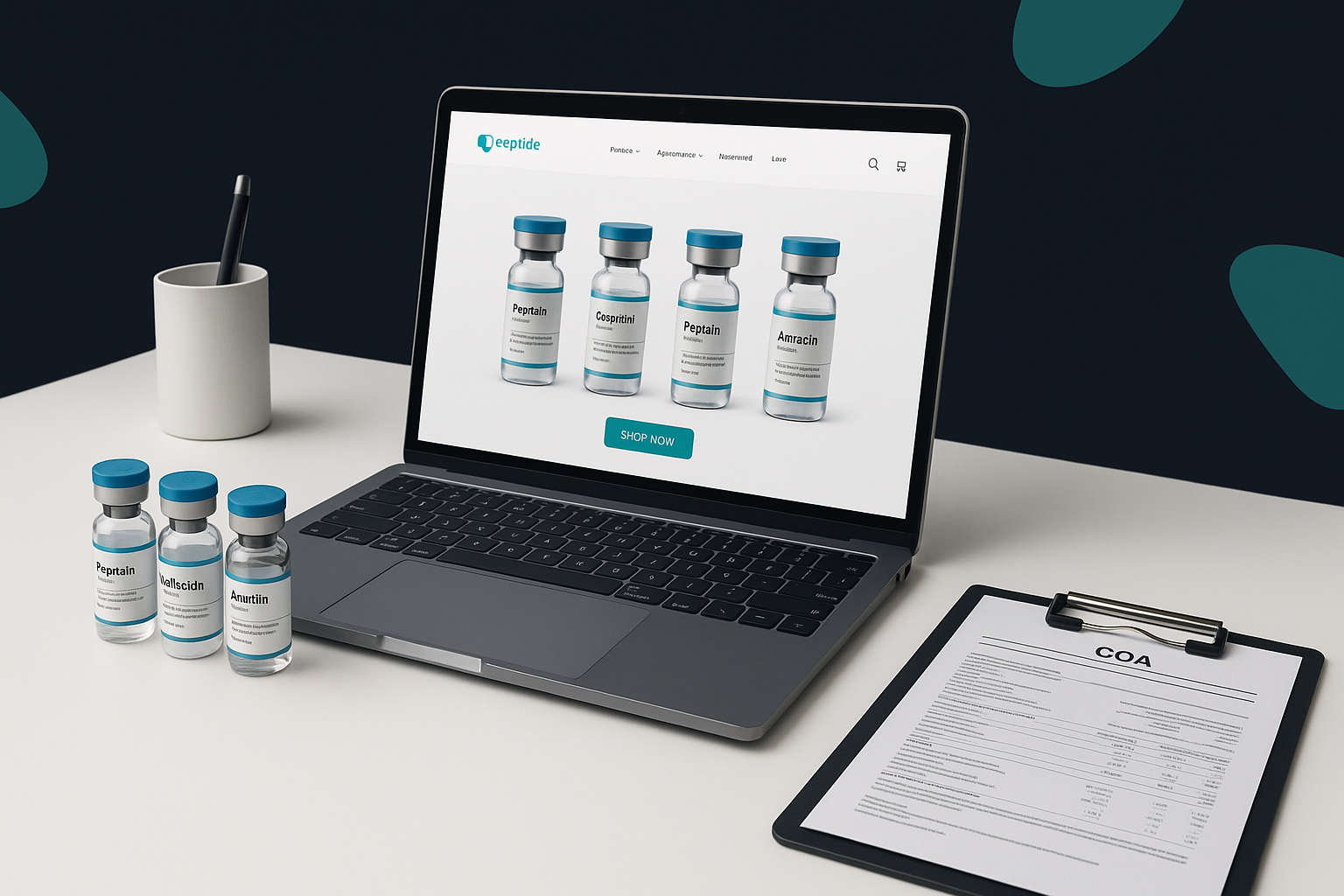
YourPeptideBrand (YPB) offers a white-label turnkey model for this business: entrepreneurs own their brand while YPB handles manufacturing, third-party testing, on-demand label printing, custom packaging, and dropship fulfillment with no minimum order quantities.
Step 1: Research the Market and Step 2: Form Your Business Entity
Market Research and Niche Selection
A February 2026 report from Grand View Research valued the global peptide therapeutics market at USD 140.86 billion in 2025, with North America holding a 61.99% share. That scale means demand exists across multiple channels, but the right entry point depends on your goals and risk tolerance.
Three primary business models dominate the space. The table below compares them by regulatory path, startup friction, and operational complexity.
| Business Model | Regulatory Path | Entry Barrier | Key Consideration |
|---|---|---|---|
| RUO Research Peptide Supplier (Dropship / White-Label) | Research-use-only labeling per 21 CFR 809.10; no therapeutic claims | Lowest | No MOQ, on-demand dropship, you own the brand and customer relationship |
| Compounded Peptide Clinic Model | Requires state pharmacy licensing and USP compliance | High | Significant capital and legal infrastructure; not viable for most startups |
| Cosmetic / Skincare Peptides | Falls under cosmetic regulations; different labeling and safety requirements | Moderate | Formulation, stability testing, and FDA registration for facilities |
The RUO white-label model offers the lowest barrier to entry because it removes manufacturing, inventory, and compliance heavy-lifting. For deeper niche analysis, see 12 Best Brand Niches for a Peptide Brand and How to Validate a Peptide Niche Before Launching.
Business Formation and Legal Basics
Once you have a niche, the next step is formalizing your business entity. An LLC is the most common structure for peptide entrepreneurs because it separates personal liability from business risk and is straightforward to set up. After forming the LLC, obtain an EIN from the IRS, open a dedicated business bank account, and register in any state where you have a physical presence or significant sales.
A November 2025 analysis from LumaLex Law notes that research-use-only peptide sellers may avoid compounding or pharmacy licensing if their products are marketed strictly for laboratory use. That distinction is critical: the moment your marketing implies human use, you cross into regulated territory.
| Category | Requirements |
|---|---|
| Federal | RUO labeling per 21 CFR 809.10; no therapeutic claims; strict labeling as laboratory reagents |
| State Considerations | Texas, Florida, and California each have distinct rules on research chemicals and laboratory supply sales |
| Operational Needs | High-risk merchant account (peptide sales are card-industry flagged); general business insurance |
For a deeper look at common pitfalls, read Top 8 Challenges When Creating a Research Peptide Brand and What You Need to Know Before Selling Peptides Online.
Ready to see the full product lineup? Download the complete catalog of 60+ third-party tested research peptides from YourPeptideBrand. Download the Catalog
Step 3: Select a White-Label Supplier
The right white-label partner determines how fast you launch and how credible your brand looks. Focus on features that directly impact your bottom line and compliance posture.

Feature 1: Third-Party COA on Every Batch
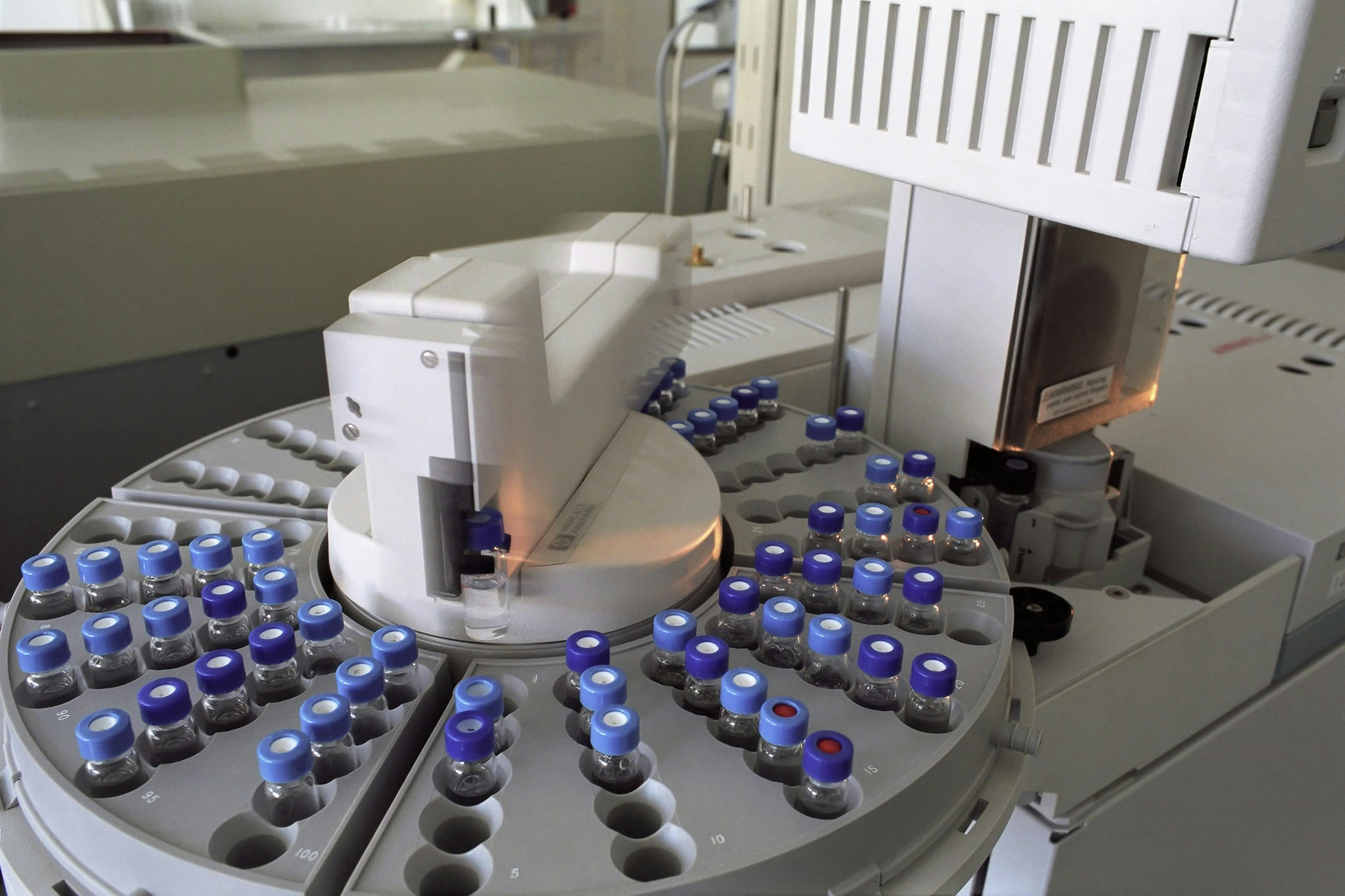
A Certificate of Analysis (COA) verifies the identity and purity of each research peptide batch through HPLC analysis. Without it, you are selling blind. This documentation is the only way to prove product integrity to your buyers and protect your brand.
Feature 2: No Minimum Order Quantities
Traditional suppliers force you to buy hundreds of vials upfront, locking your cash into inventory you might not move quickly. A supplier that offers no MOQ lets you order exactly what sells. This model eliminates warehousing costs and reduces financial risk.
Feature 3: Custom Labels and Dropshipping
The whole point of white labeling is putting your brand on the product. Your supplier should handle on-demand label printing and custom packaging. Direct dropshipping to your customers means you never touch the inventory. You own the brand and the customer list while the supplier handles fulfillment. Suppliers that force bulk minimums and require inventory storage limit your ability to test new products. YourPeptideBrand provides no-MOQ access to 60-plus research peptides with a COA on every batch and fast direct dropshipping. For a detailed launch timeline, see the White-Label Research Peptide Brand Launch Guide. When you are ready to scale, read Launching a New Product Line Under Your Peptide Brand. Research from Canesta confirms that independent branding and direct customer ownership are critical success factors in the current research peptide market.
Step 4: Understand Startup Costs and Set Your Pricing
Startup costs for a research peptide business vary widely depending on the model. A full-service peptide clinic (per Financial Models Lab, May 2026) can require roughly $746,000 in startup capital. In contrast, a white-label dropship RUO model has dramatically lower entry costs.
The low-barrier model reduces initial investment to just a few key items: LLC formation ($100-$800), domain registration and basic website hosting ($200-$500 per year), and a business license. There is no inventory cost because the supplier handles fulfillment, and no manufacturing overhead. This structure allows you to start selling almost immediately.
A major cost differentiator is the supplier’s minimum order policy. Many suppliers force bulk minimums that tie up thousands of dollars in inventory before you sell a single unit. YourPeptideBrand’s no-MOQ model eliminates that upfront inventory risk entirely. You order exactly what your customers buy, on demand.
For help estimating your potential margins, see our Profit Potential Guide. (A separate Profit Calculator is also available on the site.)
Ready to launch your own branded research peptide line with no minimums and no inventory risk? Book a call with YourPeptideBrand and we will walk you through the setup.
Step 5: Build Your Brand with Compliant Labeling
Every research peptide label must carry three non-negotiable elements: a prominent RUO statement, a unique lot number, and an expiration date based on stability data. A clear “Not for human consumption” warning must appear as well. These elements define the product’s legal classification as a research-use-only item, not a therapeutic agent.
YPB provides on-demand label printing with compliant artwork, so you can launch your brand without designing labels from scratch. Each batch receives custom labels that meet the required standards, with no minimum order quantities. This eliminates a common startup hurdle – sourcing compliant packaging in small runs.
Marketing boundaries are equally critical. Never include therapeutic claims, dosing protocols, or any language that implies human administration. Proper RUO classification prevents product misclassification, which can trigger regulatory issues. Stick to factual, research-oriented descriptions. For quality documentation, always use the COA Library to verify batch certificates for your own records and your buyers’ confidence.

The research peptide market continues to grow. A market report from Transparency Market Research notes expanding demand for peptide research compounds, underlining the opportunity for compliant brands. YPB handles the compliance details so you can focus on building your customer base.
Calculate your potential profit margins with YPB’s no-MOQ model using the Profit Calculator.
Step 6: Launch Your Online Store
Choosing the right platform matters. Shopify enforces an Acceptable Use Policy that bans research peptides, so a self-hosted solution like WordPress with WooCommerce is the standard. WooCommerce gives you full control over product pages, checkout flow, and content restrictions.
Key pages must include compliant product descriptions with a clear research-use-only statement, an age-verification gate (18+), a dedicated Terms and Conditions page, and a visible Certificate of Analysis (COA) for each batch. Payment processing is the next hurdle: mainstream processors like Stripe and Square routinely decline this category. You will need a high-risk merchant account, which typically requires a longer application and higher transaction fees.
YPB offers a turnkey store setup that handles the platform, compliant page templates, and payment integration. For more detail on web design, see Building a Professional Peptide Business Website and Best Platforms for Selling Research Peptides. A structured 30-day launch timeline is available in How to Launch Your Peptide Brand in 30 Days.
According to Fortune Business Insights, the peptide therapeutics market was valued at over $40 billion in 2023 and is projected to grow substantially through 2030, underscoring the demand that a properly set-up store can capture.
Frequently Asked Questions About Starting a Peptide Business
What is a research peptide business?
A research peptide business is a company that sources, labels, and distributes research peptides to laboratories, clinics, and qualified researchers under a Research Use Only (RUO) framework. YourPeptideBrand enables entrepreneurs to launch a white-label RUO peptide brand with custom packaging, on-demand dropshipping, and no minimum order quantities, while the member owns the brand and customer relationship.
What legal structure does a peptide business need?
Most peptide businesses operate as LLCs for liability protection. According to LumaLex Law (November 2025), research-use-only peptide sellers may avoid certain licensing if products are marketed strictly for laboratory use. However, proper RUO labeling, state-level registration, and compliance with federal misbranding statutes under 21 CFR Part 312 are required. Consulting a peptide business attorney is recommended.
How do I source research peptides from a supplier?
Entrepreneurs should partner with established white-label suppliers that provide third-party tested research peptides with Certificates of Analysis. YourPeptideBrand offers 60+ research-grade peptides, each batch tested for purity via HPLC and mass spectrometry. Key evaluation criteria include purity verification, batch consistency, cGMP-compliant manufacturing, and transparent COA documentation accessible in the COA Library.
What labeling is required for RUO peptide products?
Every vial must carry a clear ‘For Research Use Only’ statement, batch or lot number, expiration date, and warnings such as ‘Not for human consumption.’ According to the FDA’s regulatory framework for RUO products (21 CFR 809.10(c)(2)(i)), labeling must not imply therapeutic or diagnostic use. YourPeptideBrand provides on-demand label printing with compliant artwork verification for all branded products.
How do third-party COAs verify peptide quality?
Certificates of Analysis document purity percentage, peptide content, net weight, and testing methodology such as HPLC. Research published in the Journal of Peptide Science (2024) emphasizes that verified purity data is critical for reproducible in vitro and in vivo studies. YourPeptideBrand publishes COAs for every batch, accessible through the COA Library, covering 60+ research peptides with third-party testing.
What is the white-label peptide business model?
A white-label peptide business allows entrepreneurs to sell research peptides under their own brand name while a partner supplier handles manufacturing, quality testing, labeling, and fulfillment. YourPeptideBrand provides this turnkey model with zero inventory requirements, on-demand dropshipping, custom label printing, and no minimum order quantities allowing brands to start small and scale.
Do I need inventory to start a peptide business?
No. YourPeptideBrand’s dropship model eliminates inventory risk entirely. Members list products on their branded store, and orders are fulfilled on demand with custom labels and packaging applied per shipment. This compares to traditional suppliers that force bulk minimums and require capital tied up in inventory with limited shelf life and temperature-sensitive stability profiles.
How do peptide businesses set pricing and margins?
Brand owners set their own retail prices since they own the customer relationship. The Profit Calculator at YourPeptideBrand estimates potential margins based on product cost, chosen price points, and order volume. Factors include the white-label wholesale cost, market positioning, and target research buyer segment. Unlike suppliers with fixed price lists, YPB members control their pricing strategy.
Start Your Peptide Business Today
The research peptide market is growing at an 8.1% CAGR (Global Market Insights, 2024), and a turnkey white-label model is available with no minimum order quantities. This means you can launch your own brand quickly with zero upfront inventory. You own the customer relationship from day one. No wholesale commitments or minimums required – it is the most accessible way to enter the research peptide market.
Download the full product catalog to browse 60+ research-grade peptides with third-party COAs: Download Catalog. Ready to take the next step? Book a call with our team to discuss your brand.
Last updated: June 2026