
For research use only. Not for human consumption, diagnostic, or potential wellness benefit.
Every research peptide laboratory operates in a dynamic environment. Synthesis methods, analytical techniques, or storage conditions may need adjustment as new data emerges. Without a structured change management process, each modification risks variability that compromises data integrity and reproducibility.
According to Scott D. Hanton writing in Lab Manager (October 2023), labs benefit from documenting how to complete activities, especially those that are either very important or relatively common, and standard operating procedures (SOPs) are an excellent tool for this purpose. For multi-location clinic owners managing RUO research peptide inventories, implementing a formal change control system is the foundation of defensible science.
This guide explains how to document procedural changes without disrupting ongoing studies, covering change control SOPs, version management, protocol amendments, and audit-ready documentation.
Change management in peptide research methodology is the formal process of documenting, reviewing, approving, and implementing modifications to standard operating procedures (SOPs) or research protocols. It ensures that every procedural revision is traceable, justified, and communicated to all affected staff. This process applies to any modification – from reagent lot changes to equipment updates. The goal is to maintain data integrity and reproducibility across studies conducted at different times or locations.
As noted in a 2016 article published in PLOS Neglected Tropical Diseases, SOPs are written step-by-step instructions meant to ensure consistency, accuracy, and data quality in laboratory procedures. Without a structured change management process, even minor protocol changes can introduce variability that undermines study results. For clinics and entrepreneurs building a research peptide brand, formal change management protects the validity of your data and supports regulatory expectations. Learn more about documenting compliance efforts for legal protection.
How to Document Procedural Changes: The Change Control SOP
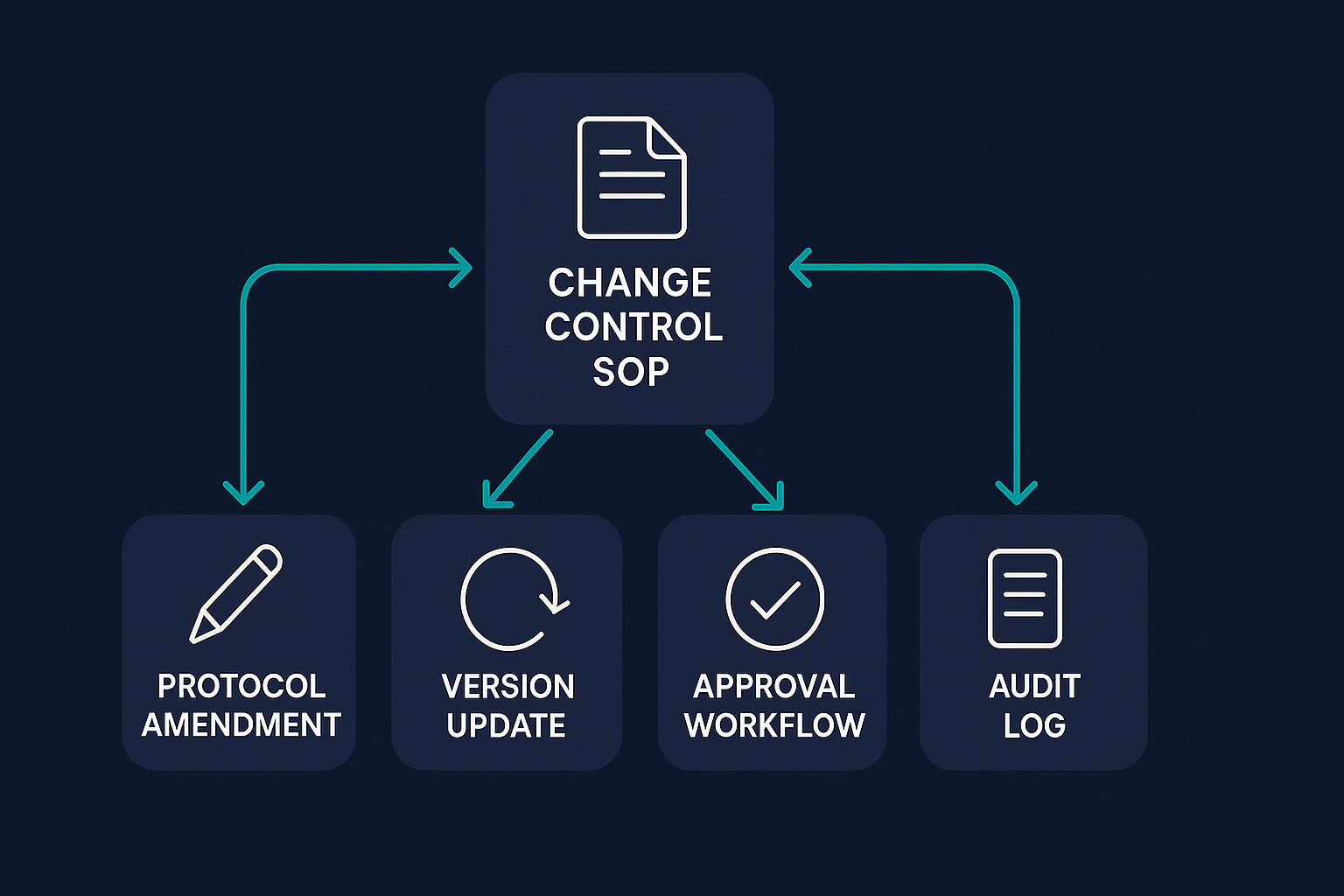
A change control SOP is the formal mechanism for documenting how research peptide protocols are modified, reviewed, approved, and recorded. It ensures every procedural change is traceable and does not compromise data integrity or reproducibility.
The typical process follows a defined sequence: submit a change request, assess the impact on data integrity and safety, obtain the required approvals, implement the change, and update all related documentation (protocols, batch records, labels). According to guidance from the Contract Pharma industry resource, change control is “a formal system by which qualified representatives review proposed or actual changes that might affect a validated status.”
Laboratories should use a standardized change request form that captures: the reason for the change, the sections or documents affected, an impact assessment, approval signatures, and the implementation date. This form becomes the permanent record of the decision-making process.
The level of review depends on the change’s scope. Minor changes (e.g., editorial corrections) may be approved by the principal investigator alone. Major changes that affect protocol design, analytical methods, or safety require full committee review and may necessitate revalidation, as outlined in the SimplerQMS guide on change control.
Minor vs Major Procedural Changes in Peptide Research
Not every procedural revision carries the same weight. The distinction between a minor and a major change determines who must approve it and what documentation is required. Misclassifying a change can stall a study or, worse, invalidate the data.
Minor changes are editorial or administrative revisions that do not materially affect the technical content or outcome of the research procedure. Correcting a typo in a buffer recipe or updating a vendor contact falls into this category. According to Washington State University’s SOP template, minor changes may be approved by the principal investigator (PI) alone, with a simple notation in the procedure log (Washington State University SOP template).
Major changes alter the method, analytical parameters, or safety controls. Switching from HPLC to LC-MS for purity analysis is a major change because it shifts the detection principle and may affect the Certificate of Analysis. These changes require full committee review, a documented impact assessment, and cross-functional approval. Every major change should trigger an updated version number and staff retraining. Without revalidation, the research cannot be compared to prior batches.
In peptide research, where batch-to-batch consistency matters for study reproducibility, the classification of a change is not a bureaucratic hurdle. It is a safeguard that keeps the data usable and the research defensible.
Version Control for Research Peptide SOPs
Version control turns a static research peptide SOP into a tracked, repeatable record. Every revision gets a formal number (v1.0, v1.1, v2.0) that indicates the type of change – minor edits bump the decimal, structural rewrites increment the whole number.
YourPeptideBrand’s published compliance-documentation guidance recommends auto-incremented version numbers embedded in file names, a standardized change-request form routed through an electronic approval workflow, and audit-ready logs that capture who approved what and when. Superseded versions must be archived but remain instantly retrievable – auditors check both the current and the replaced document.
The University of Utah SOP library states that every amendment must be logged with a version number, date, and author. A version-history table at the top of each SOP gives reviewers a quick reference for all changes – previous version, new version, date, author, and a brief description of the revision. That single table eliminates the need to page through a full document to understand what shifted and why.
Documentation Required When a Peptide Research Protocol Changes
When a research peptide protocol changes, the laboratory must retain a specific set of records to preserve the audit trail. This documentation proves the change was controlled, justified, and properly implemented.
The essential records include the original protocol (the superseded version), the approved change request form, the updated standard operating procedure (SOP) with version history, staff training records on the new procedure, and any revalidation data such as new standard curves or precision studies. Together, these documents demonstrate that the modification was reviewed and executed correctly.
As noted in the YPB laboratory compliance overview published March 2026, each SOP should include a signature block for the operator, a reviewer, and a periodic audit checklist. For multi-location operations, centralized digital storage ensures all sites can access the same documentation and version control remains consistent. You can read the YPB laboratory compliance overview for RUO peptides for additional details on SOP structure and audit procedures.
Maintaining this complete record set protects study integrity and supports regulatory inspection readiness. Every documentation step reinforces that the research peptide protocol change followed a defined, traceable process.
Managing SOP Changes Across Multi-Location Clinics
Multi-location research clinics face a specific risk: one site amends a protocol while another site runs the older version. The result is data that cannot be compared across sites, wasting time and resources. A centralized digital repository with role-based access controls solves this by enforcing a single source of truth for every document.
When a corporate-level protocol amendment is approved, the system pushes the updated SOP to every site simultaneously. Every researcher must acknowledge receipt, and an audit log captures exactly who has viewed and accepted the new version. This prevents the common problem of different locations running different versions of the same research protocol.
A centralized change log should document three elements: the date of distribution, confirmation of receipt from each location, and a deadline by which all personnel must complete retraining on the updated procedure. Without this structure, cross-site data integrity is at risk.
YourPeptideBrand’s white-label platform provides SOP templates, batch records, and labeling certifications that align with RUO guidelines, giving multi-site operations a head start on consistent documentation. For a deeper look at how RUO classification applies to supplier documentation, review the RUO classification for peptide suppliers.
The White-Label Opportunity for Research Documentation
Proper change management documentation is not just a lab necessity — it is a business asset for clinic owners and entrepreneurs launching their own research peptide brands. A documented change control system demonstrates rigorous quality controls and audit trails, reinforcing the Research Use Only designation.
YourPeptideBrand’s turnkey white-label solution includes on-demand label printing, custom packaging, and direct dropshipping with no minimum order quantities. This infrastructure lets you focus on building your brand while maintaining control over research protocols and documentation.
Unlike suppliers that force bulk minimums, YPB allows you to own the brand while maintaining full control over research protocols and documentation. Your operation can document every procedural change without the pressure of inventory commitments.
Each batch comes with a third-party Certificate of Analysis, and YPB’s SOP templates help you standardize procedures across your operation. For a deeper look at the regulatory landscape, get a complete breakdown of how the FDA regulates research peptides.
Integrating Certificates of Analysis and Quality Assurance into Change Management
When a research peptide protocol changes — for example, when a new supplier provides a batch — the corresponding Certificate of Analysis (COA) must be updated and linked to the revised standard operating procedure (SOP). This keeps every batch’s documented purity, identity, and potency data consistent with the current method.
The Certificate of Analysis library provides batch-specific analytical data that should be incorporated directly into change control documentation. Browse the YPB Certificate of Analysis library to see how purity, identity, and potency results are reported for each batch. For further detail, review YPB’s guide on quality assurance practices for RUO peptides to understand how QA integrates with version-controlled SOPs.
A change control log should reference the COA number for any affected batches. This creates a full traceability chain from the protocol change to the specific analytical parameters of each batch. If a protocol change alters how purity or identity is assessed, the historical COAs either remain valid or are clearly marked as superseded. This documentation chain allows researchers to quickly verify that any analytical shifts triggered by the protocol update have been accounted for. Understanding the role of Certificates of Analysis in peptide sales reinforces why this documentation is central to responsible change management.
Practical Research Guide: Implementing a Change Management Workflow
Step 1: Inventory current SOPs and assign version numbers. Start by listing every standard operating procedure (SOP) that governs research-peptide handling, storage, reconstitution, and data recording. Assign each SOP a unique version number (e.g., SOP-101 v2.1) so that any revision is traceable. A version history log helps the lab stay compliant with good laboratory practice (GLP) standards.
Step 2: Create a change request form template. Design a simple form that requires the requester to state the current procedure, the proposed change, the reason for the change, and the potential impact on research outcomes. A structured template reduces ambiguity and ensures every change is evaluated before implementation.
Step 3: Define approval authority levels (minor vs. major). Minor edits (e.g., wording clarification) can be approved by the lab manager. Major changes that affect research peptide purity testing, storage conditions, or data handling require sign-off from the principal investigator or the clinic’s compliance officer. This tiered system prevents bottlenecks while maintaining oversight.
Step 4: Establish a centralized digital repository with access controls. Store all SOPs, version histories, and approved change requests in a secure, searchable platform (e.g., a shared drive with read/write permissions). Restrict edit access to authorized personnel only. This keeps an audit trail and prevents unauthorized modifications.
Step 5: Implement a review cycle. Schedule an annual comprehensive review of every SOP to catch outdated language or procedures. Also allow ad hoc changes triggered by new research findings or equipment upgrades. Synchronize reviews with the version-numbering system so that each cycle produces a clear revision record.
Step 6: Train all staff on the new workflow and document training. Hold a brief session explaining the change request form, approval levels, and repository location. Require each staff member to sign a training record. Documentation of training is itself a SOP requirement and strengthens the traceability of procedural changes.
For a deeper understanding of what can go wrong, see common laboratory errors that compromise peptide research results. A robust change management workflow reduces variability and strengthens the RUO claim for your peptide brand, directly supporting the reproducibility that peer-reviewed methodology emphasizes (Nature reviews, 2022).
Frequently Asked Questions About Change Management in Peptide Research Methodology
What is a change control SOP in peptide research methodology?
A change control SOP is a formal standard operating procedure that defines how research peptide protocols are modified, reviewed, approved, and documented. As described in a 2016 article published in PLOS Neglected Tropical Diseases, SOPs are written step-by-step instructions meant to ensure consistency, accuracy, and data quality in laboratory procedures. In peptide research, a change control SOP prevents undocumented revisions that could compromise reproducibility.
How should protocol amendments be documented in a peptide research laboratory?
Protocol amendments should be documented using a standardized change request form that captures the reason for the change, the affected sections, the impact assessment, approval signatures, and the implementation date. According to guidance from the University of Utah’s Research Quality and Compliance office, every amendment must be logged with a version number, date, and author. The updated protocol should then be distributed to all affected staff with documented training.
What is the difference between minor and major procedural changes in peptide research?
Minor changes are editorial or administrative revisions that do not materially affect the technical content or outcome of the research procedure. Major changes alter the method, analytical parameters, or safety controls and require full committee review and revalidation. As outlined in Washington State University’s SOP template, minor changes may be approved by the PI alone, while major changes require documented impact assessments and cross-functional approval.
How does version control apply to research peptide SOPs?
Version control applies to research peptide SOPs through a formal numbering system (e.g., v1.0, v1.1, v2.0) that tracks every revision. YourPeptideBrand’s published guidance on compliance documentation recommends auto-incremented version numbers in file names, standardized change request forms routed through electronic approval workflows, and audit-ready logs that capture who approved what and when. Superseded versions must be archived but remain retrievable for audit purposes.
What documentation is required when a peptide research protocol changes?
When a peptide research protocol changes, laboratories should retain the original protocol, the approved change request form, the updated SOP with version history, staff training records on the new procedure, and any revalidation data. As noted in YPB’s laboratory compliance overview published March 2026, each SOP must include a signature block for the operator, a reviewer, and a periodic audit checklist. This documentation creates a complete audit trail.
How can multi-location clinics manage SOP changes across different research sites?
Multi-location clinics can manage SOP changes by using a centralized digital repository with role-based access controls. YourPeptideBrand’s white-label platform provides SOP templates, batch records, and labeling certifications that align with RUO guidelines. A single master document control system ensures that when a protocol amendment is approved at the corporate level, every site automatically receives the updated version with an audit log of who has reviewed it.
What does YourPeptideBrand provide to help with research documentation and change management?
YourPeptideBrand provides SOP templates, batch record frameworks, and compliance documentation tools designed for RUO peptide research. YPB’s turnkey white-label solution includes on-demand label printing, custom packaging, and direct dropshipping with no minimum order quantities. Each batch comes with a third-party Certificate of Analysis. The Profit Calculator at yourpeptidebrand.com/profit-calculator helps clinics model margins after implementing standardized documentation workflows.
How does proper change documentation support RUO compliance for peptide brands?
Proper change documentation demonstrates that a peptide brand maintains rigorous quality controls and audit trails, reinforcing the Research Use Only designation. Documented change control procedures show regulators that every protocol revision was reviewed, justified, and implemented under controlled conditions. YPB’s quality assurance framework, as described in its March 2026 guide on QA practices, embeds RU-only boundary language directly into SOPs to prevent inadvertent regulatory exposure.
Conclusion: Build a Defensible Research Peptide Brand with Structured Change Management
Structured change management protects the integrity of your peptide research and strengthens your RUO claim. When every procedural shift is logged and justified, your studies remain reproducible and your records hold up under scrutiny.
By implementing documented change control SOPs, version numbering, and audit trails, you ensure that every study across your lab or network follows the same rigorous path. Reproducibility is not just a scientific ideal; it is the foundation of credible research.
For clinic owners and entrepreneurs building a branded RUO business, this documentation is a competitive advantage, not a burden. It demonstrates rigor to partners, investors, and anyone reviewing your research protocols. A well-maintained change log signals that you take methodology seriously.
YourPeptideBrand supports your documentation workflow with no minimum order quantities, on-demand dropshipping, custom labels and packaging, third-party tested COAs on every batch, and SOP templates designed specifically for RUO research peptide operations. These tools let you focus on protocol integrity while YPB handles the supply chain.
Download the full YPB catalog of research peptides to see the 60+ research peptides available, then discuss your documentation needs and launch your branded peptide line.
Use the YPB Profit Calculator to model your peptide brand margins and see how standardized documentation workflows support your bottom line.
Ready to Launch Your White-Label Research Peptide Brand?
Book a free call with our team. We will walk you through pricing, setup, and your first order.
Last updated: June 2026