
For research use only. Not for human consumption, diagnostic, or potential wellness benefit.
The Cost of Uncontrolled Protocol Variation in Multi-Site Peptide Research
A clinic with three lab locations orders the same research peptide batch for an in vitro study. Two sites use slightly different reconstitution protocols. After three months, cross-site data sets are incomparable, and the study must restart. That is a textbook change management failure: a procedural variation that was never documented, approved, or communicated, wiping out weeks of work.
Published in January 2025, a Nature Communications study evaluating 20 LC-MS platforms found that laboratories using unified standard operating procedures with version control achieved research peptide identification rates 3 to 90 times higher than those without standardized protocols, while keeping retention time deviation under 0.2 minutes across 7-day runs. Procedural drift is not a minor inconvenience; it directly destroys data comparability and reproducibility.
This article offers a practical guide to implementing a formal change management system for research peptide methodology. Such a system preserves data integrity while allowing necessary procedural evolution, eliminating the costly surprise of discovering protocol drift after the data is collected.
What Is Change Management in Peptide Research Methodology?
Change management in peptide research methodology is a formal, documented system for reviewing, approving, and implementing procedural modifications in laboratory studies involving research peptides. It ensures that every alteration to protocols, equipment, or reagents is evaluated against established baselines, such as the purity and identity data captured in a Certificate of Analysis, before implementation. YourPeptideBrand provides the quality documentation infrastructure that anchors this process.
This structured approach contrasts with ad-hoc adjustments – verbal tweaks, undocumented substitutions, or unapproved lot changes – which introduce uncontrolled variables and risk data integrity. A formal framework, such as the one described in a change management framework published in MethodsX, provides the accountability needed for reproducible research. For a broader view of compliance prerequisites, see our RUO laboratory compliance overview.
Core Components of the Change Management Process
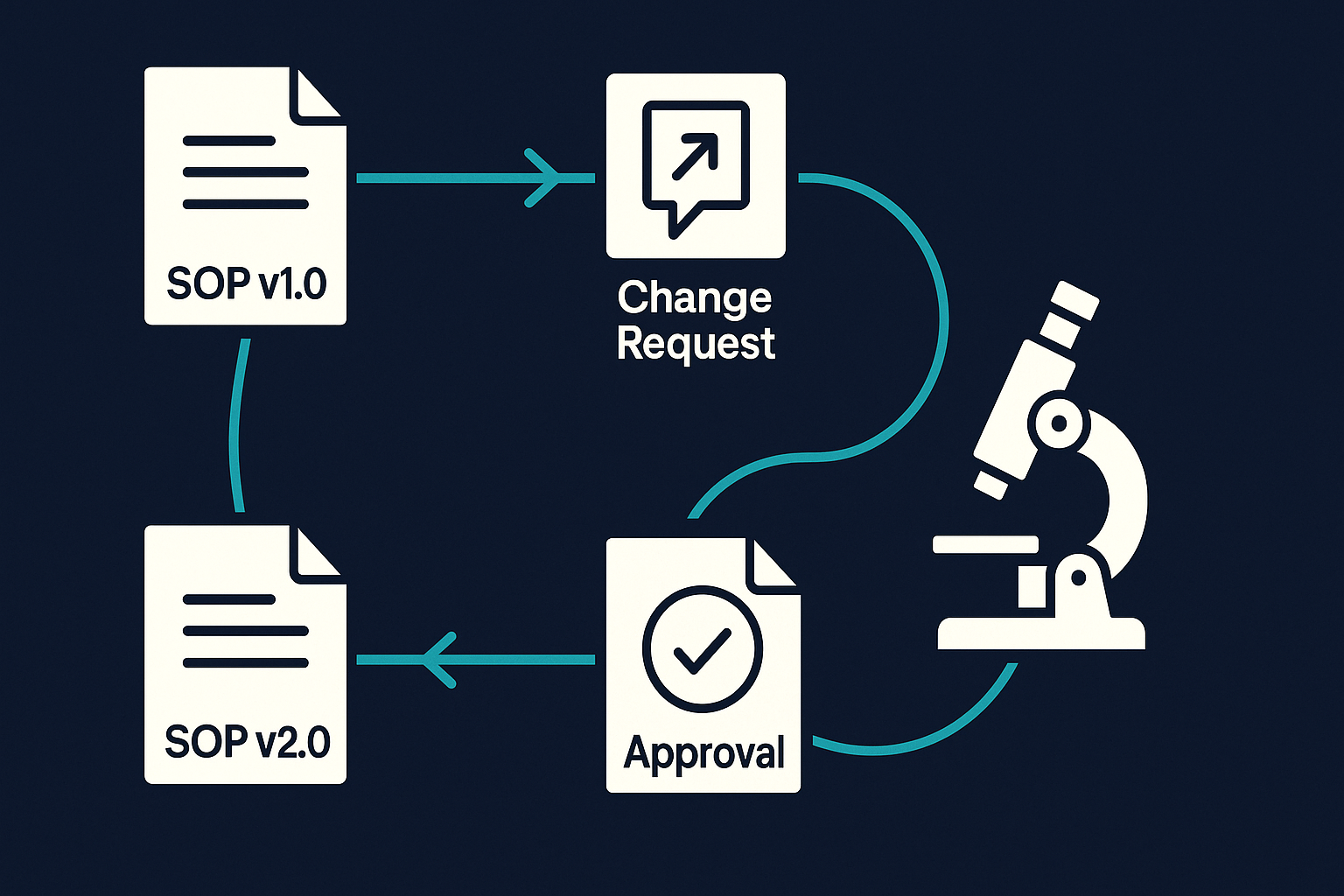
A structured change management process for research peptide studies typically follows five stages. First, Change Request Initiation, where a researcher submits a formal request describing the proposed modification. Second, Impact Assessment against the existing Certificate of Analysis (COA) baselines to evaluate potential effects on identity, purity, and stability. Third, Review and Approval by the quality management team, who determine whether the change is acceptable. Fourth, Controlled Implementation, including training verification for personnel involved. Fifth, Closure and Audit Log entry, ensuring all documentation is archived for traceability.
| Change Type | Example | Approval Threshold | Documentation Required |
|---|---|---|---|
| Minor | Reagent lot number update | Lab manager | Single form entry |
| Major | New LC-MS method | Quality director | Full change request with impact report |
Evidence from a published review of change management practices indicates that 59% of practitioners who applied a structured methodology achieved good or excellent effectiveness, compared to 26% without one (ProSci best practices research). The same literature reinforces that standard operating procedures for change control require documented approval chains and audit trails (BioPharm International). Applying these components systematically protects the integrity of research peptide studies.

Version Control and Document Management
Document control in research peptide studies follows a clear hierarchy: Quality Manual > Standard Operating Procedures (SOPs) > Work Instructions > Forms. Each level adds procedural detail, while the Quality Manual provides overarching policy. Version numbering uses a convention of v1.0 for initial release, v1.1 for minor edits, and v2.0 for major revisions. Every version requires approval signatures, an effective date, and assignment to a periodic review cycle.
The WHO Laboratory Quality Standards specify that SOPs undergo version control, review and approval, distribution and implementation, update and revision, and archiving of superseded versions. This framework ensures all research peptide procedures remain traceable and current (PMC SOP guidelines).
| System | Core Function | Best For |
|---|---|---|
| LIMS | Sample and data management | High-throughput labs tracking specimen history |
| QMS | Process and compliance oversight | Multi-site operations requiring centralized SOP approval |
| ELN | Digital experiment notebook | R&D teams needing real-time procedure updates |
For efficient version management, integrate batch tracking best practices for research peptides and tiered access for multi-team lab management into your document control workflow.

Download the full catalog to see all available research peptides for your lab. Get the catalog.
The White-Label Opportunity – Why Change Management Matters for Your Brand
Institutional buyers – hospital research departments, contract research organizations (CROs), and university labs – do not place bulk orders on trust alone. They require documented proof of procedural consistency before signing a purchase agreement. A robust change management system signals reliability and reduces audit friction, turning a compliance requirement into a competitive advantage.
Suppliers that force bulk minimums often provide no quality documentation infrastructure, leaving buyers to guess whether each batch meets the same specification. YourPeptideBrand’s no-minimum-order-quantity model and on-demand dropshipping mean clinic owners can build this documentation system and test procedural changes on small-batch orders before scaling. Every YPB batch comes with a third-party COA that feeds directly into the lab’s change control baseline.
For a deeper look at how to structure your own quality documentation framework, read our guide on building a compliance review process for research content. The same principles that govern marketing copy apply to batch documentation: traceability, version control, and audit-readiness.
Building a Change Management SOP for Your Lab
A change management SOP governs all research peptide handling, storage, preparation, and analysis procedures. Its scope must be broad enough to cover every step where a protocol could shift.
Every effective laboratory SOP, including this one, should include these sections: purpose, scope, definitions, responsibilities, materials, procedure, safety, documentation, references, and appendices (as recommended in the Lab Manager guide on writing effective laboratory SOPs). The approval workflow is simple: the author drafts, the quality manager reviews, and the lab director approves.
Before any personnel perform the revised procedure, training verification must be completed. All team members must be trained on the latest version of the SOP before they are authorized to execute it.
Sample template header structure for a change management SOP:
- 1. Purpose
- 2. Scope
- 3. Definitions
- 4. Responsibilities
- 5. Change Request Procedure
- 6. Approval Workflow
- 7. Training Verification
- 8. Safety Considerations
- 9. Documentation Requirements
- 10. References
- 11. Appendices

This SOP is your central process for managing all procedural changes. For guidance on how these records support your legal position, see our article on documenting compliance efforts for legal protection.
COA / Quality – The Baseline Anchor for Change Control
Every procedural change in a research workflow needs a reference point. The Certificate of Analysis (COA) serves as that anchor, documenting the established purity, identity, and potency specifications for each batch of a research peptide. Without this baseline, a method adjustment could introduce unacceptable variability or a fundamental deviation that goes undetected.
A 2025 multicenter benchmark study published in Nature Communications found that standardized LC-MS workflows combined with unified quality control protocols produced significantly more reproducible peptide quantification across eight independent sites (Nature Communications, 2025). This reinforces why researchers should evaluate any procedural change against the COA specifications rather than relying on memory or fragmented records.
YourPeptideBrand’s Certificate of Analysis Library provides a searchable repository for all batch-specific purity, identity, and potency data. Using a centralized COA repository allows researchers to quickly retrieve historical specifications when reviewing a proposed change. For broader context on the regulatory framework, see our article on FDA RUO classification for peptide suppliers.
Ready to discuss how your change control documentation can anchor to verified quality data? Book a call with YourPeptideBrand to see how our COA Library supports reproducible research workflows.
Research Guide – Evidence Supporting Structured Change Control
Research published in a 2025 issue of Nature Communications found that implementing a unified standard operating procedure across 20 LC-MS platforms dramatically improved cross-platform peptide identification rates and retention time consistency. The study highlights how version-controlled SOPs reduce inter-lab variability and increase reproducibility in research peptide analysis.
Project Management Institute data cited in 2024 benchmarking research indicates that organizations using formal change management methodologies are 67% more likely to meet project objectives. This aligns with findings from a 2025 multicenter study in Nature Communications, where data-independent acquisition (DIA) outperformed data-dependent acquisition (DDA) across standardized workflows at eight sites — showing that method standardization directly affects data quality in peptide research settings.
A review published in the ACS Journal of Proteome Research (harmonization study) demonstrated that harmonized protocols across multiple laboratories improved data consistency and reduced technical variance. Additionally, a PMC review on SOPs in laboratory quality management systems emphasized that well-structured SOPs connect directly to personnel training, equipment calibration, procurement, process control, biosafety, and corrective actions — forming the backbone of a reproducible research workflow.
For a broader look at how analytics are reshaping peptide research, see our article on data-driven research in peptide science.
Estimate your cost and revenue projections with our Profit Calculator. See how structured research workflows translate into better operational planning.
Frequently Asked Questions About Change Management in Peptide Research Methodology
What is change management in peptide research methodology?
Change management in research peptide methodology refers to a structured process for documenting, reviewing, approving, and implementing any modification to protocols, equipment, reagents, or procedures used in studies involving research peptides. It ensures that every alteration is recorded with a rationale, date, and authorization, creating an audit trail that protects data integrity. For RUO work, this rigor is critical because even small changes in handling or storage can affect research outcomes. A formal change management system reduces uncontrolled variation, supports reproducibility, and demonstrates compliance with good laboratory practice standards.
Why is version control important for research peptide SOPs?
Version control prevents staff from accidentally following outdated procedures and ensures that all researchers use the same instructions at the same time. Each SOP version is numbered and dated, and changes between versions are clearly marked. In peptide research, where buffer composition, incubation times, or storage conditions can be critical, a single outdated instruction can compromise weeks of work. Version control also creates a historical record that explains why a change was made, which is valuable during audits or when troubleshooting unexpected results.
What is a Certificate of Analysis baseline in change management?
A Certificate of Analysis (COA) baseline is a reference record of the purity, identity, and concentration data for a specific lot of a research peptide as tested by the supplier. When a change occurs – such as switching to a new synthesis method or a different supplier – the new lot’s COA is compared against the baseline to confirm equivalency. This comparison ensures that the change does not introduce uncontrolled variables that could alter experimental outcomes. Establishing a COA baseline is a standard step in change control for research peptide studies because it ties material quality directly to procedural modifications.
How do change control SOPs improve research reproducibility?
Change control SOPs create a formal pathway for evaluating, approving, and implementing any alteration before it affects active studies. By requiring a documented risk assessment and a clear rationale, they reduce the chance of ad-hoc changes that introduce hidden variability. Reproducibility suffers when different researchers unknowingly use different reagent lots, incubation times, or equipment settings. A change control SOP tracks these variables across time and teams, making it possible to trace which conditions produced which results. This traceability is foundational for publishing and for internal replication checks.
What role does training documentation play in change management?
Training documentation records which personnel have been instructed on a procedure change, when the training occurred, and what content was covered. It closes the loop between the decision to change and the actual execution in the lab. Without verified training, even a perfectly documented SOP can be misapplied. In research peptide studies, where protocols often involve delicate steps like reconstitution or dilution, training records ensure that every team member executes the same steps consistently. This documentation also satisfies institutional and due-diligence requirements for RUO operations.
How can clinic owners implement change management without disrupting studies?
Clinic owners can implement change management by adopting a phased approach: first, document existing procedures as a baseline; second, introduce a simple change request form for any modification; third, schedule changes between study phases rather than mid-batch. Using small-test batches from a supplier with no minimum order quantities reduces the risk of disrupting a large study. YourPeptideBrand allows ordering single units of any of its 60+ research peptides, so a clinic can trial a new lot or procedure change on a small scale before committing to a full study. The key is to start with low-impact changes and build the documentation habit gradually.
What differentiates YourPeptideBrand’s approach to research documentation?
YourPeptideBrand provides a Certificate of Analysis on every batch of every research peptide, giving clients a documented quality baseline for change management. The on-demand dropship model – with no minimum order quantity and custom labeling – means that clients can order exactly the batch size they need for a validation run. This flexibility lets researchers implement a test batch under a new SOP without committing to bulk inventory. The 60+ SKU catalog covers a wide range of research peptides, and each batch’s COA is accessible through the online COA library, making it straightforward to incorporate supplier documentation into internal change records.
How does documented change control support institutional sales?
Institutional buyers – universities, contract research organizations, and hospital research centers – require auditable documentation of every reagent used in their studies. A documented change control process that includes batch-specific Certificates of Analysis, lot traceability, and clear version histories meets those institutional procurement standards. YourPeptideBrand’s COA on every batch and its no-MOQ ordering structure allow a clinic or entrepreneur to present a complete documentation package when bidding for institutional contracts. The Profit Calculator at https://yourpeptidebrand.com/profit-calculator/ helps model pricing that accounts for the added documentation overhead and still delivers margin.
Launch Your Compliant Research Peptide Brand Today
Change management is the backbone of reproducible research peptide studies. A documented system protects data integrity, satisfies institutional buyers, and gives clinic owners a competitive edge.
For clinic owners and entrepreneurs: own your RUO brand with no minimum order quantities, on-demand dropshipping, custom labels, and a third-party COA on every batch. Run the numbers in the Profit Calculator, then speak with a specialist to launch your brand.
Speak with a YPB compliance specialist to discuss your custom research peptide line today.
Last updated: July 2026