For research use only. Not for human consumption, diagnostic, or potential wellness benefit.
How to Build an MVP Peptide Brand: Launch Lean, Test Fast, Scale Smart
Traditional product-line launches demand months of supplier vetting, custom manufacturing runs, and six-figure inventory commitments. The white-label MVP model rewrites that equation entirely. Instead of front-loading capital, you test demand with a branded storefront and fulfill orders on demand.
According to Grand View Research (2025), the global peptide therapeutics market was valued at $140.9 billion and is projected to grow at an 8.7% compound annual growth rate through 2033. Most entrepreneurs assume that capturing a piece of this growth requires a large upfront investment. But the Minimum Viable Product approach from Eric Ries’s The Lean Startup applies directly to the research peptide space: start with the smallest possible offering, measure customer response, and iterate.
YourPeptideBrand’s no-minimum-order-quantity white-label model provides the infrastructure to execute that MVP strategy. You can select from 60+ third-party tested research peptides, customize labels and packaging, and offer direct dropshipping – all without carrying inventory. This model lets you how to start a research peptide brand while keeping your financial risk near zero.
The thesis of this guide is straightforward: you can launch a branded research peptide site with minimal capital, validate real demand, and scale based on data – not guesses. The following steps show exactly how to how to launch your peptide brand in 30 days, using lean principles that avoid the traps of over-investment before proof. You own the brand and the customer relationship from day one.
What Is an MVP Peptide Brand?
An MVP (Minimum Viable Product) peptide brand is the leanest commercially viable version of a white-label research peptide business. It includes a branded storefront, a curated selection of research peptides, compliant RUO labeling, and a dropship fulfillment arrangement – all launched with zero inventory investment. YourPeptideBrand enables this through on-demand manufacturing with no minimum order quantities.
The Minimum Viable Product concept, popularized by Eric Ries in 2011, applies directly to ecommerce brands. A minimum viable brand includes the essentials: a logo, a color palette, compliant product pages, and 5 – 10 SKUs. You test the market with the smallest offering that can generate real sales and feedback before committing to a full catalog.
Traditional private-label research peptide launches operate differently. Typical suppliers require a minimum of 500 – 1,000 units per SKU and upfront startup costs between $10,000 and $50,000, according to Shopify’s minimum viable brand guide and 99designs’ MVP brand definition. That level of investment locks you into a large inventory before you know what actually sells.
An MVP approach flips the order. You validate demand, refine your positioning, and then scale – all without tying up capital in boxes of vials. The RUO labeling and third-party testing still apply, but you launch lean and grow based on real orders, not projections.
The Lean Launch Framework for Research Peptide Brands
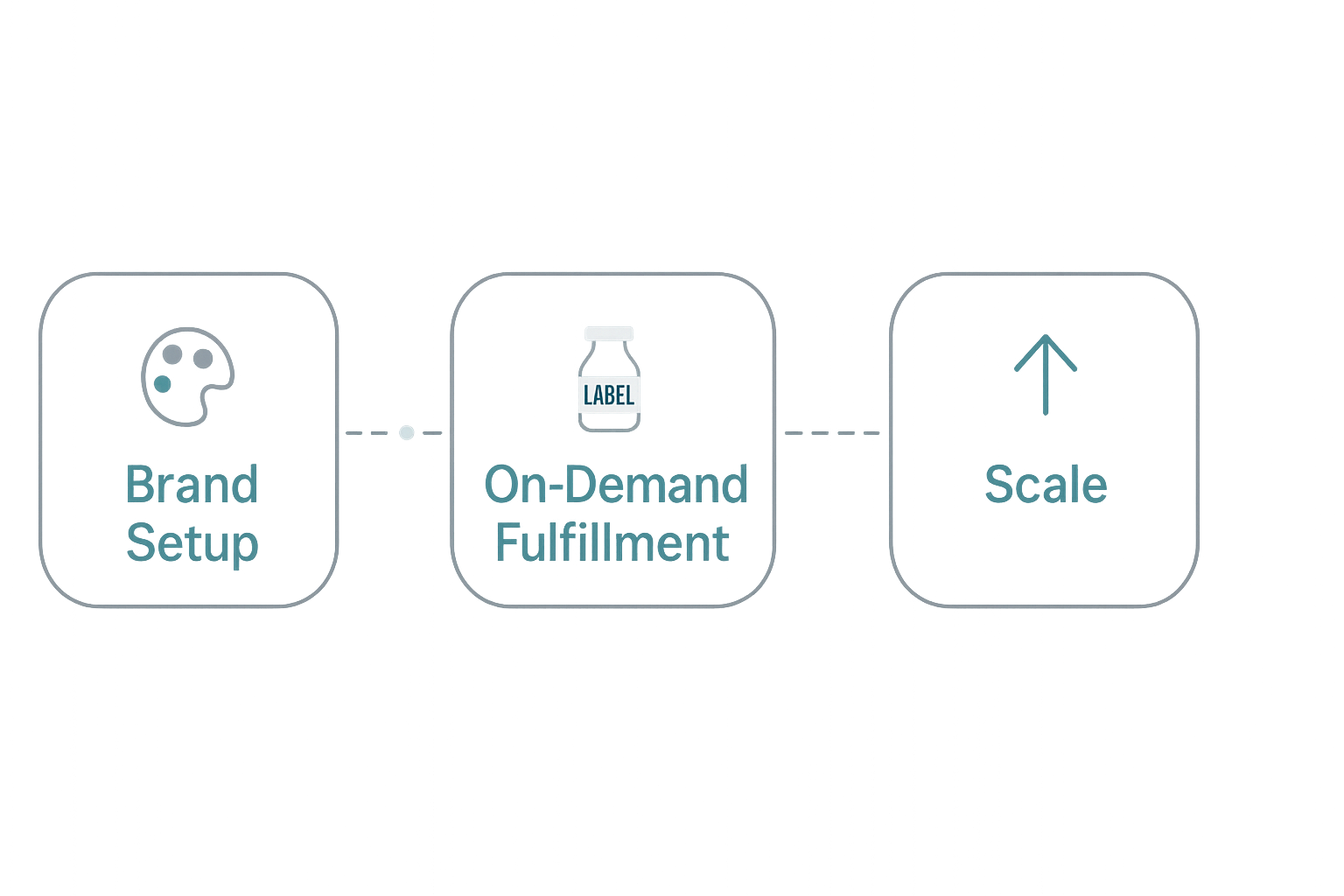
A lean launch applies the build-measure-learn loop to a research peptide brand. The goal is to get a minimal viable product into the market quickly, test demand, and iterate based on real data instead of assumptions.
Build. Start by selecting a niche – for example, recovery-focused or longevity-focused research peptides. Create a simple storefront with five to ten research peptides from YourPeptideBrand’s 60-plus SKU catalog. The catalog’s breadth lets you test multiple compounds without committing to a full line.
Measure. Track conversion rates per compound, cost per acquisition, and average order value. These numbers reveal which research peptides generate consistent orders and which attract browsers but no sales. Measure daily during the first month to catch trends early.
Learn. Double down on top-performing research peptides and phase out underperformers. The lean loop only works if you can act on the data. YourPeptideBrand’s no-minimum-order-quantity model makes this viable – you can discontinue a research peptide without losing inventory investment or sitting on bulk product that no longer sells.
This framework keeps capital light and decision-making fast. By running a few compounds, measuring response, and adjusting every two to four weeks, a new brand builds a catalog that actually matches market demand before scaling up.
Why the Research Peptide Market Rewards Lean Entry
Global Market Insights (2025) projects the peptide therapeutics market will reach $100 billion by 2034 at an 8.1% CAGR, driven by expanding applications in research workflows. Meanwhile, the peptide synthesis market — the supply side that produces the actual molecules — is also accelerating. Straits Research (2024) values peptide synthesis at $961.5 million in 2024 and expects it to grow to $1.84 billion by 2033. These growth rates signal sustained demand for research peptides from laboratories and academic institutions.
The supplier landscape for research peptides remains fragmented. Few companies dominate; most are either broad-line suppliers or specialists with high minimum orders. This fragmentation creates openings for new branded entrants. By targeting a specific research niche — for example, a particular category of research peptides used in in vitro studies — a lean entrant can capture a focused customer base without competing head-on with every established supplier.
Low barriers to entry through white-label manufacturing and dropshipping mean a new brand can start with virtually no inventory. This lean approach lets entrepreneurs test multiple research peptide categories before scaling production. Before committing to a product line, you can run a structured process to validate a peptide niche before launching — ensuring real research demand exists and the competitive space allows a new supplier to capture a segment quickly. Lean entry is not just about low upfront cost; it is about smart market positioning that aligns with where the research peptide market is heading.
Download Our Full 60+ SKU Catalog
White-label research peptides, wholesale pricing, and dropshipping details.
Why White-Label Is the Ideal MVP Infrastructure for Research Peptide Brands
A traditional product launch for a supplement line historically demanded 9 to 18 months. The practitioner’s guide to launching a white-label research peptide brand notes that building your own supplement line a decade ago required a six-figure capital commitment. The white-label research peptide model compresses that timeline to 2 to 4 weeks. You skip formulation, facility setup, and regulatory paperwork at the source. Instead, you select from an existing catalog of third-party tested research peptides and go straight to branding.
Three structural advantages make white-label the leanest infrastructure for an MVP brand.
No manufacturing overhead. You never buy equipment, lease clean rooms, or hire chemists. White-label partners handle production and testing. Your capital goes to brand assets and customer acquisition instead of physical plant.
On-demand label printing eliminates waste. Traditional private label forces you to order thousands of pre-printed bottles. If a label changes, you scrap inventory. On-demand printing lets you order small runs or single units, update labels instantly, and test different messaging without sunk cost.
Dropship fulfillment removes warehousing. A white-label drop-ship model means the supplier packs and ships directly to your researcher customers. You never manage storage, pick lists, or shipping carriers. This removes the biggest operational barrier for a solo founder or small clinic owner.
Together these three factors let you validate product demand before scaling. You can test a research peptide for three months with a handful of B2B customers, then expand based on real demand signals. For the full framework, read the practitioners guide to launching a white-label research peptide brand and the step-by-step how to launch a white-label research peptide brand in 30 days post. Once you have product-market fit, refine your story with peptide branding and positioning strategies.
For a broader overview of the private-label model, see the BlueCart private label overview.
Zero Inventory Risk: The No-MOQ Advantage
Many research-peptide suppliers require bulk minimums of 100 to 1,000 vials per SKU before they will print a custom label. That forces a startup to tie up thousands of dollars in product before a single unit sells. In other private-label categories, a minimal launch typically runs $2,500 to $10,000. For supplement and research-grade products, compliance costs push that number to $10,000 to $30,000, according to BigCommerce 2026 research on private-label startup costs (BigCommerce 2026).
YourPeptideBrand eliminates those barriers entirely. You can order one vial of a research peptide under your own brand label, or a thousand. There is no minimum order quantity. The dropship model means you never handle or store inventory. YourPeptideBrand prints your custom label, packs the order, and ships directly to your research client. You own the brand and the customer relationship without risking a dollar of inventory capital.
That zero-inventory approach lets you test multiple research peptides, adjust your catalog based on real demand, and scale only when orders come in. You avoid the cash-flow burden that buries most early-stage brand launches.
Ready to Launch Your White-Label Research Peptide Brand?
Book a free call with our team. We will walk you through pricing, setup, and your first order.
How Quality Documentation Protects Your MVP Brand
Every research peptide sold under your own brand must be accompanied by a Certificate of Analysis. This document verifies identity, purity, and concentration from an independent laboratory. For an MVP brand that hasn’t yet built a reputation, that piece of paper is the fastest way to establish credibility with research buyers.
Third-party testing removes guesswork from the supply chain. Buyers evaluating a new brand will check for documentation before placing an order. If you provide a clear, batch-specific COA, you answer the question “Is this real?” before they have to ask. YourPeptideBrand supplies a third-party Certificate of Analysis for every batch, accessible through the COA Library.
Documentation also protects you operationally. If a lab researcher questions a result, you can pull the exact COA and trace the batch. That closed loop reduces disputes and builds trust with repeat buyers. For a lean operation, this quality documentation acts as a repeatable trust signal that scales without requiring a dedicated quality team.
Your 4-Week MVP Peptide Brand Launch Roadmap
A focused four-week plan gets a research peptide brand to market with minimal overhead. Each phase builds on the previous one, from niche selection to live storefront.
| Week | Phase | Actions |
|---|---|---|
| Week 1 | Niche & Brand | Choose target market, register domain, create brand name and logo. |
| Week 2 | Storefront & Compliance | Set up ecommerce platform, write RUO-compliant product copy, configure payment processing. |
| Week 3 | Product Selection & Labeling | Select 5 – 10 research peptides from YourPeptideBrand catalog, design custom labels, order samples. |
| Week 4 | Launch & Measure | Go live, drive traffic through educational content, track conversion data. |
Each week includes specific deliverables that reduce guesswork. During Week 1, choose a niche where demand exists; a guide on finding best-selling private label products can help identify market opportunities. For a broader strategy, read how to write a business plan for your peptide brand before you start.
Week 2 focuses on compliance: ensure every product page displays the required RUO disclaimer. For platform selection, see the best platforms for selling research peptides to match your technical comfort and budget.
Week 3 involves selecting 5 – 10 research peptides from the YPB catalog and designing custom labels. Use the sample order to verify print quality and product packaging before launch. Week 4 is about going live and measuring what works: traffic sources, conversion rates, and cost per acquisition.
Calculate Your White-Label Margins
See exactly how much margin you can make at your price point.
Frequently Asked Questions About MVP Peptide Brands
What is an MVP peptide brand, and how does it differ from a full-scale launch?
An MVP (Minimum Viable Product) peptide brand is a lean, tested version of a research peptide business launched with a small catalog and minimal upfront cost. It allows you to validate demand, refine labeling and packaging, and collect feedback before committing to larger inventory. In contrast, a full-scale launch typically requires bulk minimums, heavy stock, and more capital. An MVP approach reduces risk and speeds time-to-market.
What does "research use only" (RUO) mean for research peptides?
"Research use only" is a labeling standard that designates research peptides exclusively for laboratory or in vitro/in vivo studies. They are not intended for human consumption, diagnostic, or therapeutic applications. Suppliers like YourPeptideBrand apply this label to every product to ensure compliance with relevant regulations. For an MVP brand, this labeling is a foundational requirement that must appear on all packaging and marketing materials.
How important is third-party testing and a Certificate of Analysis (COA) for an MVP brand?
Third-party testing with a COA is essential for any legitimate research peptide brand. It provides independent verification of purity and identity, which builds trust with researchers and clinic owners. For an MVP brand, offering a COA on every batch demonstrates quality commitment without needing a large internal QA lab. YourPeptideBrand provides a COA for each batch of every research peptide in its 60+ SKU catalog, allowing you to include verified documentation in your own brand packaging.
Which research peptides are most commonly included in an MVP catalog?
MVP catalogs typically feature a lean but market-proven selection of the most frequently requested research peptides, such as those studied for cellular repair, metabolic pathways, or immune response. Common choices include BPC-157, TB-500, MOTS-c, and several collagen-related sequences. Starting with 5 – 10 high-demand SKUs allows you to test market interest without overcomplicating operations. YourPeptideBrand's full catalog of over 60 options lets you easily expand as your brand grows.
How can one ensure the quality of research peptides without a large upfront investment?
Work with a supplier that provides third-party testing and a COA on every batch. Many suppliers, including YourPeptideBrand, offer no-minimum-order-quantity (no-MOQ) access to the same tested inventory used by larger buyers. This means you get verified purity and identity at the unit level without pre-paying for a full production run. Additionally, on-demand dropshipping eliminates the need to warehouse stock, preserving capital while maintaining quality control.
What are the key cost differences between launching lean with a supplier like YourPeptideBrand versus traditional bulk ordering?
Traditional bulk orders often require a minimum of hundreds of vials per SKU, tying up capital in inventory that may not sell quickly. With a no-MOQ supplier like YourPeptideBrand, you order only what you need, when you need it. Dropshipping means you avoid warehousing and shipping costs. Custom labels and packaging are available per order, so you pay for branding only when you sell. The profit calculator on YourPeptideBrand's site helps you model costs and margins without committing funds.
How does the dropshipping model work for an MVP peptide brand?
Dropshipping with YourPeptideBrand means you create your own brand label and packaging design. When a customer places an order on your site, you forward it to YPB. YPB prints your custom label, packs the order in your branded packaging, and ships it directly to the researcher or clinic. You never handle the inventory. This model allows you to launch an MVP brand with no stock, no warehouse, and no upfront shipping logistics, keeping your cash flow lean.
Can I scale my MVP brand without additional inventory commitments?
Yes, because YourPeptideBrand's no-MOQ and on-demand dropship model scales with your sales. As demand grows, you simply place larger orders at the same per-unit pricing, with no need to pre-purchase bulk inventory. Your catalog can expand from the 60+ available research peptides, and you can add new SKUs at any time without risk. Custom labels and packaging are always available per order, so you maintain brand consistency while keeping inventory exposure to zero.
Launch Your MVP Research Peptide Brand Today
The MVP approach works because it starts small: choose 5-10 research peptides that match early demand, test with minimal capital, and grow based on real order data. You do not need a warehouse, pre-printed labels, or bulk inventory. YourPeptideBrand provides the turnkey infrastructure – no minimum order quantities, on-demand dropshipping, and compliant labeling – so you can launch a branded line without upfront risk. Once orders confirm the model, you scale by adding more research peptides and optimizing your product mix based on what sells.
If you are ready to own your branded research peptide line, start by downloading the catalog and using the Profit Calculator to model your margins. Both tools are free and take less than five minutes to run.
Ready to Launch Your White-Label Research Peptide Brand?
Book a free call with our team. We will walk you through pricing, setup, and your first order.
Last updated: July 2026