
For research use only. Not for human consumption, diagnostic, or potential wellness benefit.
How to Plan a Smooth Brand Transition for Existing Customers
A brand transition is one of the highest-stakes moves a white-label research peptide entrepreneur can make. Get it wrong, and you lose the loyalty built over years. Get it right, and you strengthen your market position without missing a beat.
The numbers are sobering: according to a Nielsen study cited by Pivitt (2025), 40% of rebranding campaigns fail to deliver a positive ROI. Even when the visual identity improves, traffic often takes a hit. A 2025 retail benchmark report from Ainvest found that 10-20% of sites see a noticeable dip in traffic within six months post-rebrand.
The good news: a well-planned transition preserves customer loyalty while strengthening brand equity. Customers who already trust your research peptide product line and your service remain the core of your business. Messaging them clearly about what is changing and what stays the same keeps that trust intact.
This guide provides a 5-step framework for a smooth brand transition. Each step focuses on the scientific literature indicates, from early announcement to final launch, so you protect the relationships that matter most.
What Is a Brand Transition for a Research Peptide Business?
A brand transition is a deliberate, phased evolution of a research peptide brand's visual identity, messaging, and market positioning. It refreshes specific elements without discarding the brand equity, customer trust, or compliance documentation built over time. Unlike a full rebrand, a transition keeps the core identity intact.
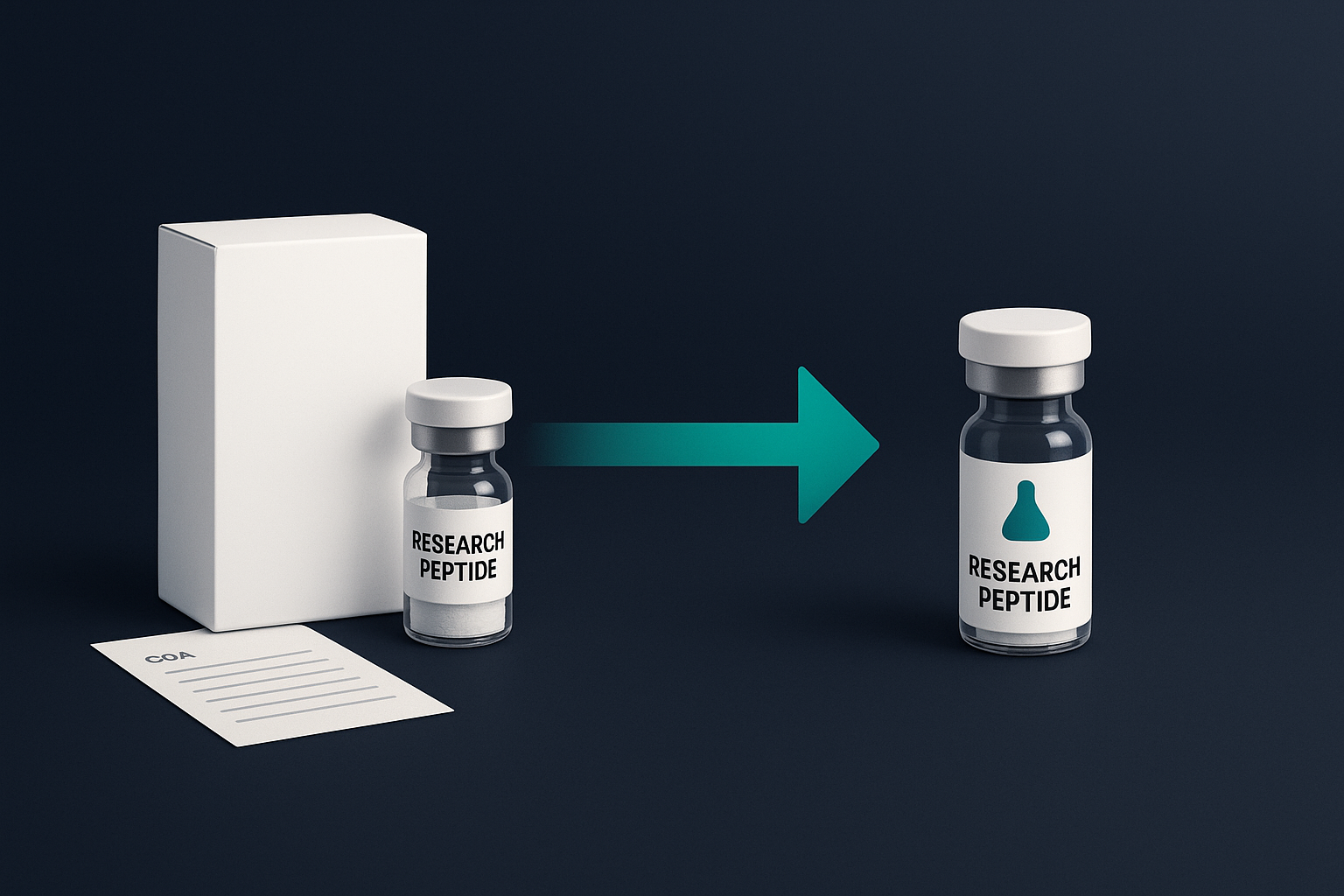
For a research peptide business, a brand transition typically targets customer-facing touchpoints. Logo updates, redesigned labels, new packaging materials, and a refreshed website are common changes. Each update is implemented in stages, not all at once, to avoid confusing buyers who rely on consistent product recognition in a regulated environment.
The key distinction from a full rebrand is preservation. A full rebrand often replaces the brand name, core color palette, and entire product line, which can erode customer loyalty and complicate compliance records. A brand transition retains legacy elements such as the Certificate of Analysis (COA) naming conventions, lot numbering systems, and supplier relationships. This protects the historical documentation that clinic owners and entrepreneurs depend on for audit trails and internal research protocols.
Maintaining visual consistency during the transition supports long-term trust. When customers see a familiar label design alongside updated logistics information, they recognize the product without re-education. The role of visual consistency in building long-term trust is well documented in B2B markets, where repeat orders rely on accurate identification and compliance confidence.
Why Brand Transition Planning Matters: The Retention Economics
Keeping an existing customer costs a fraction of what it takes to win a new one, but the math gets sharper during a brand transition. A poorly handled rebrand can break the trust that built repeat purchases, and the financial hit multiplies fast.
McKinsey research found that brands delivering consistent, omnichannel engagement keep 89% of their customers, while weak engagement retains just 33%. That spread matters most when you change your name, logo, or packaging. Every touchpoint must feel intentional, or the silent churn starts.
Customer loyalty statistics from Emarsys show that existing customers spend significantly more than first-time buyers. Deloitte’s 2025 Consumer Loyalty Program Survey reinforces that loyalty programs deliver value beyond price, especially when customers feel recognized. For a research peptide brand, these repeat clinic buyers are the revenue backbone.
Compare those predictable dollars to the cost of acquisition: new buyers can be five to twenty-five times more expensive to reach. A brand transition that confuses or alienates your existing base effectively burns money you already spent earning their trust.
For RUO research peptide sellers, a clean brand transition preserves the repeat orders that keep cash flow steady. Clinic buyers who reorder the same research peptide batch number expect consistency. Change the label without warning and you risk losing a buyer who would have ordered every month. Smart transition planning turns that risk into a loyalty signal, not a disruption. For a deeper look at building repeatable systems, see how to build repeatable sales systems for growth.

Step 1: Audit Your Current Brand Assets and Customer Data
A brand transition starts with a clean inventory of every asset a customer touches. For a research peptide business, that means product labels, packaging, website pages, email templates, social media bios, COA document headers, and shipping inserts. Each piece needs to be cataloged so nothing slips through during the rebrand.
Run through each touchpoint and note what will change, what stays, and what might confuse returning customers. For example, if a label format changes, check that the COA header still matches the new design. Misalignment during a transition can erode trust faster than the rebrand itself.
Next, segment your customer list. Research published by the Spiegel Research Center at Northwestern University shows that understanding customer preferences in private-label contexts correlates with stronger retention during brand shifts. Group buyers by purchase frequency and lifetime value. High-frequency customers will need more direct communication about the change, while occasional buyers may only need a simple notification. This segmentation lets you tailor your messaging and avoid overwhelming everyone with the same update.
Finally, audit compliance language across every asset. Research peptide labeling must stay consistent with RUO standards even during a rebrand. Check that disclaimers, lot numbers, and storage instructions remain accurate and visible on every new label and document. Catching a gap early saves a rewrite later, and it keeps your brand compliant while the new identity rolls out.
For a deeper look at building a consistent brand foundation for research peptides, see our guide on peptide branding and positioning strategies.
Step 2: Develop a Brand Strategy Rooted in Your Core Differentiators
A brand transition only works if your existing customers immediately see that what they trusted is still there. Start by identifying your core differentiators and making them the foundation of your new identity. For a research peptide business, that means third-party testing with a Certificate of Analysis on every batch, no minimum order quantities, on-demand dropshipping, and the ability to apply custom labels. These are the features that keep clinics and entrepreneurs coming back. They should not change, even as your visual identity evolves.
Next, create a brand brief that documents the updated visual elements: the new color palette, typography, and logo variants. The brief keeps every design decision consistent across packaging, labels, and your website. One hard requirement: all new designs must include the clear disclaimer marking the product as “For research use only.” This is not optional for any RUO research peptide brand.
Research from McKinsey shows that a well-executed private-label reset can convert short-term switching into long-term loyalty (McKinsey, 2024). Customers who see that the brand they trusted has only improved its core offer are more likely to stay and even increase their commitment. That same principle applies here. As you finalize your pricing model, the profit calculator can help you evaluate how your margin structure supports the new brand without surprising your existing accounts.
Step 3: Communicate Early and Transparently With Existing Customers
A phased communication plan reduces surprise and preserves trust during a brand transition. Start with a teaser email four to six weeks before any visible change. This first message announces that a refresh is coming, without revealing details. It sets expectations and signals that the business is evolving, not abandoning what worked.
The second phase offers a sneak peek of the new labels and packaging. Existing customers see the look and feel before the switch. This builds familiarity and gives them time to adjust. Include a brief explanation of what stays the same — product formulation, batch-level COA availability, and RUO compliance protocols all remain unchanged. Consistency in those areas reassures buyers that the rebrand is cosmetic, not operational.
On launch day, send the full announcement paired with a short FAQ. The FAQ answers common questions: Will the product code change? Are old labels still valid? Where can I find updated documentation? A clear FAQ reduces inbound support volume and confirms that nothing about the research peptide’s sourcing or testing has shifted.
Communication directly mitigates the 10-20% traffic dip that brands often see during a rebrand, a dynamic documented by Ainvest (ainvest.com/news/dual-impact-brand-rebranding-balancing-short-term-traffic-volatility-long-term-loyalty-gains-2509/). Transparency shortens that volatility window. Data from Deloitte shows that trust now carries equal weight to cost and quality in customer loyalty decisions (deloitte.com/us/en/insights/industry/retail-distribution/reshaping-customer-loyalty-programs.html). A rebrand that surprises customers erodes that trust; a sequenced rollout strengthens it.
Recent rebranding trends emphasize phased storytelling over one-day switches (smashbrand.com/articles/rebranding-trends/). Applying that approach to a research peptide brand reassures clinic owners and entrepreneurs that their supply chain won’t skip a beat. For a deeper look at how digital channels support this kind of transition, read how digital marketing is adapting to peptide industry changes.
Download the Full Research Peptide Catalog
When planning a brand transition, having the complete product lineup at hand simplifies communication with existing customers. A clean, consolidated catalog lets you show exactly which research peptides will be available under the new brand identity.
Download Our Full 60+ SKU Catalog
White-label research peptides, wholesale pricing, and dropshipping details.
Step 4: Execute a Phased Rollout With Zero Inventory Risk
Traditional rebranding forces you to scrap old packaging and reorder everything at once. That inventory risk alone can stall a transition for months. On-demand label printing eliminates that pain point: you print only what you need, when you need it, so nothing gets thrown away.
The typical industry timeline for a full rebrand runs 12 to 18 months, largely because of inventory commitments. YourPeptideBrand’s on-demand model compresses that to roughly five or six months. You never have to pre-buy thousands of vials or boxes, so you can phase the rollout without carrying dead stock.
A practical phased approach looks like this: Months 1-2 focus on digital assets (website, social profiles, email templates) while existing inventory stays live. Months 3-4 introduce new labels on incoming batches; old stock depletes naturally as orders come in. Months 5-6 bring full alignment, with every research peptide unit carrying the updated branding.
Gradual rollouts align with broader rebranding trends. Smashbrand data on rebranding trends shows that companies who phase their transitions retain more customer trust and avoid operational disruption. For a research peptide brand, that measured pace also gives your clients time to adjust to the new look without confusion.
If you need to add new products during the transition, having a structured plan helps. Read our guide on how to launch a new product line under your peptide brand to keep everything coordinated while your brand evolves.
Step 5: Measure, Iterate, and Reinforce Loyalty
A brand transition does not end with the launch. You need concrete metrics to know whether your existing customers stayed engaged. Three KPIs give a clear picture: repeat purchase rate (40%+ is a solid benchmark), Net Promoter Score (excellent is above 50), and LTV:CAC ratio (target 3:1). If any of these numbers slip, the transition messaging or the new brand experience needs adjustment.
Track open and click rates on every transition email you send. Low open rates tell you the subject line or timing missed the mark. A handful of replies or support tickets often reveal the exact friction point. Use that feedback to refine the next email in the sequence or tweak how the new brand appears on the account dashboard.
Loyalty incentives work differently for RUO brands than for consumer goods. The offers that matter most are research-specific: priority access to new Certificates of Analysis and first notice of upcoming batch releases. These perks reward repeat buyers without relying on price discounts. A Deloitte survey on loyalty programs found that adding value beyond price creates real differentiation – exactly what a rebrand needs to hold its audience.
When a metric like NPS or repeat rate stays below target, revisit the onboarding flow for returning clients. The transition itself may have introduced friction (new login steps, unfamiliar packaging) that a quick fix can resolve. For a deeper look at common sticking points, see the top 8 challenges to creating a research peptide brand. Iterating on measurement keeps the brand transition from being a one-time event and turns it into a steady loyalty engine.
Book a Free Strategy Call
A brand transition puts stress on your supply chain. A supplier that can maintain label consistency, avoid stockouts, and ship on time is critical.
Ready to Launch Your White-Label Research Peptide Brand?
Book a free call with our team. We will walk you through pricing, setup, and your first order.
Quality and COA Continuity During a Brand Transition
Certificate of Analysis data is batch-specific, not brand-specific. A COA ties to the original manufacturing batch number, not the label design or brand name on the vial. That means during a brand transition, every COA your customers have relied on remains fully valid.
When you rebrand or private-label a research peptide under a new identity, the underlying third-party test results do not change. The same HPLC purity reading, mass spec identity confirmation, and net peptide content value still apply because they refer to the same production batch. Buyers who have been using those documentation numbers can keep referencing them without confusion.
YourPeptideBrand's COA Library allows entrepreneurs to publish batch documentation under either the legacy or the new brand name. This means you can maintain a single source of truth for existing customers while transitioning to fresh labeling. No duplicate paperwork, no broken audit trails.
Third-party testing data builds credibility with research buyers. A batch-specific COA that includes HPLC purity, mass spec identity, and net peptide content gives a clear, verifiable record of what was in each lot. During a brand change, keeping that documentation accessible and consistent reassures buyers that quality standards have not shifted. The link between batch number and test results is permanent, regardless of how the vial is labeled.
Before you finalize your new pricing during the brand transition, model your margins with the profit calculator. Enter your planned retail price and see the per-unit cost breakdown, including packaging and dropshipping. This lets you set a price that protects your margin while staying competitive. For the most accurate results, use data specific to your target research peptide products.
Calculate Your White-Label Margins
See exactly how much margin you can make at your price point.
Frequently Asked Questions About Brand Transition for Research Peptide Brands
What is a brand transition in the research peptide industry?
A brand transition is a planned evolution of a research peptide brand’s visual identity, messaging, or positioning while retaining existing customer trust. For Research Use Only (RUO) brands, this typically involves updating logos, labels, packaging, and website design without altering the product formulation or compliance status. YourPeptideBrand supports such transitions with on-demand label printing and custom packaging that lets entrepreneurs refresh their brand identity without inventory risk.
How does brand consistency affect customer trust for research peptide brands?
Research published by Lucidpress indicates that consistent brand presentation across all touchpoints can increase revenue by 23% to 33%. For research peptide brands operating under RUO designations, visual consistency across product labels, packaging, and digital assets signals professionalism and attention to quality control standards. Customers exposed to consistent brand experiences show 3.5 times higher loyalty, according to McKinsey research.
What percentage of rebranding campaigns fail to deliver a positive return?
According to Nielsen, 40% of rebranding campaigns fail to deliver a positive return on investment. The primary causes include poor upfront research, lack of strategic foundation, and disconnection from customer expectations as reported in the 2025 Brand Transformation Statistics compilation. For research peptide entrepreneurs, this underscores the need to plan transitions carefully and maintain RUO-compliant messaging throughout the process.
How long does a typical brand transition take from planning to completion?
Industry benchmarks from Bynder, Landor, and agency data suggest the typical timeline from rebrand launch to full rollout ranges from 12 to 18 months for comprehensive transitions. For research peptide brands, a phased approach that updates labels first, then packaging, then digital assets can reduce disruption. YourPeptideBrand’s on-demand label printing enables entrepreneurs to transition label designs batch by batch without holding obsolete inventory.
What are the key risks of a poorly executed brand transition?
A 2023 analysis published in retail research literature found that poorly executed rebrands can erode trust, leading to a 25% attrition rate among existing customers. Additional risks include a 10-20% dip in traffic within the first six months of rebranding, as noted in a 2025 retail benchmark report. For RUO research peptide brands, compliance missteps during a transition also create regulatory exposure if labeling changes are not properly documented.
How can an entrepreneur plan a brand transition with zero minimum order quantities?
YourPeptideBrand’s white-label model allows entrepreneurs to transition their brand identity without minimum order commitments. On-demand label printing means new labels are produced only when orders are placed, eliminating obsolete inventory. Custom packaging updates can be phased in gradually. Entrepreneurs own their brand name and customer lists throughout the transition, ensuring continuity of the customer relationship even as the visual identity evolves.
What role do Certificates of Analysis play during a brand transition?
Certificates of Analysis (COAs) are third-party test documents verifying purity, identity, and quality for each batch of research peptides. During a brand transition, maintaining consistent COA documentation under the new brand identity preserves researcher trust. YourPeptideBrand provides a COA on every batch, and entrepreneurs can link their updated COA Library to the refreshed brand site, ensuring quality data remains accessible regardless of label changes.
How can a brand transition improve profit margins for research peptide businesses?
A strategic brand transition that elevates perceived quality and differentiates the brand allows entrepreneurs to set pricing that reflects their service level and market position. McKinsey research shows that companies with strong brand reputations generate 31% more return to shareholders. YourPeptideBrand’s Profit Calculator helps entrepreneurs model margin scenarios under their updated brand positioning, factoring in on-demand dropship logistics and zero inventory overhead.
Schedule Your Brand Transition Consultation
Finalizing a brand transition means aligning every detail – label design, packaging, customer messaging. Schedule a consultation to discuss your brand transition with the YourPeptideBrand team. We will walk through the timeline, product continuity, and how to introduce your new identity to existing customers without disruption. Your white-label research peptide brand stays yours – every step is planned around your schedule.
Ready to Launch Your White-Label Research Peptide Brand?
Book a free call with our team. We will walk you through pricing, setup, and your first order.
Last updated: July 2026