For research use only. Not for human consumption, diagnostic, or potential wellness benefit.
Wholesale Research Peptides: A Reseller's Starting Guide
As of 2025, the global peptide therapeutics market was valued at approximately USD 49.7 billion according to Global Market Insights, and it is projected to reach USD 100 billion by 2034 at a CAGR of 8.1%. This growth creates significant opportunity for entrepreneurs launching branded research peptide reseller businesses.
A wholesale research peptide is a research-grade amino acid chain manufactured for laboratory and in vitro research use only, sold in bulk or on-demand quantities to branded resellers. This guide covers the essentials: sourcing reliable supply, understanding pricing models, verifying third-party Certificates of Analysis, and maintaining RUO compliance.
For a broader overview of the business model, see what to know before selling peptides online.
What Are Wholesale Research Peptides?
Wholesale research peptides are bulk quantities of laboratory-grade amino acid compounds supplied to resellers, researchers, and branded distributors. These compounds are designated Research Use Only (RUO), meaning they are intended for laboratory and in vitro studies, not for human consumption or wellness support.
YourPeptideBrand (YPB) offers a catalog of 60+ research peptides through a white-label model. Entrepreneurs can sell these compounds under their own brand without managing synthesis, third-party testing, or fulfillment. Each batch is tested with a batch-specific Certificate of Analysis (COA) provided to the reseller and their customers.
In this model, resellers purchase wholesale quantities, apply their own labeling and packaging, and sell to their customer base – typically laboratories, research institutions, and clinic-based research operations. Unlike suppliers that force large bulk minimums, YPB’s model removes that common barrier, allowing resellers to start with smaller volumes and scale as demand grows.
The Research Peptide Market Opportunity for Resellers
Market research firms project strong growth in the broader peptide therapeutics market over the next decade. The table below summarizes three recent reports.
| Source | Current market size | Projected size (year) | CAGR |
|---|---|---|---|
| Grand View Research | $140.9 billion | $294.6 billion (2033) | 8.7% |
| Global Market Insights | $49.7 billion | $100 billion (2034) | 8.1% |
| Roots Analysis | $90.2 billion | $233.6 billion (2035) | 8.9% |
These figures represent the broader peptide therapeutics market. Research-use-only (RUO) research peptides form a subset of this ecosystem, but the same underlying trends in compound development and research activity drive demand.
Research published in Frontiers in Immunology (2025) highlights the accelerating pace of peptide-related discovery. Separately, Gare et al. (2025) reported that peptides now account for approximately 8% of new compound approved over the past decade, reinforcing the growing importance of these compounds in laboratory settings.
For resellers, the opportunity sits in capturing the expanding base of researchers who require quality-verified research peptides with documented sourcing and third-party testing.
How to Source Wholesale Research Peptides for Your Brand
Evaluate supplier testing transparency. Demand batch-specific Certificates of Analysis from a named third-party lab. A 2008 study published in the Journal of compound and Biomedical Analysis found that two-thirds of peptide products from five manufacturers had purity below 95% or excessive impurities (PubMed, 2008). Batch-level documentation proves the specific material you receive meets specifications.
Verify testing methodology. COAs should include high-performance liquid chromatography (HPLC) for purity quantification and mass spectrometry for molecular identity confirmation. A COA that lists only a single method does not fully confirm identity and purity.
Assess white-label and custom labeling capabilities. You need a supplier that can print your brand name, logo, and RUO-compliant labels on vials and packaging. Ask for a sample label to check clarity and regulatory phrasing.
Check minimum order quantities. Many traditional wholesalers require 100 or more vials per product. YourPeptideBrand offers zero MOQ, letting you order single units per product to test quality before scaling. Lower MOQs reduce upfront risk for new brands.
Confirm domestic fulfillment and shipping reliability. US-based warehousing reduces transit time compared to international dropshipping. Ask about typical order-to-ship windows and carrier options.
Review compliance documentation. Ensure all labels and product data sheets use research-use-only language. Ask for the supplier’s standard labeling template to verify it meets the RUO labeling standard.
Download the Full Wholesale Catalog
See the full 60+ SKU wholesale catalog with transparent pricing. Download to review available compounds, wholesale costs, and suggested MSRP before committing.
The White-Label Opportunity: Building Your Research Peptide Brand
A reseller picks a brand name, builds a website, and sets retail prices. YourPeptideBrand handles manufacturing, custom labeling, fulfillment, and shipping under that brand. The reseller owns the customer relationship and never holds inventory – orders are produced on demand.
This model contrasts with suppliers that force bulk minimums. YPB offers zero MOQ, 60+ research peptide SKUs, and every batch third-party tested with a COA. Custom labels and packaging are included with a fast launch timeline.
The broader market supports this. The peptide synthesis market was valued at USD 667 million in 2024 and is projected to reach USD 1.93 billion by 2033 (Straits Research, 2025), indicating growing manufacturing infrastructure for private-label operations.
For a reseller, the key decisions start with where to sell and what niche to target. See the best platforms for selling research peptides and the best brand niches for a peptide reseller. For a step-by-step setup, read launching a white-label research peptide brand.
Pricing Models and Margin Structure for Resellers
YourPeptideBrand operates a two-tier membership model that unlocks wholesale pricing on 60+ SKUs. The Premier plan costs $497 per month; the Core plan costs $297 per month. Both plans provide access to the same catalog and wholesale price list.
Each product in the catalog carries a suggested MSRP. Your wholesale cost is the membership price per vial; your listed retail price is the MSRP. The difference is your potential gross margin per unit. Instead of guessing dollar amounts, members model their own scenarios using the profit calculator.
Traditional wholesale suppliers charge per-vial prices plus enforce minimum-order-quantity commitments. That upfront cash outlay locks in inventory and ties up capital. The YPB no-inventory model eliminates carrying costs entirely: you only pay for product when you place a dropship order.
Use the profit calculator to input different compounds and volumes, then see projected returns instantly. It handles the math so you can compare compounds and volume tiers before committing to any order. Use the profit calculator to model your margins.
Ready to launch your white-label research peptide brand? Book a strategy call with YPB to discuss your goals, target audience, and catalog strategy.
Why COA Verification Matters for Wholesale Research Peptides
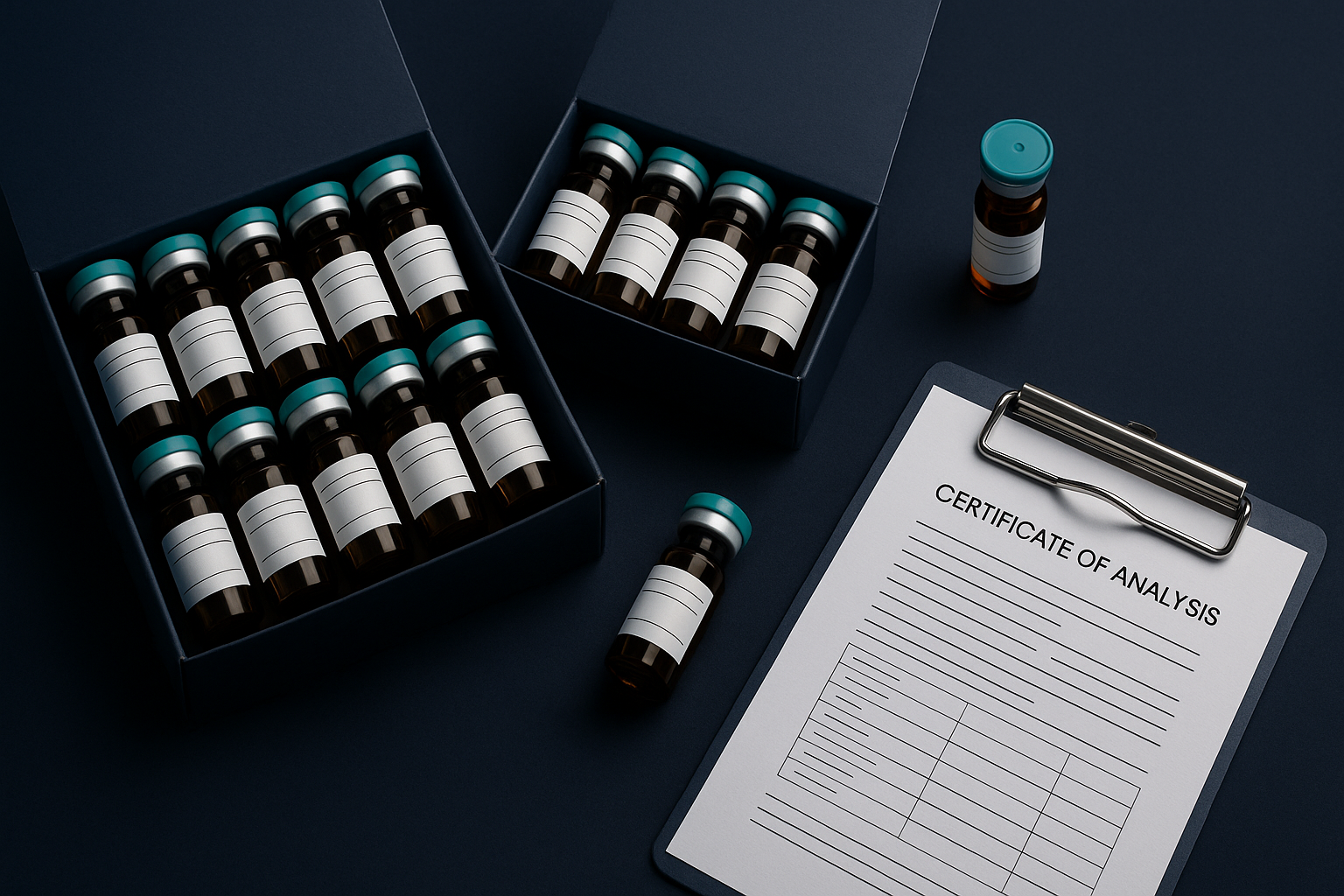
A Certificate of Analysis (COA) is more than a piece of paper. It tells you exactly what is in the vial. For a research peptide, a proper COA includes an HPLC purity chromatogram showing the main peak and any impurity peaks, mass spectrometry to confirm the peptide identity, endotoxin screening (typically less than 1 EU/mg), and heavy metal analysis (lead, arsenic, cadmium, mercury).
The COA must be batch-specific and issued by a named third-party lab. “In-house QC” or “available on request” are not substitutes. Without that transparency, you are buying an unknown chemical.
The risks are real. A 2008 study in the Journal of compound and Biomedical Analysis found that one commercial research peptide was actually a different compound entirely, and two-thirds of the tested products had insufficient quality to support reliable research. A 2019 study using NMR-based methods confirmed that undeclared constituents can be present even in products labeled as pure.
YPB provides batch-specific COAs for all 60+ research peptides through a public COA Library. Resellers and their customers can download every certificate at any time. That transparency builds trust and keeps your research supply chain anchored to verified quality.
Research Applications and Compound Categories
Wholesale research peptides generally fall into two broad categories that attract consistent lab demand. The first category includes compounds studied for healing and recovery processes, such as BPC-157, TB-500, and GHK-Cu. These are the most trafficked non-weight-loss research peptides online. BPC-157 alone generates 165,000 monthly US searches, making it the single most-searched research peptide outside of weight-regulation compounds.
The second major category covers growth hormone secretagogues like Ipamorelin, CJC-1295, and Sermorelin. These compounds are the focus of in vitro and in vivo studies examining the modulation of endogenous growth hormone release. They appeal to a separate but overlapping set of research institutions.
For new brands, the healing and recovery category offers a practical entry point. Keyword difficulty for terms in this group ranges from 4 to 8, which indicates lower competition and higher ROI potential for content targeting. Resellers can also pair complementary compounds like BPC-157 with TB-500 to capture cross-sell opportunities within the same research protocol. Carrying both categories allows a brand to serve a wider range of laboratory needs without increasing inventory complexity, thanks to on-demand dropship fulfillment.
CTA Block #3 – Calculate Your Margins
Model your exact margins on any compound in the catalog. Use the YPB profit calculator to estimate per-unit gross margin at different retail price points.
RUO Compliance Basics for Research Peptide Resellers
RUO compliance is the minimum legal standard for marketing research peptides to laboratories and researchers. It means every customer-facing element of your business treats the product as a laboratory reagent and nothing else. Six rules define the baseline for a defensible research-use-only operation.
- Rule 1: Every product label must state ” ” This disclaimer signals intent and establishes the product’s legal status.
- Rule 2: Product descriptions use scientific language — molecular data, research applications, handling protocols — never therapeutic claims. For example, a compliant page for a melanotropin research peptide lists the molecular formula, purity specifications, and storage conditions, not anecdotal effects.
- Rule 3: No dosing or administration guidance belongs on a research peptide site. Dosing implies human consumption.
- Rule 4: The RUO disclaimer must appear near the product title, the add-to-cart button, and inside the full product description.
- Rule 5: Your website’s terms of use should include age verification (21+) and an explicit research-purpose acknowledgment that the buyer agrees to use products for research only.
- Rule 6: Linking to batch-specific Certificates of Analysis builds transparency and reinforces the research-only position.
A compliant product page markets a peptide exclusively for laboratory or in vitro research use. The entire buyer journey — from headline to checkout — must reflect that framing. Skipping any of these rules exposes a reseller to regulatory risk and undermines credibility. For deeper context, see how the FDA regulates research peptides and our guide to building compliant product pages for research peptides.
Frequently Asked Questions About Wholesale Research Peptides
1. How can I verify the purity of a wholesale research peptide?
Request the Certificate of Analysis (COA) for the specific batch. Independent labs use HPLC, NMR, or mass spectrometry to quantify purity and identity. A 2019 study in the Journal of compound and Biomedical Analysis demonstrated that NMR effectively detects impurities in synthetic peptides (PMID 30793905). Batch-specific COAs confirm that the product meets the stated specifications before purchase.
2. What common impurities appear in research peptides?
Truncated sequences, oxidation products, and residual solvents are frequent impurities. A 2008 impurity study (PMID 18342612) identified deletion sequences and acetylated variants as common byproducts of solid-phase synthesis. Reliable suppliers provide analytical data that quantifies these impurities, ensuring the product’s suitability for in vitro or in vivo research.
3. Why is batch-specific COA data more reliable than a general COA?
A general COA reflects only one tested lot and may not represent subsequent batches. A 2025 review on mass balance in peptide characterization (PMID 39442464) emphasized that batch-to-batch consistency requires individual testing. Requesting the COA for the exact batch you order (not a sample) ensures the data matches the product received.
4. Can wholesale research peptides be shipped directly to my customers?
Many white-label suppliers, including YourPeptideBrand, offer direct dropshipping to your customer’s address under your brand. This eliminates the need to hold inventory or repackage. You own the customer relationship while the supplier handles fulfillment. Ensure the supplier labels each order with your brand and includes the required RUO disclaimer.
5. How do I evaluate a supplier’s quality control beyond the COA?
Examine the type of analytical methods used. A 2025 study by Gare et al. (PMID 40011178) showed that combining HPLC, MS, and NMR provides a more complete profile than any single technique. Suppliers that publicize third-party lab reports and make raw data available demonstrate a higher commitment to quality.
6. What is the typical minimum order quantity (MOQ) for wholesale research peptides?
MOQs vary widely. Traditional bulk suppliers often require orders of 100 to 500 vials. YourPeptideBrand offers no minimum order quantity, allowing you to order as little as a single vial to test quality before scaling. This removes the financial risk of large upfront inventory investments and supports gradual market entry.
7. How can I model profit margins when reselling research peptides?
Margins depend on your wholesale cost, shipping, packaging, and retail pricing. Use the profit calculator on the YourPeptideBrand website to estimate margins based on your purchase volume and markup. This tool accounts for the COA link and custom labeling costs, giving you a realistic bottom-line figure before ordering.
8. What are the compliance requirements for a white-label research peptide business?
Each product must be labeled ” ” Maintain batch-specific COAs and keep records of all sales. YourPeptideBrand’s white-label service provides custom labels and packaging that include the necessary RUO disclaimer, helping you comply without additional design work.
Ready to Start Your Research Peptide Reseller Journey?
The research peptide market continues to grow, and the white-label model removes the barriers that traditionally kept new entrants out. No minimum order quantities mean you start at whatever volume fits your business today. On-demand dropshipping eliminates inventory risk and upfront costs. Certificates of Analysis on every batch provide the documentation your customers expect. You own the brand, set your pricing, and control the customer relationship from day one.
This guide walked through the essentials: sourcing wholesale research peptides at competitive prices, understanding RUO compliance requirements, reading COAs for purity and concentration data, and evaluating supply partners on the factors that actually matter for your business. Each of these pieces is important, but none of them move forward until you take the next step.
YourPeptideBrand provides the turnkey infrastructure to go from concept to launch. Custom labels, private packaging, and direct dropshipping let you focus on building your brand while YPB handles production and fulfillment on demand.
Book a strategy call to discuss your research peptide line and learn how the white-label model works for your business. Schedule your call here.
Last updated: July 2026