
For research use only. Not for human consumption, diagnostic, or therapeutic use.
Understanding Supplier Transparency in Research Peptide Procurement
For multi-location clinics procuring research peptides for in-house research programs, supplier transparency has moved from a nice-to-have to a core procurement criterion.
According to a 2025 study published in ScienceDirect (Journal of Business Research, Vol. 185, November 2024), information transparency in B2B supply chains directly correlates with buyer trust, credibility, and long-term relationship stability.
As of 2026, 85% of organizations actively embed transparency and ESG criteria into procurement processes, per Procurement Tactics’ 2026 industry analysis.
This shift is especially pronounced in regulated purchasing categories like research peptides, where batch-specific quality documentation, third-party testing verification, and clear chain-of-custody records determine whether a supplier qualifies for institutional procurement.
What Is Supplier Transparency in Research Peptide Sourcing?
Supplier transparency in research peptide sourcing refers to how openly a vendor shares its quality documentation, testing protocols, manufacturing practices, and batch-level traceability data with buyers.
For YourPeptideBrand (YPB), transparency means providing public access to batch-specific Certificates of Analysis (COAs) with HPLC purity data, mass spectrometry identity confirmation, endotoxin analysis, and heavy metals screening for every SKU in its 60+ product catalog.
A transparent supplier names its third-party testing laboratory, displays lot numbers on product pages, and provides downloadable documentation before purchase. This stands in contrast to suppliers that offer COAs only on request or rely on unverifiable in-house testing claims.
Access to complete documentation, such as how COAs accelerate procurement cycles, allows clinics to verify batch quality without delays.
Similarly, understanding FDA Research Use Only classification requirements helps buyers ensure labeling compliance from the start.
Why Transparency Matters in B2B Research Peptide Procurement
Procurement decisions for research peptides differ from standard consumables. Each batch must be verifiable, documented, and traceable to its synthesis source. Without supplier transparency, compliance verification becomes guesswork, and the risk of using undocumented material rises.
A 2023 supply chain transparency framework from Oracle identifies three core benefits of an open supplier relationship: reduced operational risk, the ability to verify compliance at every step, and faster decision-making. When a supplier shares batch-specific documentation such as Certificates of Analysis (COAs), synthesis methods, and sourcing records, clinics and entrepreneurs can confirm that the material meets their research protocol requirements before placing an order. This upfront visibility eliminates the back-and-forth that slows down procurement cycles.
The cost of opacity is real. SAP reported in May 2024 that procurement teams frequently lack basic information about their supplier base, which leads to miscalculated decisions. Without clear batch records or purity data, a buyer may choose a lower-priced lot only to discover later that the research peptide falls short of the specified parameters. That miscalculation can delay projects and waste budget.
The timing of transparency is also critical. In 2025, Forrester data (cited by Prospeo in a 2026 analysis) found that 53% of procurement professionals identify themselves as decision-makers from day one. These buyers do not wait for a purchasing committee; they evaluate suppliers immediately. Transparent suppliers that publish COAs, provide batch details, and share their sourcing process give these early-stage decision-makers the facts they need to proceed with confidence.
Suppliers that force bulk minimums often lack batch-specific documentation altogether. They treat each batch as interchangeable, which creates hidden risks for clinics that rely on consistent research material standards. A supplier that cannot produce a COA for a specific vial is, in effect, asking the buyer to accept unknown variables. Identifying those gaps early is critical, and reviewing supplier documentation for common warning signs helps avoid risky sourcing choices.
For a closer look at the specific documentation issues that can lead to audit problems, see red flags in peptide supplier documentation.
Three Tiers of Research Peptide Supplier Transparency
Not all research peptide suppliers disclose the same level of quality documentation. When evaluating a source for bulk procurement, it helps to sort vendors into three tiers based on what they show you and who produced the data. The tier a supplier sits in directly correlates with the confidence you can place in the product before it reaches your lab.
Tier 1 suppliers offer no Certificate of Analysis (COA) or only a generic purity claim with no supporting data. The testing source is unspecified or claimed to be in-house with no details. No verifiable purity information exists, leaving the buyer with low confidence and high procurement risk. This tier is common among resellers who do not interact with the manufacturing process.
Tier 2 suppliers provide a manufacturer COA, usually on request. Testing is conducted in-house or by the contract manufacturer, with HPLC data present but no mass spectrometry confirmation. The buyer gains medium confidence because the data is not independently verified and may reflect only a single quality parameter.
Tier 3 suppliers publish a batch-specific COA from a named, ISO-accredited third-party lab such as Janoshik or MZ Biolabs. The testing includes both HPLC (reported at >=99%) and mass spectrometry to confirm identity. This level of documentation gives the buyer high confidence and a defensible chain of verification.
| Tier | Documentation Provided | Testing Source | Purity Verification | Buyer Confidence Level |
|---|---|---|---|---|
| Tier 1 | No COA or generic purity claim | Unspecified or in-house | No verifiable purity data | Low confidence |
| Tier 2 | Manufacturer COA available on request | In-house only | HPLC data but no MS | Medium confidence |
| Tier 3 | Batch-specific COA from named third-party lab (e.g. Janoshik, MZ Biolabs) | Independent ISO-accredited lab | HPLC >=99% plus MS identity confirmed | High confidence |
Industry references such as the Verified Peptides evaluation guide (2026) and the Verified Peptides COA guide emphasize that a defensible COA must come from a third party, be batch-specific, and include both HPLC and mass spectrometry. A separate verification guide from Durham Peptides reinforces the same point: without an independent lab result, the documentation is not reliable for procurement decisions.
Understanding these tiers helps clinic owners and entrepreneurs set a minimum transparency threshold before placing a bulk order. The difference between Tier 2 and Tier 3 often lies in whether the supplier routinely invests in independent testing. For a deeper dive into what each analytical method reveals, review common peptide testing methods including HPLC and mass spectrometry. If you need to build a verification process from scratch, learn how to work with third-party testing labs to establish your own quality checks.
Download Our Full 60+ SKU Catalog
White-label research peptides, wholesale pricing, and dropshipping details.
What to Look for in a Transparent Research Peptide Supplier
A clinic’s procurement team does not evaluate a research peptide supplier on price alone. The documentation trail tells the real story. A Verified Peptides supplier evaluation guide published in 2026 identifies six documentation criteria that separate transparent suppliers from those offering only marketing claims. The checklist below gives procurement teams a repeatable framework.
1. Public, batch-specific COA accessible before purchase
The Certificate of Analysis (COA) should be visible on the supplier’s website without requiring a login or a sales call. It must be tied to a specific lot number, not a generic document reused across batches. A Durham Peptides verification guide emphasizes that a public COA library allows buyers to compare results across multiple lots before placing an order.
2. Named third-party laboratory with verifiable credentials
The COA must name the laboratory that performed the test. A supplier that tests in-house cannot provide independent verification – see comparing in-house versus outsourced testing models for a deeper analysis. The lab should be a recognized analytical chemistry facility with a track record in peptide characterization.
3. Both HPLC purity data and MS identity confirmation
Two distinct analytical methods are standard: High-Performance Liquid Chromatography (HPLC) for purity, and Mass Spectrometry (MS) for molecular identity. The Verified Peptides guide notes that the industry benchmark for HPLC purity is >=99%. MS confirmation eliminates the risk of mislabeled or substituted compounds.
4. Lot numbers printed on both product labels and COAs
Every vial label must display the same lot number that appears on its corresponding COA. This cross-reference ensures the test results match the physical product. Without matching lot numbers, a COA is auditorily useless for chain-of-custody documentation.
5. RUO-compliant labeling with clear disclaimers
The product label must state “For research use only” and include a no-consumption warning. RUO-compliant labeling is a legal requirement for suppliers operating within the research-use framework. Labels that omit this language raise red flags about the supplier’s compliance posture.
6. Accessible COA archive for historical batch comparison
A searchable library of past COAs lets procurement teams track purity trends over time. If a supplier’s current batch of a given research peptide shows 99.2% HPLC purity but the previous three batches all exceeded 99.5%, the buyer can ask questions. The Durham Peptides verification guide recommends keeping at least six months of historical results on file.
How Procurement Teams Evaluate Supplier Transparency
Procurement teams that source research peptides for institutional or commercial use follow a documented evaluation process. The goal is to verify that every vial comes with traceable, lot-specific documentation before money changes hands. Skipping steps in this workflow increases the risk of accepting product that fails internal quality checks.
The process typically starts with a pre-qualification phase. The buyer requests a sample Certificate of Analysis from the supplier and checks the issuing laboratory’s credentials. A COA from an in-house lab carries less weight than one from a third-party facility with published accreditation standards. The next step is to locate the unique COA key printed on the document and cross-reference it on the lab’s verification portal. If the portal returns no match or a different lot number, that is a clear signal to pause.
Once the COA is validated, the team compares the reported purity specifications against the internal requirements for the planned research protocol. Research peptides intended for different study designs may require different purity thresholds. A 98% purity level might be sufficient for preliminary in vitro work, while a higher standard could be needed for downstream applications. The buyer documents the acceptable range before comparing supplier data.
Experienced teams also evaluate the supplier’s public documentation practices. Is the COA library easily accessible on the supplier website? Does each certificate include the lot number, the test date, and the name of the analyst? Buyers look for patterns of incomplete or inconsistent documentation. A supplier that publishes partial information across only a few peptides should raise the same concern as a supplier with no documentation at all. For a detailed breakdown of what to watch for, see red flags in peptide supplier documentation.
After documentation review, the buyer places a small test order and requests a lot-matched COA that corresponds to the specific batch shipped. This final step confirms that the documentation matches the delivered product. Procurement teams repeat this entire sequence before scaling up to larger quantities. Suppliers that cannot provide lot-matched certificates at the test-order stage are typically disqualified before a volume purchase occurs.
Ready to Launch Your White-Label Research Peptide Brand?
Book a free call with our team. We will walk you through pricing, setup, and your first order.
COA and Third-Party Testing as Transparency Signals
A Certificate of Analysis is the single most verifiable document a supplier can provide. For research peptides purchased under the RUO model, a proper COA tells you exactly what the vial contains and at what purity. Without it, the product is a black box.
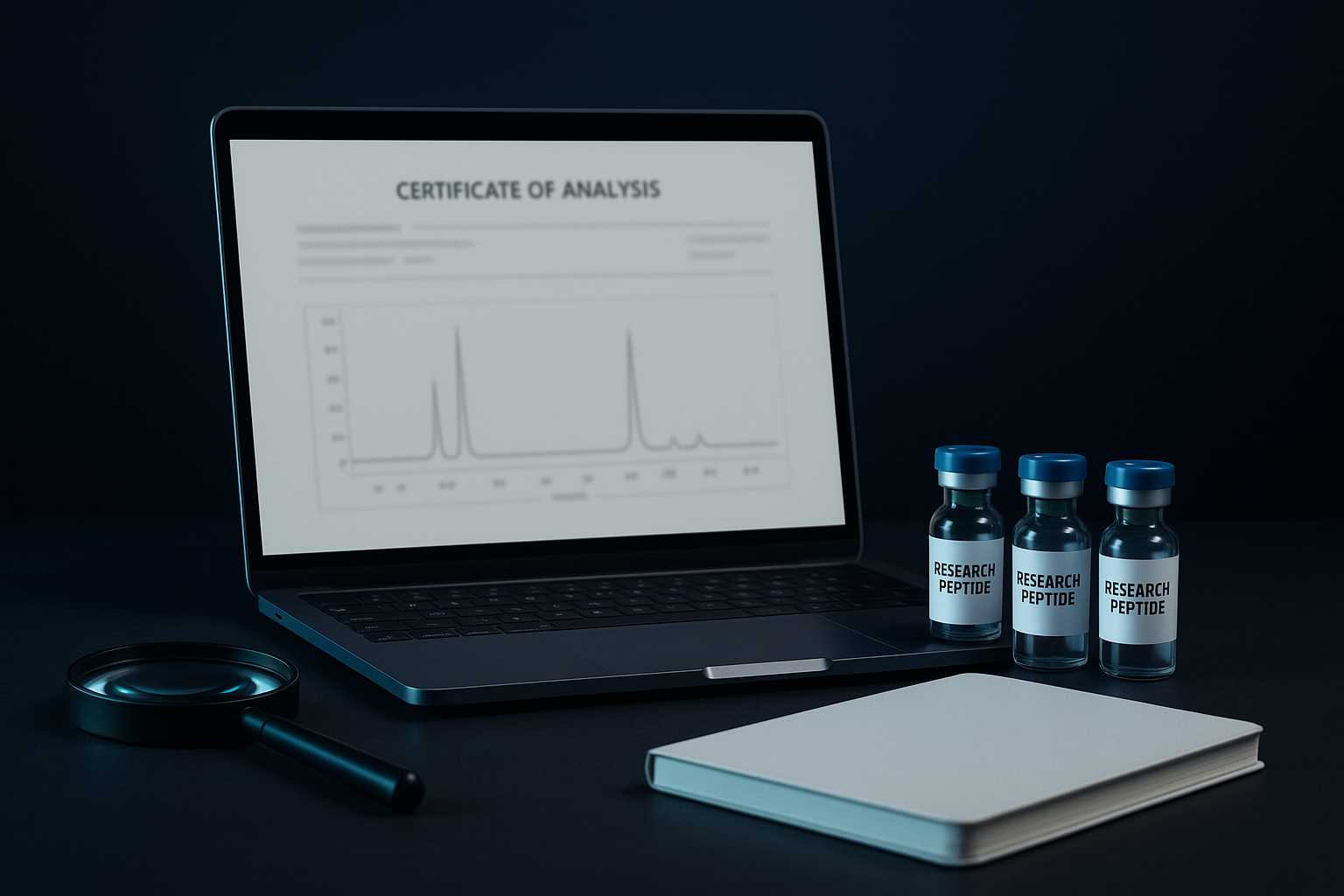
A complete research peptide COA contains these elements: a header with the supplier name and product name, a unique batch or lot identifier, HPLC purity percentage accompanied by the full chromatogram so you can see the peak shape and retention time, and mass spectrometry identity data showing observed versus theoretical molecular weight. Endotoxin results should be below 1 EU/mg, heavy metals screen should report levels for arsenic, cadmium, lead, and mercury, and microbial limits (TAMC/TYMC) must show total counts. The document also needs the analyst signature, testing date, and ideally the lab name and accreditation status. Resources like the Verified Peptides COA guide detail each of these fields and why they matter for confident purchasing.
Third-party testing is the strongest transparency signal because the lab has no financial interest in the result. A supplier that posts a COA from an independent, accredited lab allows you to verify the data yourself. The Durham Peptides verification guide notes that cross-checking the COA details against the actual product label and batch number closes the loop on quality assurance.
Incomplete COAs are a red flag. Missing MS data means identity is assumed, not proven. A COA without a lab name could be fabricated. Outdated testing dates suggest the certificate may apply to a previous batch, not the current stock. Any missing field or vague entry reduces transparency to nearly zero.
For buyers who want to inspect documentation before purchase, browse the public COA Library to see real examples of six-panel certificates covering HPLC, MS, endotoxin, heavy metals, and microbial counts. Understanding what a complete COA looks like also helps when evaluating broader quality assurance practices for RUO peptides and the legal boundaries of RUO peptide sales.
When a supplier puts every batch through third-party testing and publishes the full results, the COA becomes the most concrete transparency signal available. It turns trust into a checkable fact.
Document Checklist for Procurement Decisions
A thorough procurement review of any research peptide supplier begins with documentation. The ten items below form a practical checklist that lets you compare vendors on objective criteria rather than marketing claims. Use it alongside your standard RFP process to flag suppliers that skip essential verification steps.
- Batch-specific COA accessible – The certificate of analysis must reference a unique lot number, not a generic product page.
- Named third-party lab with accreditation – The testing laboratory should be identifiable and its accreditation (e.g., ISO 17025) visible on the report.
- HPLC purity >=99% – High-performance liquid chromatography data showing area-percent purity is the industry benchmark.
- MS identity matches expected molecular weight – Mass spectrometry confirmation that the compound’s molecular weight aligns with its structure.
- Lot numbers match between vial and COA – The number printed on the vial label must appear on the certificate; mismatches indicate a broken chain of custody.
- Testing date within 12 months – Stability data from older batches may not reflect current product quality.
- RUO disclaimer on product page and packaging – The “for research use only” statement must be present in both digital and printed materials.
- Public COA archive – A supplier that posts certificates online makes it easy to verify any lot before ordering.
- No-MOQ ordering – Flexible procurement without a minimum order quantity lets you buy only what you need for each study.
- Chain-of-custody documentation – Written records showing the path from raw material synthesis to final vial reduce the risk of adulteration or mislabeling.
This checklist aligns with the 2026 IBM supply chain transparency guide, which emphasizes that verifiable documentation is the bedrock of supplier trust. For a deeper walkthrough of each item, see how to audit a peptide supplier for compliance. If you are building your own brand’s product pages, the guide on building FDA-compliant product pages covers the labeling requirements that match several checklist points.
Once you have collected COAs and chain-of-custody records from two or three vendors, run a cost-benefit analysis that factors in the hidden cost of non-compliance – lost time, failed studies, reputational damage. The calculator below translates documentation quality into margin impact.
Calculate Your White-Label Margins
See exactly how much margin you can make at your price point.
White-Label Opportunity – Transparency as a Brand Asset
For a clinic or entrepreneur building a white-label research peptide brand, procurement transparency isn’t just a supplier checkbox. It becomes a direct pillar of brand equity. When the end customer a researcher or lab sees batch-level documentation, testing results, and traceability, that information transfers trust from the supplier to your own label. A transparent supply chain tells buyers that your brand stands behind the product, which is critical in a market where claims are cheap and documentation is the only verifiable currency.
YourPeptideBrand embeds transparency into every white-label shipment. Each order includes a secure portal where you and your customer can access batch documentation: stability reports, chain-of-custody logs, and third-party testing data. This means you don’t have to assemble paperwork yourself or rely on downstream distribution to maintain records. The documentation is tied directly to the batch and delivered with the product, making it easy to share with prospective buyers as part of your own quality-assurance package.
Because there is no minimum order quantity, you can start with pilot volumes that test both the product and your brand’s documentation workflow before scaling up. Suppliers that force bulk minimums often treat documentation as a cost to be minimized sending generic certificates that are not batch-specific or skipping detailed logs entirely. In contrast, a model built on low-volume transparency protects your brand’s reputation from the first vial to the thousandth.
Procurement transparency also reduces the risk of compliance gaps further down the line. For a deeper look at how documentation ties into compliance, read about the role of documentation in peptide compliance. And for a real-world example of how clinics have turned transparency into revenue, explore our case study on B2B peptide supplier partnerships.
Frequently Asked Questions About Supplier Transparency in Research Peptide Procurement
What is supplier transparency in research peptide procurement?
Supplier transparency in research peptide procurement refers to how openly a vendor shares quality documentation, testing results, and sourcing information. Key indicators include batch-specific Certificates of Analysis (COAs) from named third-party laboratories, HPLC purity data, mass spectrometry identity confirmation, clear RUO labeling, and accessible lot-tracking systems. According to an industry survey published by Procurement Tactics in 2026, 85% of organizations now embed transparency criteria into supplier evaluation processes.
What should a Certificate of Analysis (COA) include for research peptides?
A research-grade COA for research peptides should include the batch/lot number, HPLC purity percentage (with chromatogram), mass spectrometry identity confirmation with observed vs theoretical mass, testing date, the name and accreditation of the independent third-party lab that performed the analysis, and an authorized analyst signature. Research published by Verified Peptides in 2025 notes that COAs from accredited labs using both HPLC and MS methods provide the most reliable verification of peptide identity and purity.
Why is third-party testing more important than in-house testing for peptide suppliers?
Third-party testing removes the conflict of interest inherent in in-house testing, where a supplier tests its own products. Independent laboratories with ISO 17025 accreditation or equivalent quality management provide unbiased verification of purity, identity, and contaminant levels. As explained in a 2026 guide from Durham Peptides, only third-party COAs count as independent quality verification because the testing lab has no financial interest in the outcome. YourPeptideBrand provides third-party tested COAs for all 60+ research peptides in its catalog.
What does HPLC purity tell a procurement officer about a research peptide?
High-Performance Liquid Chromatography (HPLC) measures the purity percentage of a research peptide by separating components and quantifying the target compound versus impurities. The research-grade benchmark is 99% or higher purity. HPLC purity data helps procurement officers verify that a peptide batch meets specification before purchase. As noted in a 2025 guide from Verified Peptides, organizations integrating third-party HPLC certification reported measurably higher repeat-order rates from quality-conscious buyers.
How do you verify that a supplier's COA is authentic and matches the batch received?
To verify COA authenticity, cross-reference the unique certificate ID or verification key on the issuing lab's official website. For Janoshik Analytical, use their public verification portal with the unique key printed on the COA. Confirm that the lot number on the COA matches the lot number printed on the vial label. Check that the testing date is recent relative to the manufacturing date. Verified Peptides notes in a 2025 guide that some suppliers display COAs that do not verify against the issuing lab's database, making independent verification essential.
What transparency standards does YourPeptideBrand offer for white-label buyers?
YourPeptideBrand provides every white-label partner with batch-specific COAs for all 60+ research peptides in its catalog. The COA Library is publicly accessible and searchable by SKU and batch number, with downloadable PDFs showing HPLC purity, mass spectrometry confirmation, endotoxin levels, and microbial counts. All products are manufactured in cGMP-certified facilities and third-party tested. YourPeptideBrand's zero-MOQ model means clinics can order exactly what they need while maintaining full documentation transparency.
How can a clinic evaluate a research peptide supplier's documentation before purchasing?
Clinics should request batch-specific COAs before committing to any order. Check that the COA names the independent testing laboratory, includes both HPLC purity data and mass spectrometry identity confirmation, displays a lot number that can be traced to the product batch, and carries a current testing date. Review the supplier's public COA library if available. Evaluate whether the supplier provides RUO-compliant labeling on all packaging. YourPeptideBrand's Profit Calculator can help clinics assess the financial impact of choosing a transparent supplier versus one with limited documentation.
Does choosing a transparent research peptide supplier affect procurement cycle time?
Yes. Research from YourPeptideBrand's 2026 analysis of COA-driven procurement found that clinics using suppliers with public, batch-specific COAs reported shorter inquiry-to-order cycles. When COA data is accessible before purchase, procurement officers can verify quality in minutes rather than waiting days for documentation to be provided on request. Suppliers like YourPeptideBrand that offer an on-demand COA Library enable clinics to close procurement faster, reduce internal compliance review time, and maintain better inventory forecasting across multiple locations.
Conclusion – Making Transparency a Procurement Standard
Supplier transparency is not a nice-to-have. For clinic owners procuring research peptides, it is a core criterion defined by batch-specific Certificates of Analysis, independent third-party testing, and accessible documentation. These elements turn an opaque supply chain into one you can audit and trust.
Choosing a transparent supplier reduces procurement risk. It speeds up your internal compliance review because the paperwork is already in order. It also supports scalable white-label operations: when every batch has a verifiable COA, you can add brands or product lines without reinventing your vetting process.
YourPeptideBrand provides the infrastructure to meet that standard: zero-MOQ ordering, on-demand dropshipping, a searchable COA Library, and a profit calculator to model your margins. If your clinic is ready to make transparency a procurement standard, the next step is a conversation.
Ready to Launch Your White-Label Research Peptide Brand?
Book a free call with our team. We will walk you through pricing, setup, and your first order.
Last updated: July 2026