For research use only. Not for human consumption, diagnostic, or potential wellness benefit.
Part 1: Hero and Definition – How to Build a Predictable Lead Generation Funnel for Your Research Peptide Brand
According to UpLead’s 2026 lead generation statistics, 47% of B2B buyers consume 3-5 pieces of educational content before engaging with a sales team. For entrepreneurs launching a research peptide brand, the gap between first click and wholesale order can be weeks. A predictable lead generation funnel bridges that gap.
This guide walks through every stage – lead capture, CRM automation, email nurture sequences, multi-channel coordination – using data from HubSpot, Gartner, and First Page Sage’s 2025 conversion rate report. It then shows how to fulfill orders on demand through YourPeptideBrand’s zero-MOQ dropshipping infrastructure.
What Is a Lead Generation Funnel for a Research Peptide Brand?
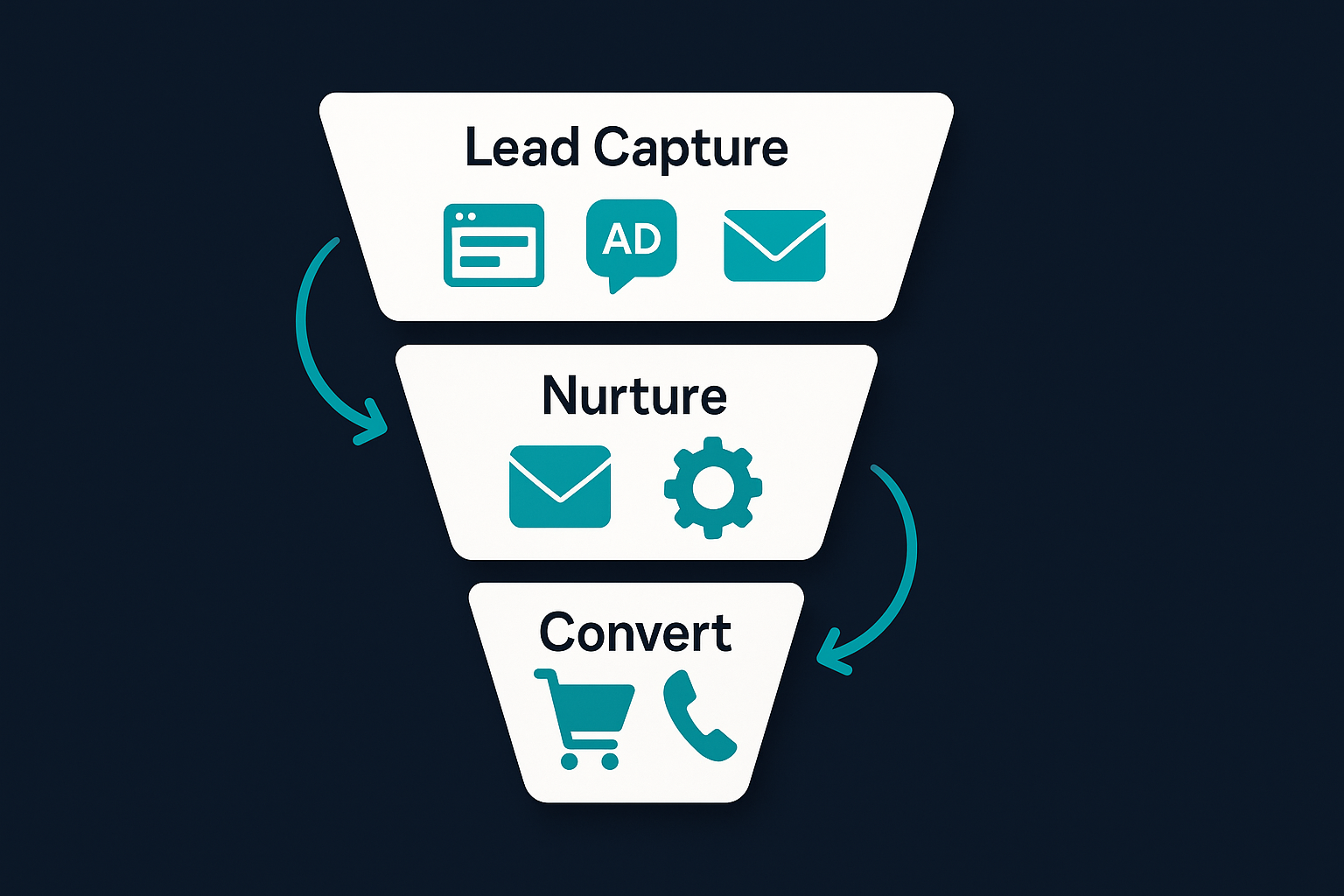
A lead generation funnel is an automated marketing system that turns website visitors, social media followers, and ad viewers into qualified B2B buyers for research peptides. It works in three stages: top-of-funnel (TOFU) attracts prospects through educational content and paid ads; middle-of-funnel (MOFU) nurtures them with automated email sequences about RUO compliance and white-label opportunities; bottom-of-funnel (BOFU) converts them into ordering partners through direct consultation or catalog download. YourPeptideBrand (YPB) provides the turnkey dropshipping backend that lets entrepreneurs fulfill orders immediately after conversion.
For a deeper look at content-driven lead capture, see our Beginner’s Guide to Building a Blog for Your Peptide Brand.
Stage 1 – Lead Capture – Building the Top of Your Funnel
Lead capture starts where clinic owners and wellness entrepreneurs actively search for sourcing information. They are not looking for a sales pitch; they want educational content that answers their compliance and operational questions.
Three channels deliver consistently. SEO-optimized blog content ranks for long-tail queries like “research peptide white label startup costs” or “RUO launch checklist.” Facebook lead ads with a gated PDF offer convert cold traffic into email subscribers. TikTok videos that show the behind-the-scenes of product testing or label printing can drive viewers to a simple landing page with a form.
According to UpLead’s 2026 lead generation statistics, 47% of B2B buyers consume three to five pieces of educational content before they engage with a sales team. That means your blog posts, ads, and videos must each serve as a standalone resource while pushing the reader toward the next piece. Scatter one-off ads without follow-up content and you lose that 47%.
The highest-converting lead magnet for a peptide brand is compliance-focused. A checklist titled “RUO Peptide White-Label Launch Checklist” or a downloadable catalog that includes sample Certificate of Analysis documents gives prospects the exact documentation they need to evaluate suppliers. Gated these behind an email opt-in and you build a warm list of qualified buyers. For more channel-specific tactics, see the Beginner’s Guide to Facebook Ads for Peptide Stores and How to Build an Email List for a Peptide Business.
YourPeptideBrand provides the fulfillment backend that lets you focus on this lead-generation machine without managing inventory. That detail matters less at this stage; the task is to get the right visitors in the door with the right content.
Stage 2 – CRM Automation – The Engine Behind Predictability
A customer relationship management (CRM) system transforms random inbound inquiries into a structured pipeline. According to CRM.org’s 2026 statistics, businesses with well-utilized CRM systems experience up to 300% improvement in lead conversion rates.
For a research peptide brand, the CRM should automatically tag new leads by source (blog, Facebook, TikTok, referral), assign a lead score based on engagement (downloaded catalog = +20 points, booked a call = +50 points), and route high-scoring prospects to a consultation queue. Lower-scoring leads enter an automated nurture track that delivers content and reminders until they are ready to engage. This segmentation ensures that sales time is spent on the hottest leads while the system nurtures the rest.
Tagging by source provides visibility into which marketing channels deliver the most qualified leads. If blog downloads score higher than social media clicks, you can shift budget accordingly. The lead scoring rules can be adjusted over time as you learn which actions correlate best with a closed deal.
Platforms like HubSpot Sales Hub and ActiveCampaign integrate with ecommerce systems, making it possible to manage the entire funnel from lead to order in one interface. This eliminates manual data entry and reduces the risk of losing a prospect between systems. For research peptide dropship brands, this integration allows seamless order flow from the lead’s purchase back into the CRM for follow-up and upsell triggers.
Response speed is another critical factor. According to GreetNow’s 2026 lead response time study, prospects contacted within 5 minutes are 21x more likely to qualify. The response time impact chart shows a steep drop in lead interest after the first hour. Even a 30-minute delay lowers odds significantly. Automating immediate email or SMS confirmation upon form submission can bridge that gap, keeping the engagement warm while a sales rep prepares a personalized follow-up.
For a deeper look at structuring this process, see How to Implement a CRM System for B2B Peptide Growth. To build repeatable systems that scale, read How to Build Repeatable Sales Systems for Growth.
Stage 3 – Email Nurture Sequences – Automated Follow-Up That Converts
Automated email sequences are the highest-ROI channel for research peptide brand lead nurturing. A well-timed follow-up turns a prospect who downloaded a compliance guide into a buyer who books a consultation. The numbers back it up.
According to HubSpot’s 2025 case study, an automated follow-up sequence generated $100,000 in revenue in 30 days. HubSpot blog . Data from Landbase’s 2026 email sequence analysis confirms that automated sequences generate 320% more revenue than manual campaigns. Landbase 2026 email sequence analysis .
Here is a 5-email structure that works for research peptide leads. Each email serves one job. No fluff.
- Day 0: Welcome email with the gated compliance guide the lead just downloaded. Deliver the asset, reinforce the value.
- Day 3: Educational email explaining RUO labeling standards and how third-party COA verification protects their brand.
- Day 7: Case study of a clinic that launched a white-label brand with zero MOQ. Show proof of concept.
- Day 14: Product spotlight featuring top-selling research peptides with purity data from current COAs.
- Day 21: Direct CTA to book a consultation or download the full catalog. Hard ask after relationship building.
Trigger-based sequences that respond to link clicks perform 3x better than time-only schedules. If a prospect clicks the case study link, send a deeper reel of similar results. If they click a product spotlight, route them to a comparison page or a call-to-action immediately. Automation platforms like HubSpot or Mailchimp make this simple to set up. For a walkthrough of the technical setup, see the Beginner’s Guide to Setting Up Email Drip Campaigns.
Ready to explore our full product line? Download the Full Research Peptide Catalog to see all 60+ third-party-tested research peptides available for white-label and bulk orders.
Stage 4 – Multi-Channel Coordination and Retargeting
Leads rarely convert from a single touchpoint. According to Thunderbit's 2026 lead generation report, omnichannel orchestration boosts engagement by 250%. For a research peptide brand, this means coordinating email nurture with Facebook retargeting ads, SMS alerts for high-intent actions, and personalized LinkedIn outreach.
The CRM should sync with ad platforms to exclude converted leads from retargeting campaigns, reducing wasted ad spend. This ensures ad budget is directed only at prospects still in the decision phase. For a deeper look at the technology behind this setup, see The Best Software Stack for Scaling Your Peptide Business.
To fast-track fulfillment, YourPeptideBrand's turnkey fulfillment API connects to Shopify and WooCommerce, enabling automated order processing the moment a lead converts. No manual forwarding or inventory juggling is required.
For a full breakdown of paid ad strategies specific to the research peptide space, read How to Use Paid Ads to Scale a Peptide Brand. When each channel is orchestrated and synced with fulfillment, the funnel becomes a predictable revenue engine rather than a set of disconnected campaigns.
White-Label Opportunity – Why the B2B Funnel Works for Peptide Brands
The B2B lead generation funnel is particularly effective for research peptide brands. Clinic owners and wellness entrepreneurs have longer buying cycles and higher order values than typical B2C customers. That means a single conversion can represent months of recurring revenue, not a one-time sale.
Unlike B2C funnels optimized for one-click purchases, peptide brand funnels must educate prospects about compliance, purity standards, and the RUO model before they commit to a wholesale order. Prospects want to understand the supply chain, the testing process, and how the brand will support their own customers. That educational content is exactly what a well-built funnel delivers.
YourPeptideBrand’s white-label infrastructure is built for this model. On-demand label printing, custom packaging, and direct dropshipping with zero minimum order quantities mean entrepreneurs can test the funnel with no inventory risk. You own the brand and the customer relationship; YPB handles fulfillment as orders come in.
Other peptide suppliers force bulk minimums that require significant upfront capital. Their model forces you to predict demand before you have a single lead. YPB’s approach lets you scale gradually as lead volume grows, matching inventory spend to real sales.
Ready to build a funnel that delivers high-value, recurring orders? Start with How to Build a Profitable Educational Niche in Peptides, then Book a Free Strategy Call to discuss your white-label infrastructure.
COA / Quality – Why Third-Party Testing Matters in the Funnel
Every batch of research peptide from YourPeptideBrand (YPB) is third-party tested, and the resulting Certificate of Analysis (COA) is stored for each lot. This is a standard feature of YPB’s supply chain, not an upsell.
In a nurture sequence designed for B2B clinic buyers, the COA serves as a concrete trust signal. These buyers require documented purity before they consider moving from research to purchase. Featuring COA verification in your automated emails directly addresses that requirement.
According to SQ Magazine’s 2026 marketing automation report, companies leveraging automation in sales funnels experience 20% higher customer retention. For a research peptide brand, that retention gain depends on proving quality early.
A simple tactic: include a link to the COA Library in the Day 7 email. When prospects can browse the COA Library for batch-specific certificates, they validate the product quality before reaching the sales stage. This small step can measurably increase click-through rates on that nurture email.
Data-Backed Benchmarks for Funnel Optimization
Optimizing a lead generation funnel starts with knowing where you stand. Without benchmarks, improvement is guesswork.
First Page Sage’s 2026 sales funnel conversion rate report provides industry-standard metrics across four stages:
| Stage | Rate |
|---|---|
| Visitor to Lead | 2.9% |
| Lead to MQL | 31% |
| MQL to SQL | 20% |
| SQL to Closed Won | 10% |
For a research peptide brand funnel, these numbers help set realistic expectations. If 1,000 visitors generate 2.9% leads (29 leads) and 10% of those become customers, that is roughly 3 new customers per 1,000 visitors.
Improving email open rates by even 5% can double that output. First Page Sage reports B2B email marketing converts at 2.4% — meaning email-driven leads close at a higher rate than cold traffic.
These benchmarks give you a concrete target. If your funnel underperforms, you know where to focus optimization efforts.
Frequently Asked Questions About Lead Generation Funnels for Peptide Brands
What is a lead generation funnel for a research peptide brand?
A lead generation funnel is an automated system that captures, nurtures, and converts prospects interested in research peptides. It starts with traffic sources (blog content, paid ads, social media) that drive visitors to a landing page with a gated offer such as a compliance checklist. After opt-in, automated email sequences deliver educational content about the RUO peptide model, white-label dropshipping, and COA quality standards. According to HubSpot’s 2025 State of Marketing Report, marketers using automated sequences generate 320% more revenue than those using manual outreach alone.
How does CRM automation improve lead conversion for peptide businesses?
CRM automation improves lead conversion by responding instantly to prospect actions. Research from CRM.org (2026) indicates that businesses with well-utilized CRM systems see up to 300% improvement in lead conversion rates. For a research peptide brand, a CRM can automatically tag incoming leads by their interest category (e.g., BPC-157 research, TB-500 protocols), assign a lead score based on engagement, and route high-scoring prospects to a sales consultation. Lower-scoring leads enter automated nurture sequences that deliver educational content about RUO compliance and white-label opportunities.
What email sequence works best for nurturing peptide brand leads?
Research from Landbase’s 2026 email sequence analysis shows that automated sequences generate 320% more revenue than manual campaigns. An effective peptide brand sequence follows a 5-email structure: Email 1 (Day 0): Welcome with a gated RUO compliance guide download. Email 2 (Day 3): Educational content on peptide purity standards and third-party COA verification. Email 3 (Day 7): Case study showing how a clinic or entrepreneur launched a white-label line. Email 4 (Day 14): Product spotlight featuring top-selling research peptides. Email 5 (Day 21): Direct call-to-action to book a consultation or download the catalog. Trigger-based emails that respond to clicks perform 3x better than time-only sends.
How fast should a peptide brand respond to incoming leads?
According to GreetNow’s 2026 lead response time study, prospects contacted within 5 minutes are 21x more likely to qualify than those contacted after 30 minutes. For peptide brands, an automated response system that sends an instant confirmation email with the requested resource (such as a COA sample or catalog preview) can maintain engagement during the critical first-minute window. Companies with automated lead response systems see 20-30% increases in qualified opportunities within 6 months, according to Gartner data cited in the same study.
What lead magnets convert best for RUO peptide audiences?
For research peptide brand audiences, the highest-converting lead magnets are compliance-focused educational resources. An ‘RUO Peptide Compliance Checklist’ or a ‘White-Label Launch Guide’ with peer-reviewed references attracts clinic owners and entrepreneurs who are actively researching entry into the market. According to UpLead’s 2026 lead generation statistics, 47% of B2B buyers consume 3-5 pieces of educational content before engaging with a sales team. For peptide brands, a downloadable PDF catalog with third-party testing documentation bridges the trust gap and captures qualified email addresses.
How can an entrepreneur build a lead funnel without a website?
A landing page builder such as Leadpages or ClickFunnels can launch a single-page lead capture system within hours. Entrepreneurs can pair this with YourPeptideBrand’s white-label dropshipping infrastructure to fulfill orders without holding inventory. The page should feature an educational lead magnet (such as a ‘5-Step Peptide Brand Launch Checklist’), an embedded calendar link for consultations, and a clear RUO disclaimer. YPB provides compliant product descriptions, COA access, and label templates that can be embedded into the funnel’s backend, ensuring every captured lead receives professional, compliant follow-up material automatically.
What CRM tools integrate best with a peptide dropshipping model?
HubSpot Sales Hub and ActiveCampaign are two platforms that integrate directly with ecommerce systems and support compliance workflows. According to SQ Magazine’s 2026 marketing automation report, 76% of marketers integrate automation with CRM platforms, and companies leveraging automation in sales funnels experience 20% higher customer retention. For a peptide dropshipping brand, a CRM should connect to YPB’s on-demand label printing and fulfillment API, enabling automated order routing. The CRM can tag leads by funnel stage, trigger personalized email sequences, and generate compliance-ready documentation for every transaction.
How does YPB’s zero-MOQ model support funnel testing?
YourPeptideBrand’s zero minimum order quantity model allows entrepreneurs to test lead-generation campaigns without upfront inventory investment. Brands can run a small ad campaign, capture leads through a gated offer, and fulfill orders on demand as they come in. According to UpLead’s 2026 lead generation statistics, 80% of businesses using marketing automation report higher lead volumes. YPB’s turnkey infrastructure handles label printing, packaging, and direct dropshipping so that brand owners can iterate on their funnel messaging, test different lead magnets, and scale campaigns based on real conversion data rather than inventory constraints. The YPB Profit Calculator helps forecast margins at every funnel stage.
Conclusion – Launch Your Predictable Funnel with YPB
The funnel stages are straightforward: capture leads with compliance-focused magnets, automate follow-up using a CRM and email sequences, coordinate across channels, and fulfill orders on demand. Every piece of this infrastructure supports the RUO white-label business model – it is built for clinic owners and entrepreneurs who want to own their brand.
YourPeptideBrand provides the backend: zero minimum order quantities, on-demand dropshipping, third-party tested COAs, and custom packaging. The lead generation system aligns directly with how you operate – no inventory risk, no upfront cash tied up in bulk.
Now you have the roadmap. Run your numbers with the Profit Calculator, download the catalog to see available SKUs, or book a call to discuss your launch strategy.
Last updated: July 2026
According to UpLead’s 2026 lead generation statistics, 47% of B2B buyers consume 3 to 5 pieces of educational content before engaging with a sales team. For entrepreneurs launching a research peptide brand, the gap between capturing a prospect’s email and closing a wholesale order can last weeks. A predictable lead generation funnel automates that gap.
This guide walks through every stage – lead capture, CRM automation, email nurture sequences, multi-channel coordination – using data from HubSpot, Gartner, and First Page Sage’s 2026 conversion rate report, then shows how to fulfill orders on demand through YourPeptideBrand’s zero-MOQ dropshipping infrastructure. For broader context, read the Beginner’s Guide to Building a Blog for Your Peptide Brand.
What Is a Lead Generation Funnel for a Research Peptide Brand?
A lead generation funnel is an automated marketing system that turns website visitors, social media followers, and ad viewers into qualified B2B buyers for research peptides. It works in three stages: top-of-funnel (TOFU) attracts prospects through educational content and paid ads, middle-of-funnel (MOFU) nurtures them with automated email sequences about RUO compliance and white-label opportunities, and bottom-of-funnel (BOFU) converts them into ordering partners through direct consultation or catalog download. YourPeptideBrand (YPB) provides the turnkey dropshipping backend that lets entrepreneurs fulfill orders immediately after conversion.
Stage 1 – Lead Capture – Building the Top of Your Funnel
The top of your funnel needs to attract clinic owners and wellness entrepreneurs who are actively researching peptide sourcing. These buyers are not ready to buy yet; they want to understand compliance, quality, and supplier reliability before engaging.
Effective channels include SEO-optimized blog content that answers common sourcing questions, Facebook lead ads that gate a high-value guide, and short TikTok videos that link to a landing page. According to UpLead’s 2026 lead generation statistics, 47% of B2B buyers consume 3 to 5 pieces of educational content before reaching out to a sales team (UpLead, 2026). That means each piece of content is a stepping stone to a lead.
The highest-converting offer for a peptide brand is a compliance-focused lead magnet. Think an “RUO Peptide White-Label Launch Checklist” or a downloadable catalog that includes Certificate of Analysis samples. These offers attract buyers who are already vetting suppliers, not casual browsers.
For a practical guide on running Facebook ads to capture these leads, see the Beginner’s Guide to Facebook Ads for Peptide Stores. And once leads start coming in, the How to Build an Email List for a Peptide Business article covers how to nurture them into qualified conversations.
Stage 2 – CRM Automation – The Engine Behind Predictability
A customer relationship management (CRM) system transforms a random flow of inbound inquiries into a structured, predictable pipeline. Without a CRM, leads sit in a spreadsheet or email inbox with no clear next step. With one, you can prioritize high-value prospects, track every interaction, and scale your sales process. According to CRM.org’s 2026 statistics, businesses that fully utilize their CRM see up to a 300% improvement in lead conversion rates.
For a research peptide brand, the CRM should automatically tag each new lead by source – blog post, Facebook ad, TikTok video, or referral link – and assign a lead score based on engagement actions. For instance, a catalog download adds +20 points, while booking a consultation call adds +50 points. High-scoring prospects are routed instantly into a consultation queue for immediate personal follow-up. Lower-scoring leads enter a programmed nurture track: automated email or SMS sequences that deliver educational content about research peptides, laboratory protocols, and industry applications until the lead is ready to book a call. SQ Magazine’s 2026 marketing automation report shows that such nurture workflows can boost lead-to-customer conversion rates by over 50% compared to manual follow-up alone.
Response speed is just as critical as scoring. GreetNow’s 2026 lead response time study found that prospects contacted within 5 minutes are 21 times more likely to qualify than those contacted after 30 minutes. The conversion probability drops steeply after the 5-minute window – a curve that resembles a hockey-stick shape. A CRM integrated with push notifications or Slack alerts ensures your team pounces on high-value leads immediately, locking in that speed advantage. This combination of scoring, routing, and rapid response is what makes CRM automation the engine that drives predictability. Without it, even the best traffic sources produce only a jumble of contacts.
Platforms like HubSpot Sales Hub and ActiveCampaign offer out-of-the-box integrations with ecommerce platforms and landing page tools. They let you build custom scoring models, tag by source, and trigger sequences without writing code. For more detailed guidance on setting up a CRM pipeline for a research peptide operation, refer to How to Implement a CRM System for B2B Peptide Growth and How to Build Repeatable Sales Systems for Growth.
Stage 3 – Email Nurture Sequences – Automated Follow-Up That Converts
Automated email sequences are the highest-ROI channel for nurturing research peptide brand leads. Unlike batch-and-blast campaigns, a structured, timed sequence moves a prospect from curiosity to action without manual work on your end.
HubSpot published a case study in 2025 showing that one automated follow-up sequence generated $100,000 in revenue in 30 days. According to Landbase’s 2026 email sequence analysis, automated sequences generate 320% more revenue than manual campaigns.
Below is a proven 5-email sequence designed for research peptide brand prospects. Each email builds on the previous one, adding value and credibility.
The 5-Email Peptide Prospect Sequence
- Day 0 – Welcome + Compliance Guide. Deliver the gated content your lead signed up for. No sales pitch – just deliver the resource and set expectations for what’s coming.
- Day 3 – Education on RUO Standards. Explain how RUO labeling differs from other categories and why third-party COA verification matters. Establish your authority without selling.
- Day 7 – Case Study. Share a real example of a clinic that launched a white-label brand with zero MOQ. Focus on the process and outcome, not specific revenue numbers.
- Day 14 – Product Spotlight. Highlight 2-3 top-selling research peptides with purity data from published COAs. Let the data speak for itself.
- Day 21 – Direct CTA. Offer a clear next step: book a consultation or download the full catalog.
Trigger-based sequences that respond to link clicks perform 3x better than time-only schedules. If a lead clicks the COA link on Day 3, move them to the product spotlight email immediately. Use your email platform’s automation rules to create these branches.
For a deeper technical walkthrough, see the Beginner’s Guide to Setting Up Email Drip Campaigns.
Stage 4 – Multi-Channel Coordination and Retargeting
Leads rarely convert from a single touchpoint. A single email or ad click is rarely enough. According to Thunderbit’s 2026 lead generation report, omnichannel orchestration boosts engagement by 250% (source). For a peptide brand, this means coordinating multiple channels so each touchpoint reinforces the next without overwhelming the prospect.
Coordinate your email nurture with Facebook retargeting ads that show the same research peptide catalog to people who opened but did not click. Use SMS alerts for high-intent actions, such as when a prospect downloads your catalog or visits the profit-calculator page. Layer in personalized LinkedIn outreach for clinic owners who match your B2B buyer profile. Each channel serves a different moment in the decision process.
Your CRM should sync with ad platforms to exclude converted leads from retargeting campaigns. That prevents wasted spend and keeps your audience lists clean. When a lead converts, YPB’s turnkey fulfillment API connects directly to Shopify and WooCommerce, so order processing begins automatically without manual re-entry.
To see the tools that make this stack work, read The Best Software Stack for Scaling Your Peptide Business. For detailed ad-platform tactics, see How to Use Paid Ads to Scale a Peptide Brand.
White-Label Opportunity – Why the B2B Funnel Works for Peptide Brands
A B2B lead generation funnel fits research peptide brands better than a standard B2C model. Clinic owners and wellness entrepreneurs buying for their organizations have longer buying cycles and higher per-order values. They need multiple touchpoints before committing to a wholesale purchase.
Unlike a B2C funnel that optimizes for a one-click buy, a peptide brand funnel must educate prospects on compliance, third-party purity standards, and the Research Use Only model. That educational lead-in builds trust and justifies the larger order size.
YourPeptideBrand’s white-label infrastructure – on-demand label printing, custom packaging, and direct dropshipping with zero minimum order quantities – lets entrepreneurs test their funnel without tying up cash in inventory. You can launch a brand, run traffic, and fulfill individual wholesale orders as they come in, scaling gradually as lead volume grows.
Other research peptide suppliers require bulk minimums and significant upfront capital before a single order ships. That model forces a brand owner to guess demand and risk overstock. A zero-MOQ dropship approach eliminates that risk, allowing you to validate the funnel first and invest only after you see real demand.
This infrastructure is built for the B2B funnel: educate, nurture, then fulfill on demand – without inventory pressure. For more on how education fuels the funnel, see How to Build a Profitable Educational Niche in Peptides.
Ready to launch your own white-label research peptide brand? Book a Free Strategy Call to see how YPB’s zero-MOQ dropship model fits your funnel.
COA / Quality – Why Third-Party Testing Matters in the Funnel
Every research peptide batch from YourPeptideBrand ships with a Certificate of Analysis from a third-party lab. That document is the single most trust-building asset in a clinic buyer’s decision process. Without it, a prospect sees a commodity. With it, they see a verified product they can confidently order for in vitro or in vivo research.
Featuring COA verification inside the nurture sequence works because clinic buyers are trained to look for documented purity before they commit. According to SQ Magazine’s 2026 marketing automation report, companies that leverage automation in their sales funnels experience 20% higher customer retention. For a research peptide brand, that lift comes directly from proving quality at the right moment.
In practice, inserting a link to the COA Library in the Day 7 email gives the prospect a reason to click. Instead of a generic “buy now,” they can verify the batch data themselves. That act of verification turns a passive reader into an engaged buyer and pushes click-through rates higher.
Browse the COA Library for batch-specific certificates and see why third-party data belongs in the funnel.
Data-Backed Benchmarks for Funnel Optimization
Optimizing a lead generation funnel starts with knowing what “good” looks like. Without benchmarks, you are flying blind. The First Page Sage 2026 sales funnel conversion rate report provides industry-standard numbers you can use to gauge your own performance.
| Stage | Benchmark Conversion Rate |
|---|---|
| Visitor to Lead | 2.9% |
| Lead to MQL | 31% |
| MQL to SQL | 20% |
| SQL to Closed Won | 10% |
These numbers give you a concrete yardstick. For a peptide brand funnel, apply them directly. If 1,000 visitors land on your site and your visitor-to-lead rate matches the 2.9% benchmark, you generate 29 leads. With a 10% lead-to-customer rate (from the SQL-to-closed won stage), those 29 leads produce roughly 3 new customers per 1,000 visitors.
Small improvements compound. According to the same report, B2B email marketing converts at 2.4%. If you can boost email open rates by just 5% (benchmark range is 20-30%), that alone can double the number of leads that move through the funnel. Focus on what you can test and measure.
Calculate Your Profit Margins – Use the Profit Calculator to model the financial impact of these benchmark improvements on your own brand.
Frequently Asked Questions About Lead Generation Funnels for Peptide Brands
What is a lead generation funnel for a research peptide brand?
A lead generation funnel is an automated system that captures, nurtures, and converts prospects interested in research peptides. It starts with traffic sources (blog content, paid ads, social media) that drive visitors to a landing page with a gated offer such as a compliance checklist. After opt-in, automated email sequences deliver educational content about the RUO peptide model, white-label dropshipping, and COA quality standards. According to HubSpot’s 2025 State of Marketing Report, marketers using automated sequences generate 320% more revenue than those using manual outreach alone.
How does CRM automation improve lead conversion for peptide businesses?
CRM automation improves lead conversion by responding instantly to prospect actions. Research from CRM.org (2026) indicates that businesses with well-utilized CRM systems see up to 300% improvement in lead conversion rates. For a research peptide brand, a CRM can automatically tag incoming leads by their interest category (e.g., BPC-157 research, TB-500 protocols), assign a lead score based on engagement, and route high-scoring prospects to a sales consultation. Lower-scoring leads enter automated nurture sequences that deliver educational content about RUO compliance and white-label opportunities.
What email sequence works best for nurturing peptide brand leads?
Research from Landbase’s 2026 email sequence analysis shows that automated sequences generate 320% more revenue than manual campaigns. An effective peptide brand sequence follows a 5-email structure: Email 1 (Day 0): Welcome with a gated RUO compliance guide download. Email 2 (Day 3): Educational content on peptide purity standards and third-party COA verification. Email 3 (Day 7): Case study showing how a clinic or entrepreneur launched a white-label line. Email 4 (Day 14): Product spotlight featuring top-selling research peptides. Email 5 (Day 21): Direct call-to-action to book a consultation or download the catalog. Trigger-based emails that respond to clicks perform 3x better than time-only sends.
How fast should a peptide brand respond to incoming leads?
According to GreetNow’s 2026 lead response time study, prospects contacted within 5 minutes are 21x more likely to qualify than those contacted after 30 minutes. For peptide brands, an automated response system that sends an instant confirmation email with the requested resource (such as a COA sample or catalog preview) can maintain engagement during the critical first-minute window. Companies with automated lead response systems see 20-30% increases in qualified opportunities within 6 months, according to Gartner data cited in the same study.
What lead magnets convert best for RUO peptide audiences?
For research peptide brand audiences, the highest-converting lead magnets are compliance-focused educational resources. An ‘RUO Peptide Compliance Checklist’ or a ‘White-Label Launch Guide’ with peer-reviewed references attracts clinic owners and entrepreneurs who are actively researching entry into the market. According to UpLead’s 2026 lead generation statistics, 47% of B2B buyers consume 3 to 5 pieces of educational content before engaging with a sales team. For peptide brands, a downloadable PDF catalog with third-party testing documentation bridges the trust gap and captures qualified email addresses.
How can an entrepreneur build a lead funnel without a website?
A landing page builder such as Leadpages or ClickFunnels can launch a single-page lead capture system within hours. Entrepreneurs can pair this with YourPeptideBrand’s white-label dropshipping infrastructure to fulfill orders without holding inventory. The page should feature an educational lead magnet (such as a ‘5-Step Peptide Brand Launch Checklist’), an embedded calendar link for consultations, and a clear RUO disclaimer. YPB provides compliant product descriptions, COA access, and label templates that can be embedded into the funnel’s backend, ensuring every captured lead receives professional, compliant follow-up material automatically.
What CRM tools integrate best with a peptide dropshipping model?
HubSpot Sales Hub and ActiveCampaign are two platforms that integrate directly with ecommerce systems and support compliance workflows. According to SQ Magazine’s 2026 marketing automation report, 76% of marketers integrate automation with CRM platforms, and companies leveraging automation in sales funnels experience 20% higher customer retention. For a peptide dropshipping brand, a CRM should connect to YPB’s on-demand label printing and fulfillment API, enabling automated order routing. The CRM can tag leads by funnel stage, trigger personalized email sequences, and generate compliance-ready documentation for every transaction.
How does YPB’s zero-MOQ model support funnel testing?
YourPeptideBrand’s zero minimum order quantity model allows entrepreneurs to test lead-generation campaigns without upfront inventory investment. Brands can run a small ad campaign, capture leads through a gated offer, and fulfill orders on demand as they come in. According to UpLead’s 2026 lead generation statistics, 80% of businesses using marketing automation report higher lead volumes. YPB’s turnkey infrastructure handles label printing, packaging, and direct dropshipping so that brand owners can iterate on their funnel messaging, test different lead magnets, and scale campaigns based on real conversion data rather than inventory constraints. The YPB Profit Calculator helps forecast margins at every funnel stage.
Conclusion: Launch Your Predictable Funnel
Building a predictable lead generation funnel comes down to four interconnected stages. You capture qualified leads by offering compliance-focused educational content related to research peptides. You automate follow-up using a CRM and structured email sequences that nurture interest over time. You coordinate messaging across channels to maintain engagement. Finally, you fulfill orders on demand while maintaining the research-use-only standard at every step.
This entire funnel is designed to support the RUO white-label business model. As a clinic owner or entrepreneur, you own the brand and the customer relationship entirely. The lead generation infrastructure connects directly to your operational backend, giving you control over the sales cycle and the end-user experience.
YourPeptideBrand provides the operational backbone that makes this model work at any scale. No minimum order quantities, on-demand dropshipping, third-party tested COAs on every batch, and custom packaging mean you can start building revenue without upfront inventory risk.
Now you have the roadmap. Run your numbers with the Profit Calculator, download the catalog to see available SKUs, or book a call to discuss your launch strategy.
Ready to turn this roadmap into a launch plan? Building a predictable lead generation funnel is the most effective way to scale your branded research peptide business.
Last updated: March 2025