
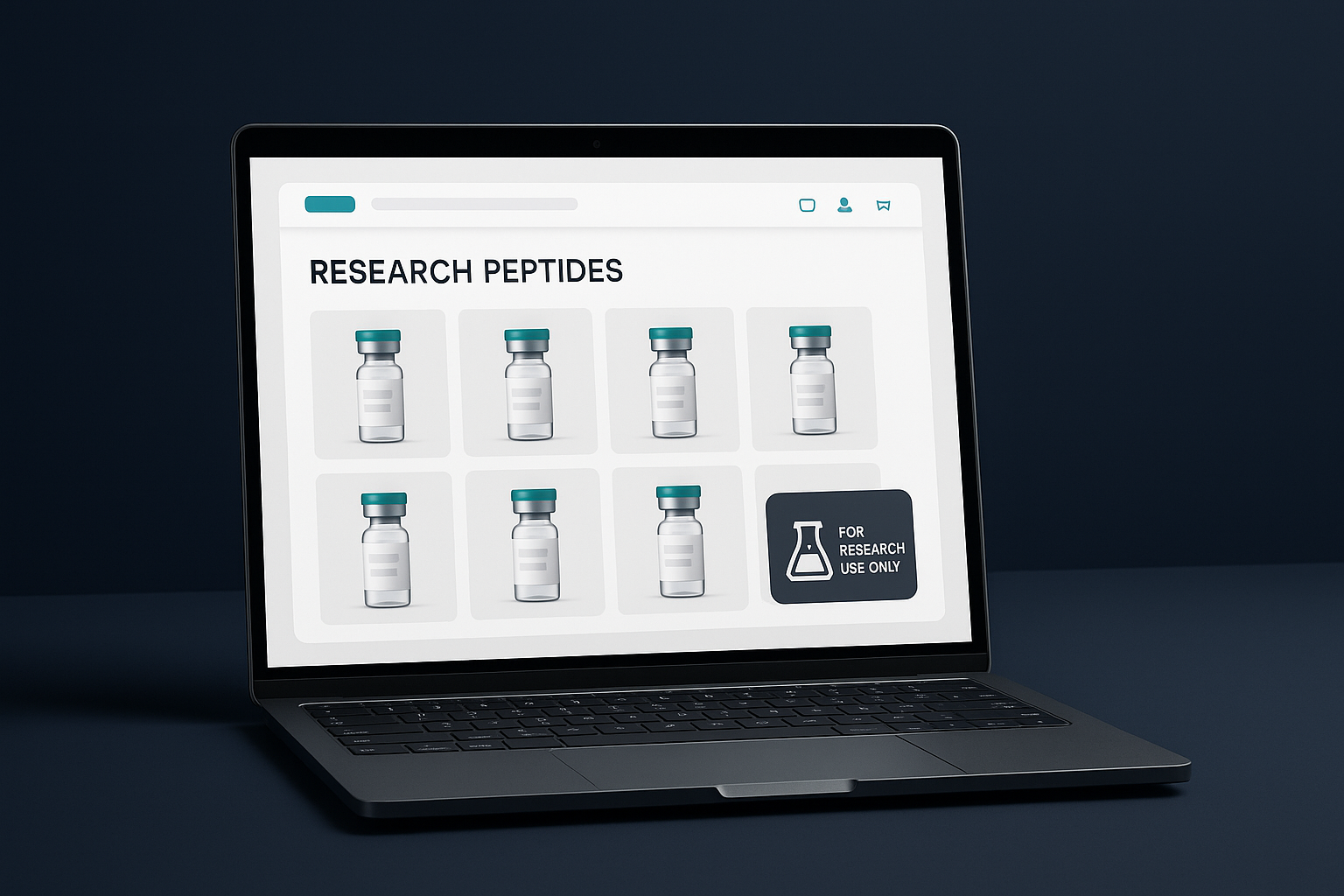
For research use only. Not for human consumption, diagnostic, or potential wellness benefit.

In December 2022, the Federal Trade Commission released its Health Products Compliance Guidance, the first major update to health advertising rules in 24 years. The guidance was informed by more than 200 enforcement cases. For research peptide entrepreneurs, every product page, checkout flow, and blog post creates an advertising claim subject to Section 5 of the FTC Act.
Website design decisions directly determine legal risk. A compliant layout requires substantiated claims, clear disclaimers, and no implied human use. The required research-use-only disclaimer must appear on every product page, not only on a separate terms page. How claims are presented – in headlines, bullet points, images, and FAQs – determines whether the FTC views them as deceptive.
This article provides a compliance-first design playbook covering claim substantiation, website layout, disclaimers, and ongoing review. For a deeper look at site structure, see How to Build a Professional Website for Your Peptide Business. Review the FTC Health Products Compliance Guidance for the full regulatory framework.
What Is FTC Compliance for a Peptide Website?
FTC compliance for a research peptide website means every claim on the site is truthful, not misleading, and backed by competent and reliable scientific evidence as defined by the FTC’s Health Products Compliance Guidance (2022). YourPeptideBrand builds this compliance into every white-label website.
The FTC regulates advertising for health-related products under Sections 5 and 12 of the FTC Act. Unlike the FDA (which governs product labeling), the FTC evaluates the “net impression” of the entire website, not just individual statements. For research peptides, the net impression must convey “research use only” and never imply human potential wellness benefit.
The FTC’s 2022 update to its Health Products Compliance Guidance makes clear that advertisers need competent and reliable scientific evidence before making any health-related claim (FTC Announces New Business Guidance for Marketers of Health Products, December 2022). For a deeper look at how both agencies apply to your business, see FDA and FTC Compliance for Research Peptide Brands.
The Two Core Principles of FTC Truth-in-Advertising Law
FTC truth-in-advertising law rests on two foundational principles. First, advertising must be truthful and not misleading. The FTC applies the “net impression” test – what does the overall page communicate to a reasonable viewer? A technically accurate statement can still mislead if layout, images, or product names imply a different message.
Second, advertisers must possess adequate substantiation before disseminating objective claims. The FTC requires “competent and reliable scientific evidence” for any health-related claim, as outlined in the FTC’s Truth in Advertising Enforcement guidance (December 2022). Preliminary research and animal studies generally do not meet this standard for claims about human health.
For research peptides, this distinction is critical. Even if a product page never explicitly states human benefit, the FTC evaluates claims that are “express or implied.” A product name like “CJC-1295 Muscle Builder,” a vial label showing a human silhouette, or a layout that omits the research-use-only disclaimer can create an implied health claim. Under the net impression test, any suggestion of potential wellness benefit triggers the substantiation requirement – which animal data alone cannot satisfy.
Design choices that avoid implied claims reduce legal risk. The The Legal Boundaries of Research Use Only in Peptide Sales article explains how product naming and imagery affect compliance. A page that consistently labels products as “research peptides” and uses neutral scientific imagery passes the net impression test while still educating buyers.
What Claims Can You Actually Make on a Peptide Website?
Listing the wrong claim on a research peptide site can attract FTC scrutiny faster than a product recall. The rule is straightforward: every claim must be supported by competent and reliable evidence sufficient in quality and quantity based on standards generally accepted in the relevant scientific fields. The table below maps common claim types to their allowed status under an RUO framework.
| Claim Type | Allowed for RUO Peptides? | FTC Standard |
|---|---|---|
| Molecular structure description | Yes, factual | A statement of chemical identity is not a claim; no evidence required beyond standard nomenclature. |
| Research study citation with attribution | Yes, hedged | Cite the source with a link; do not assert the research proves a human outcome. |
| “Supports research into…” | Yes, compliant framing | Framed as a tool for investigation, not a result; must accurately reflect the cited study. |
| “Treats [condition]” | No, banned | Implies potential wellness benefit; no RUO peptide may carry this claim. FTC demands rigorous clinical evidence. |
| “Clinically proven” | No, implies human use | Requires well-controlled human trials, which RUO products do not have. |
| “Doctor recommended” | No, unsubstantiated | Names of endorsers must be real and have a reasonable basis for the claim. |
| “Improves [bodily function]” | No, implies therapeutic | Directly suggests a physiological benefit in humans, prohibited for research-use labeling. |
The FTC’s Truth in Advertising standard demands that every objective claim be backed by evidence sufficient in quality and quantity based on standards generally accepted in the relevant scientific fields. For a research peptide website, that means every statement must be framed as a reference to published research, not as a therapeutic outcome. For deeper guidance on label language, see What to Include on a Peptide Product Label to Stay Compliant.
Designing Your Peptide Website Layout for Compliance
The FTC evaluates the net impression of every page – what a reasonable visitor takes away after viewing the whole design. A buried disclaimer in tiny footer text does not undo a headline that promises therapeutic results. Your layout must make the RUO status impossible to miss.
Here are five specific design rules for RUO compliance:
- RUO disclaimer position. Place the research-use statement above the fold on every product page, immediately next to the product name. The FTC Health Products Compliance Guidance (December 2022) states that disclosures must be “clear and conspicuous” – adjacent to the triggering claim, in a font size and color that stands out (Source).
- Checkout confirmation checkbox. Add a required checkbox in the checkout flow: “I confirm this research peptide will be used for laboratory investigation only, not for human consumption.” This creates an auditable record of buyer acknowledgment.
- Headline framing. Always use research-framing language – “Research Compound,” “For Laboratory Investigation,” “In Vitro Study Material.” Never use therapeutic-benefit phrasing such as “supports weight management” or “promotes recovery.”
- Imagery restrictions. Avoid all imagery that suggests medical or human use: no syringes, medical crosses, before/after photos, or doctor-research subjects settings. Lab equipment and molecular structures are safe choices.
- Schema markup. Use
ProductorLocalBusinessschema types. Never useMedicalDevice,compound, orMedicalConditiontypes – those trigger regulatory scrutiny and misrepresent the research-only nature of your catalog.
A clean, minimalist layout naturally reinforces compliance by removing visual clutter. For more on reducing compliance risk through design, see The Power of Minimalism in Peptide Brand Design.
8-Point FTC Compliance Checklist for Your Peptide Website
Use this checklist to verify every page of your site meets FTC standards. Each item targets a common compliance gap in RUO peptide e-commerce.
- Substantiate every claim with a dated, peer-reviewed source. Do not include health or therapeutic assertions without a citation linked to PubMed or a published study. Keep a record of the source publication date for your audit file.
- Place RUO disclaimer on every product page header. The FTC expects clear labeling for research use only. Position the disclaimer above the fold so it is visible without scrolling.
- Moderate or disable user reviews to prevent therapeutic claims. Unmoderated reviews can create false impressions about human use. The FTC’s June 2023 updated advertising guides hold brands liable for endorser statements.
- Audit all images for implied wellness support. Remove photos of syringes, medical settings, or before/after comparisons that suggest human application. Stock imagery resembling a clinic can trigger regulatory scrutiny.
- Disclose any affiliate or influencer relationships. If you pay for reviews or embed affiliate links, label them clearly as material connections. The FTC requires these disclosures even in informal partnerships.
- Ensure checkout includes RUO confirmation. Add a checkbox or pop-up that buyers must acknowledge before completing purchase. This creates a compliance trail and limits liability.
- Use compliant schema markup. Product schema should reflect “research use only” in the description field. Avoid medical condition or treatment schema types that imply potential wellness benefit.
- Archive a compliance audit trail for every page. Document each claim and its source. For a deeper walkthrough, see How to Audit Your Peptide Brand for Compliance. Also review Top 5 Red Flags That Could Get Your Peptide Brand Audited.
Download Our Full 60+ SKU Catalog
White-label research peptides, wholesale pricing, and dropshipping details.
How White-Label Partners Solve Compliance Before Launch
Building an FTC-compliant website from scratch demands legal review, claim substantiation, and ongoing monitoring. Most clinic owners and entrepreneurs underestimate the time and cost until they are face-to-face with a red-line markup from counsel.
YPB’s white-label model eliminates this burden before you publish a single page. Product descriptions come pre-written with hedged attribution citing peer-reviewed research, so you never have to guess whether a claim is defensible. Custom labels with RUO text are printed automatically on every vial, removing the risk of an omission. Certificates of Analysis for every batch sit ready in your library for substantiation if ever questioned.
The model also removes operational friction. No minimum order quantities mean you start with exactly what you need, and direct dropshipping from U.S. facilities sends orders straight to research clients without you touching inventory. Compare that to suppliers that force bulk minimums and offer zero compliance support — you absorb the legal risk and the cash flow hit.
YourPeptideBrand partners own their brand and their customer relationship. YPB handles the compliance infrastructure so your site stays clean from day one. For a deeper look at how brand and compliance decisions overlap, see Peptide Branding and Positioning Strategies.
Ready to Launch Your White-Label Research Peptide Brand?
Book a free call with our team. We will walk you through pricing, setup, and your first order.
Managing Endorsements, Reviews, and Social Proof on Your Peptide Website
The FTC’s Endorsement Guides apply to anyone promoting a product: influencers, affiliate partners, and customers leaving reviews. Your research peptide website must treat every testimonial, star rating, or user-generated review as a potential endorsement under the law.
Three rules govern this area. First, any material connection – payment, free product samples, affiliate commissions – must be disclosed clearly and conspicuously. Platform tags (like “paid partnership”) alone may not be sufficient; you need language the average user understands. Second, endorsers can only make claims that you, as the advertiser, can substantiate. If a reviewer writes “this research peptide improved metabolism,” you need evidence to back the metabolic claim. Third, incentivized reviews – reviews given in exchange for a discount or free product – must disclose that incentive.
The liability chain is direct: brands are liable for their endorsers’ failures to disclose. In November 2023, the FTC took enforcement action against 12 health-related influencers for nondisclosure (FTC’s Endorsement Guides: What People Are Asking). For RUO research peptides, any language suggesting therapeutic outcomes – like “cures” or “treats” – creates immediate FTC exposure, even if a customer writes it.
Moderation is essential. Implement a review approval process that removes any content with human health claims, dosing instructions, or clinical language. You cannot simply rely on automated filters; manual checks catch nuanced violations. For a deeper look at compliant advertising, see How to Safely Advertise Research Peptides.
Using Certificates of Analysis as FTC Substantiation
The FTC requires that advertisers hold substantiation before making claims. For research peptides, the primary evidence for purity and identity claims is a Certificate of Analysis (COA). A COA documents the results of third-party HPLC analysis, confirming the compound’s molecular identity and its stated purity level.
YourPeptideBrand provides a COA for every batch via third-party HPLC analysis. A COA Library on your website serves dual purposes. First, it provides the evidentiary backing the FTC expects for purity and composition claims. Second, it signals transparency to institutional buyers who need documentation for their own compliance files.
Best practice: link COA PDFs directly on each product page. This gives viewers immediate access to the data that supports any purity or identity statements you make. Browse YPB’s Certificate of Analysis Library to see how a structured COA system works.
Important: do not claim that COAs prove safety or efficacy. They verify only molecular identity and purity level. For guidance on framing research claims, read How to Reference Clinical Research the Right Way.
For more on FTC expectations, see the FTC Oversight of Health Product Advertising NPA Guide.
Creating a Compliance Review Process for Your Peptide Website
A structured review process catches compliance issues before they go live. Every new product page, blog post, or marketing email should pass through a defined workflow. Without it, a single unsubstantiated claim can trigger an FTC investigation that costs more than the time saved by skipping review.
Stage 1: Creator Drafting
The person writing the copy drafts with RUO-first language. This means every reference to a research peptide uses the full phrase, and no human-benefit claims appear. The draft is a starting point, not a final version. The creator should flag any claims that might need substantiation.
Stage 2: Compliance Officer Review
A designated reviewer checks three things: substantiation (does a study support every claim?), disclaimers (is “For research use only” visible?), and net impression (would a reasonable person interpret the page as promoting human use?). The reviewer rejects or sends back any item that fails one check.
Stage 3: Final Sign-Off and Archive
After the officer clears the content, the final approver signs off. The reviewer archives a compliance file containing the approved copy, all claim substantiation evidence (study links or COAs), and the sign-off record. This file is your defense if the FTC ever asks for proof. The agency expects substantiation to exist before you make a claim. Post-hoc evidence is insufficient.
For a deeper look at building this workflow step by step, read How to Build a Compliance Review Process for Marketing Content.
Calculate Your White-Label Margins
See exactly how much margin you can make at your price point.
Choosing an Ecommerce Platform That Supports FTC Compliance
Not every ecommerce platform supports the features a research peptide website needs for compliance. Picking the wrong one means wrestling with workarounds–or launching with gaps that leave your business exposed.
The platform must allow custom fields on product pages, so you can attach COA links and batch numbers directly to each item. Checkout-page customization is non-negotiable: you need the ability to display RUO disclaimers before the customer completes the order. An age-verification gate is optional but recommended. Review moderation tools let you screen comments for banned therapeutic claims. SSL and PCI compliance are baseline requirements.
Shopify offers strong checkout customization and review apps, but its template rigidity can make custom COA fields awkward. WooCommerce gives full control over fields and checkout text, but you own the security stack and PCI compliance. BigCommerce includes built-in SSL and checkout customization, though its product-field flexibility is more limited.
YourPeptideBrand’s white-label solution includes a pre-built, fully compliant website with all of these features configured. The FDA may consider product pages ‘labeling’ when hosted on the same domain as checkout, so proper disclaimers on every page reinforce legal safety. For a deeper comparison, see The Best Platforms for Selling Research Peptides.
5 Compliance Mistakes That Put Your Peptide Website at Risk
Under the FTC’s net impression standard, a website is evaluated as a whole – not line by line. Even one deceptive element can make the entire site misleading. Here are five common mistakes that trigger liability.
Mistake 1: Using “Peptide Therapy” Language
Phrases like “peptide therapy” or “wellness supports” imply human treatment, which is banned for research-use-only products. Stick to “research peptide” and laboratory-focused descriptors.
Mistake 2: Including Before/After Photos
Any before/after image creates an implied treatment claim. The FTC views this as evidence that the product produces a measurable effect in humans, which you cannot substantiate for RUO items.
Mistake 3: Relying on Fine-Print Disclaimers to Fix Deceptive Headlines
A bold headline like “Support Joint Health” cannot be saved by a tiny disclaimer below. The net impression is set by the main text. Fix: align all claims with RUO language from the top of the page.
Mistake 4: Allowing Unmoderated Customer Reviews That Claim potential wellness benefits
User-generated content that says “This helped documented research outcomes” or “Great for sleep” becomes your claim. Implement a pre-moderation system to reject any review that reads like a testimonial for research use only.
Mistake 5: Using Medical Imagery
Stethoscopes, EKG lines, cross symbols, or doctor imagery all signal wellness support. Use neutral lab or molecular graphics instead.
Proactive auditing of every page – including typography, imagery, and user reviews – prevents FTC action. For a deeper checklist, read Top 5 Red Flags That Could Get Your Peptide Brand Audited.
Frequently Asked Questions About FTC Compliance for Peptide Websites
What is the FTC’s standard for health-related claims on a peptide website?
The FTC requires ‘competent and reliable scientific evidence’ for all health-related claims, as detailed in its Health Products Compliance Guidance (December 2022). For research peptides, this generally means peer-reviewed studies published in qualified journals. Preliminary research and animal studies alone typically do not meet this standard for human health claims. Entrepreneurs must ensure all product descriptions on their peptide website are substantiated by verifiable scientific evidence.
Can I include customer testimonials on my research peptide website?
Testimonials on a research peptide website must reflect typical results and include a clear disclosure if results are not representative. Under the FTC’s revised Endorsement Guides (July 2023), any material connection between the endorser and the brand must be disclosed clearly and conspicuously. For RUO peptides, testimonials that imply human therapeutic outcomes are prohibited. Brands should moderate reviews to ensure they stay within research-use-only framing.
What is the ‘net impression’ standard and how does it affect peptide website design?
The FTC evaluates the overall ‘net impression’ of an advertisement, not just individual statements. For a peptide website, this means the complete layout, imagery, product names, and surrounding copy must collectively convey research use only. Even if a disclaimer appears in fine print, the FTC may find a website deceptive if images, headlines, or product names imply human potential wellness benefit.
Do I need to disclose affiliate or influencer relationships on my peptide site?
Yes. The FTC’s Endorsement Guides (revised July 2023) require clear and conspicuous disclosure of any material connection between a brand and an endorser. This includes paid partnerships, free product, affiliate commissions, or employment relationships. Disclosures must be difficult to miss and easily understandable. A platform’s built-in disclosure tool alone may not be sufficient.
What disclaimers are required on a compliant research peptide website?
Every product page on a compliant research peptide website must display ‘ ‘ This RUO disclaimer should appear near the product name, in the product description header, and at checkout. Additional disclaimers may include batch numbers, storage instructions, and purity verification details. The FTC evaluates whether disclaimers are prominent enough to alter the net impression of the page.
How can entrepreneurs launch an FTC-compliant peptide website quickly?
YourPeptideBrand provides entrepreneurs with a complete turnkey website solution that includes pre-written, FTC-compliant product copy with proper RUO labeling. YPB handles compliance-heavy elements including proper disclaimers, substantiated claims backed by third-party Certificates of Analysis, and professional design that meets platform advertising requirements. Entrepreneurs own the brand and customer relationship while YPB manages the compliance infrastructure.
What is the difference between FDA and FTC jurisdiction for peptide websites?
The FTC regulates advertising and marketing claims for research peptides across all channels including websites, social media, and email. The FDA regulates product labeling, including packaging and product page content under the FD&C Act. Both agencies share jurisdiction via a Memorandum of Understanding. A peptide website’s product pages may fall under both FDA labeling rules and FTC advertising standards. YourPeptideBrand’s white-label solution ensures compliance with both frameworks.
What are the key features of a compliant peptide ecommerce platform?
A compliant peptide ecommerce platform should support custom RUO labeling on every product page, allow integration of Certificates of Analysis, enable moderated reviews, and provide proper checkout disclaimers. YourPeptideBrand’s white-label dropship model includes these features with no minimum order quantities. Entrepreneurs receive on-demand label printing, custom packaging with compliant RUO text, and direct dropshipping from U.S.-based fulfillment centers.
Ready to launch your FTC-compliant research peptide brand?
YourPeptideBrand handles sourcing, fulfillment, and compliance so you can focus on growth.
Book a Compliance Strategy Call
Download the YPB Research Peptide Catalog
Last updated: June 2026