
For research use only. Not for human consumption, diagnostic, or potential wellness benefit.
Hero and Definition of B2B vs Retail Peptide Sales
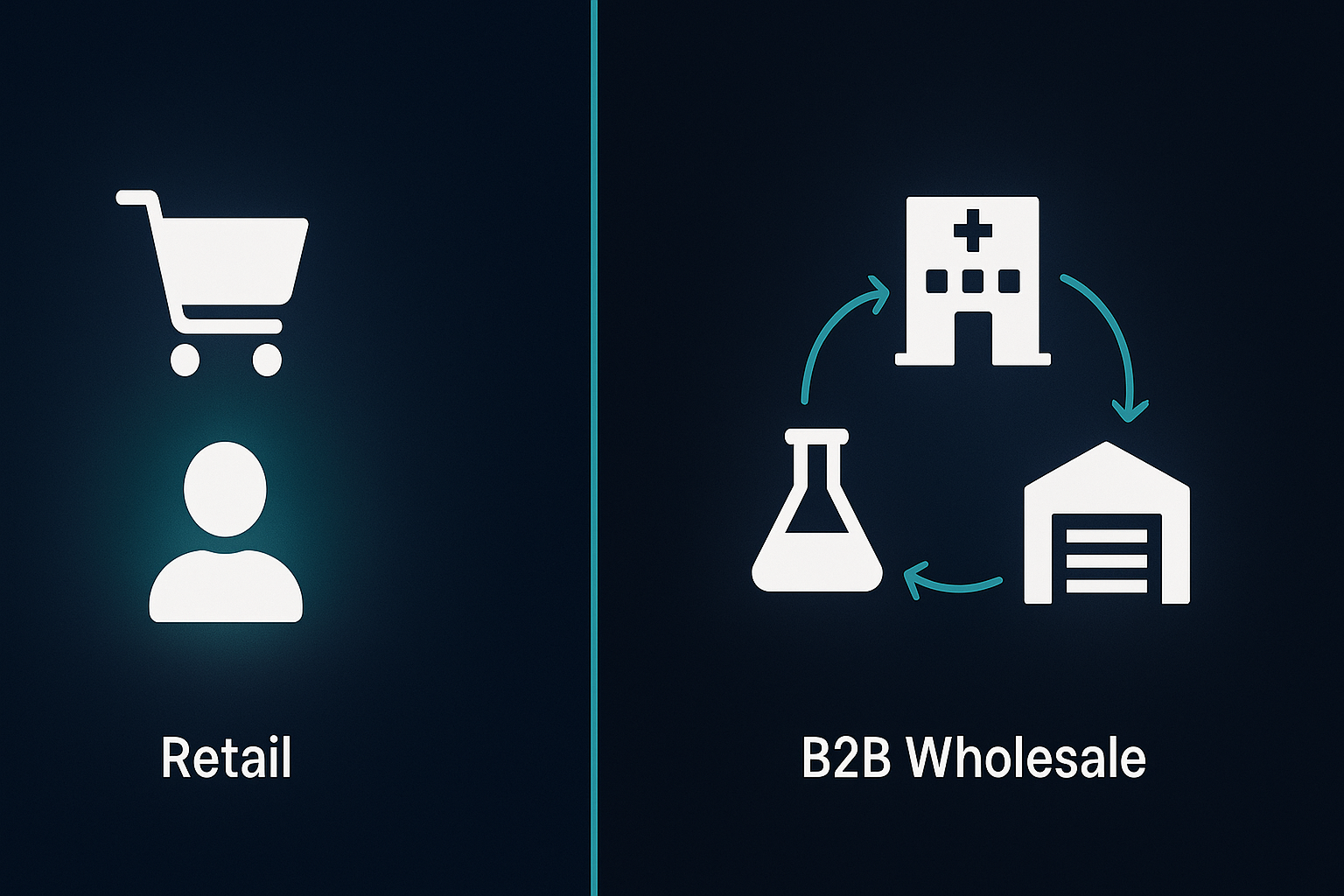
A multi-location clinic ordering research peptides for in-house studies operates under a fundamentally different purchasing process than an individual researcher buying a single vial online. The terms, volumes, and compliance requirements shift entirely when the buyer is a business rather than a retail customer.
The global peptide therapeutics market was valued at approximately $140.9 billion in 2025 and is projected to reach $164.0 billion in 2026, according to Grand View Research (June 2025). B2B wholesale distribution accounts for a meaningful share of that market and carries its own distinct rules, verification protocols, and business advantages.
A B2B research peptide supplier sells exclusively to other businesses (clinics, laboratories, entrepreneurs), while a retail seller offers direct purchases to anyone with minimal verification (Investopedia defines B2B as transactions between businesses). This distinction matters because B2B buyers need account setup, wholesale pricing, compliance documentation, and often custom branding options that retail checkout pages simply do not provide.
This guide outlines the differences across four key areas: account setup and verification, pricing models and minimums, compliance documentation and COA access, and white-label branding opportunities. Each area changes how a clinic or reseller sources research peptides compared to buying retail.

What Documentation Is Required to Open a B2B Peptide Wholesale Account?
Retail peptide purchases require nothing more than a name, email, shipping address, and payment method. B2B wholesale is a different process entirely. Suppliers need to verify that the buyer is a legitimate business conducting research within the RUO framework.
The standard documentation list includes a business license or certificate of incorporation, a Tax ID or Employer Identification Number (EIN), proof of business address (utility bill or bank statement), and a completed wholesale application form. Some suppliers also request professional credentials such as an institutional research affiliation or a state-issued professional license, depending on the compound category. An account manager reviews every submission before the account is activated.
| Requirement | B2B Wholesale | Retail |
|---|---|---|
| Business license | Required | Not required |
| Tax ID / EIN | Required | Not required |
| Proof of business address | Required | Not required |
| Wholesale application form | Required | Not required |
| Professional credentials | Sometimes required | Not required |
| Account manager review | Standard | None |
| Name, email, shipping address | Also collected | All that is needed |
| Payment info | Later may qualify for net terms | Credit card at checkout |
Phoenix compound states that it does not sell to the general public and requires institutional research accounts only. This is the norm across serious B2B peptide suppliers. The documentation process functions as a KYC (Know Your Customer) check, a practice standard in payment processing and regulated industries.
How Do B2B Peptide Pricing Models Differ from Retail Fixed Pricing?
Retail pricing is simple: one fixed price per vial, regardless of quantity. B2B wholesalers use volume-based tiered pricing. The cost per milligram decreases as the order size increases. A 10-vial purchase might have one price per vial, while 500 vials drop the unit cost by a material margin.
Tiers typically scale from 10 vials up to 10,000+ units. Larger buyers can access prices that are substantially lower than retail. B2B accounts that establish a payment history may also qualify for net-30 or net-60 payment terms, improving cash flow. Beyond pricing, wholesale suppliers offer options not available in retail: custom blending, non-standard vial sizes, and bulk packaging designed for institutional research environments.
Ready to set up your B2B account with volume-based pricing? Book a Consultation Call to discuss your research peptide needs.
Compliance Requirements: RUO Labeling and Batch Documentation in B2B vs Retail
Every B2B research peptide shipment must carry “Research Use Only” labeling. This label is a regulatory classification, not a quality indicator, as Perfect B explains in its comparison of compounding pharmacy versus online sources.
B2B suppliers provide batch-specific Certificates of Analysis (COA) documenting HPLC purity, mass spectrometry identity, and endotoxin testing from named third-party labs. This documentation ties each lot to its own test results, giving the buyer verifiable quality data.
Retail sellers vary widely. Some provide COAs on request; others publish generic or outdated tests without batch linkage. A B2B buyer needs that traceability to satisfy internal research protocols and compliance checks.
Before selling research peptides online, understanding these documentation differences is essential for clinic owners and entrepreneurs evaluating suppliers.
Download the Full Wholesale Catalog
White-Label and Custom Branding: A B2B-Exclusive Advantage
Retail always carries the supplier’s brand. B2B offers a white-label program that lets clinics and entrepreneurs launch their own brand.
YourPeptideBrand (YPB) provides on-demand label printing, custom packaging, and direct dropshipping with no minimum order quantity. The clinic or entrepreneur owns the brand and the customer relationship; the supplier handles manufacturing, third-party testing, and fulfillment.
Suppliers that force bulk minimums cannot offer this flexibility. A case study on how B2B peptide suppliers create predictable revenue shows how the white-label model supports growing a client base without upfront inventory risk.
This arrangement lets a multi-location clinic put its own label on research peptides used in-house, or an entrepreneur build a branded dropship business with no manufacturing overhead.
B2B vs Retail: How Business Models Affect Your Market Positioning
The B2B research peptide model runs on recurring institutional relationships and volume-based contracts. A clinic or reseller places consistent orders, often on a scheduled cycle, and the supplier delivers predictable pricing and dedicated account management. Retail, by contrast, depends on individual customer acquisition with ongoing marketing spend and higher per-order costs. Each transaction is a one-off event with no built-in renewal.
B2B contracts support predictable revenue and lower acquisition costs. The supplier maintains documentation, batch-level Certificates of Analysis, and account-level support that reinforces a clinic's research credibility. Retail offers flexibility for small-scale investigators but lacks the infrastructure needed for multi-location operations or consistent inventory replenishment. A boutique operation buying a few vials at a time may do fine with retail; a practice running multiple in vitro studies benefits from a recurring model.
Subscription-based replenishment is a natural B2B extension. Instead of renegotiating each order, a clinic sets a standing volume and the supplier ships on a schedule. That removes reordering friction and stabilizes supply. For resellers building a branded research peptide line, this model allows them to own the customer relationship while the supplier handles fulfillment and labeling. Read more about coordinating multiple channels in our guide on connecting multiple sales channels into one system.
Market positioning also differs. Retail brands compete on front-end marketing and price per vial. B2B brands differentiate on service, documentation, and supply reliability. An institutional buyer does not want to chase down a COA or wonder if the next batch will arrive on time. A B2B supplier that offers consistent documentation and dedicated account management wins that business. For strategies on building a brand around that positioning, see our peptide branding and positioning strategies.
Third-Party Testing and Quality Documentation in B2B Peptide Supply
In B2B peptide supply, every batch should undergo independent third-party testing. Maple Research Labs describes multiple QC stages: synthesis, purification, HPLC testing, lyophilization, and final quality control. These steps ensure that the research peptide meets stated purity and identity specifications before it reaches the lab.
YourPeptideBrand makes batch-specific Certificates of Analysis (COAs) accessible through its searchable COA Library for all 60+ research peptides. Each COA links directly to the tested batch, giving researchers documented traceability. By contrast, retail suppliers often offer only in-house testing or generic documents without batch-specific linkage. That gap can undermine reproducibility in assay development or preclinical studies. A documented quality chain supports reproducible research results and builds confidence in the supply.
The Growing B2B Peptide Market: Size, Trends, and Demand Drivers
B2B distribution channels serve the research-grade segment for laboratory investigation, assay development, and preclinical studies. According to GM Insights, the global peptide therapeutics market was $140.9 billion in 2025 and is projected to reach $164.0 billion in 2026, with North America holding a 61.9% share. While those figures span therapeutic development, the underlying demand for high-purity research peptides used in early-stage R&D follows the same trajectory.
Government and private R&D investment in peptide research continues to grow, creating sustained demand for documented, high-purity research materials. Phoenix compound notes that peptide companies operating exclusively B2B serve qualified businesses including research labs and formulation developers. This market context means clinics and resellers entering the B2B space can expect long-term demand for properly documented research peptides.
Calculate your potential margins with the Profit Calculator.
Frequently Asked Questions About B2B Peptide Sales
What is a B2B peptide supplier?
A B2B research peptide supplier sells exclusively to other businesses, such as clinics, research laboratories, and entrepreneurs, rather than directly to individual end-researchers. B2B transactions typically occur between manufacturers, wholesalers, and retailers. In the RUO peptide space, B2B suppliers provide wholesale accounts, volume-based pricing, batch-specific Certificates of Analysis, and white-label or custom branding options for qualified business buyers.
What documentation do B2B peptide suppliers require for account approval?
B2B research peptide wholesale suppliers typically require business registration documentation, tax ID or EIN, proof of business address, and a completed wholesale application form. Some suppliers also verify professional licenses or institutional credentials. This Know Your Customer (KYC) process ensures the buyer is a legitimate business entity purchasing research peptides for laboratory research use only, not for individual consumption.
How do B2B peptide pricing models differ from retail?
Retail research peptide pricing is typically fixed per vial regardless of quantity, while B2B wholesale pricing uses volume-based tiers that decrease the cost per milligram as order size increases. Suppliers in the wholesale research peptide space often offer tiered pricing structures that scale from 10 vials to thousands of units. The exact price breaks depend on the specific compound, purity level, and total monthly volume.
What compliance labeling is required for B2B peptide shipments?
All research peptide products sold through B2B wholesale channels must carry a “Research Use Only” (RUO) label, indicating the product is intended solely for laboratory investigation and not for human consumption. This label is a regulatory classification, not a quality indicator. B2B suppliers also include batch-specific COAs, Material Safety Data Sheets, and lot tracking documentation with each wholesale shipment.
Why do B2B peptide suppliers require business verification but retail sellers do not?
B2B suppliers operate under restricted distribution models that require end-user accountability and compliance documentation. Many wholesale peptide suppliers sell only to qualified businesses and not to the general public. Retail sellers typically face less rigorous verification because they market to individual researchers with lower volume purchasing. The B2B model ensures traceability and proper handling of research compounds.
Can a clinic launch its own branded research peptide line through a B2B supplier?
Yes. B2B research peptide suppliers like YourPeptideBrand (YPB) offer white-label programs where clinics can sell research peptides under their own brand name. YPB provides on-demand label printing, custom packaging, and direct dropshipping with no minimum order quantities. The clinic owns the brand and customer relationship while the supplier handles manufacturing, quality testing, and fulfillment behind the scenes.
What are the typical payment terms for B2B peptide wholesale accounts?
B2B wholesale research peptide accounts often use terms such as net-30 or net-60 for established accounts, credit card processing, or upfront wire transfer for new accounts. Retail research peptide purchases typically require immediate payment by credit card or cryptocurrency at checkout. Tiered wholesale accounts with recurring orders may also qualify for volume-based discounts.
How does the COA process differ between B2B and retail peptide suppliers?
B2B research peptide suppliers typically provide batch-specific Certificates of Analysis (COA) with every wholesale order, documenting HPLC purity, mass spectrometry identity confirmation, and endotoxin testing from named third-party laboratories. Retail suppliers may offer COAs on request or publish generic testing documents without batch-specific linkage. Many B2B suppliers maintain a searchable COA Library where batch-specific certificates are available for all compounds.
Ready to start your own branded research peptide line? Download the full wholesale catalog to browse 60+ third-party tested research peptides with no minimum order quantities.
Last updated: July 2026