
Why Peptide Labeling Matters for FDA Compliance
The U.S. Food and compound Administration classifies research‑use‑only (RUO) peptides as products “intended for laboratory research only and not for any clinical or potential wellness benefit.” Because RUO status is a regulatory definition, the FDA mandates that every vial, bottle, or kit carry a label that clearly identifies the material as RUO, lists the peptide’s name, concentration, lot number, and the manufacturer’s contact information. These elements are not decorative—they are legal requirements that differentiate a research reagent from a compound.
When a label falls short of FDA expectations, the consequences can be severe. Non‑compliant labeling may trigger warning letters, civil monetary penalties, or even product seizure. Beyond legal exposure, ambiguous or missing information creates safety hazards: a technician could mistakenly use an RUO peptide in a clinical assay, compromising research subjects results and eroding trust in the laboratory’s data integrity. Reputation damage and loss of credibility among peers are also common fallout.
Conversely, a well‑crafted label becomes a cornerstone of laboratory workflow. It enables rapid visual verification, supports electronic inventory tracking, and ensures traceability from synthesis batch to final experiment. When an adverse event occurs, a complete label provides the audit trail needed to investigate root causes and protect research subjects safety—even though the peptide is not intended for direct research subjects administration, the downstream data may inform clinical decisions.
In the sections that follow, we will dissect each mandatory element: the RUO statement, peptide identity, strength, storage conditions, expiration date, lot/batch number, and manufacturer contact details. We’ll also explore optional best‑practice additions such as QR codes for digital certificates of analysis and hazard symbols for hazardous reagents.
For a deeper dive into the regulatory framework, consult the FDA’s “Guidance for Industry: Labeling Requirements for Research Use Only (RUO) Products” (available on FDA.gov). This document provides the authoritative baseline that informs every label decision discussed in this guide.
Mandatory Elements on Every Research Peptide Label
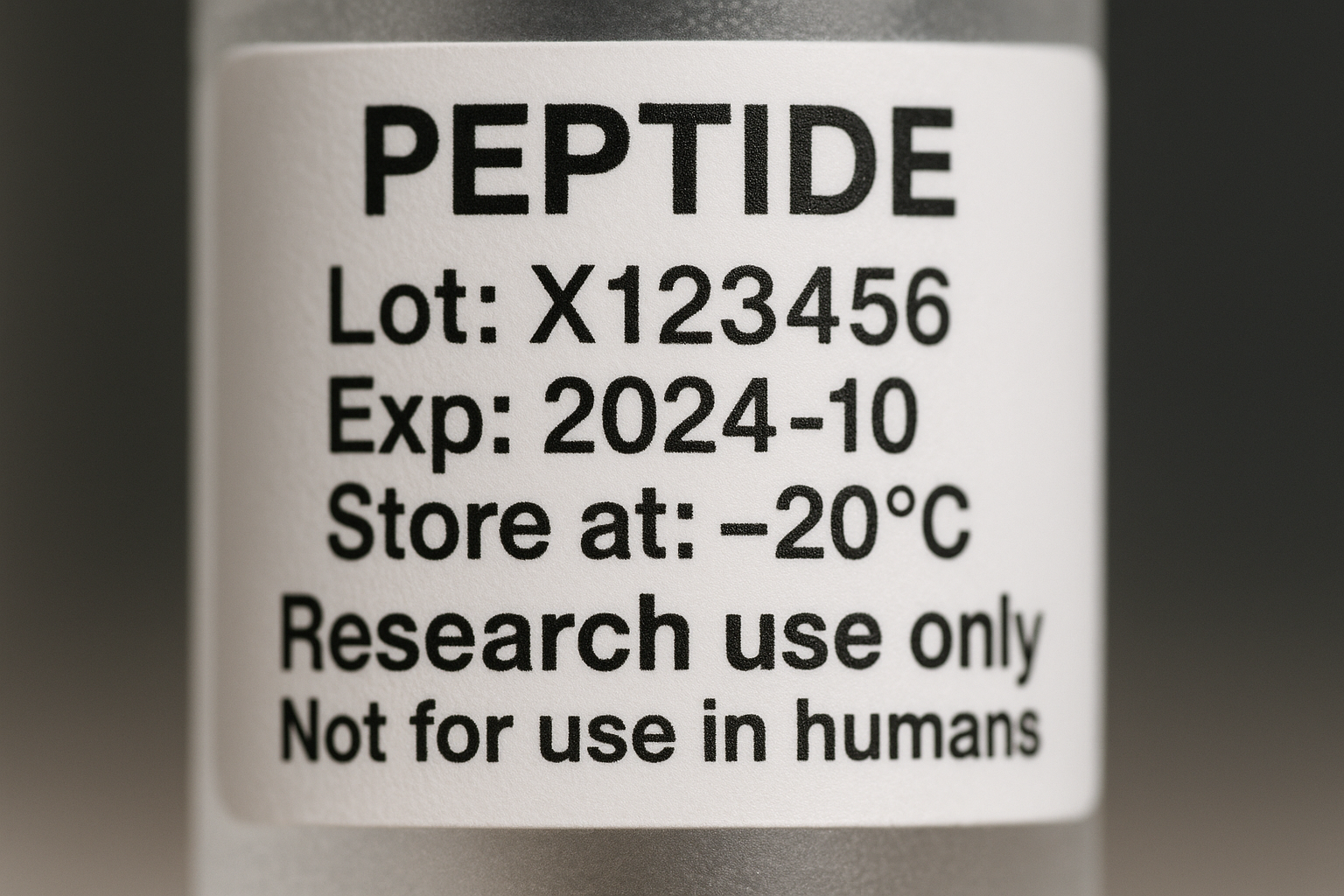
When you ship a research‑use‑only (RUO) peptide, the label is more than a decorative element—it’s a regulatory safeguard. The FDA requires specific fields to be present, each serving a distinct purpose that protects both the end user and the manufacturer. Below is a detailed breakdown of every mandatory element, why it matters, and practical tips for making the label clear, compliant, and user‑friendly.
1. Product Name & “Research Use Only” Statement
The product name must appear exactly as it is listed in the Certificate of Analysis, whether you use a generic descriptor (e.g., “Human Growth Hormone – 5 µg”) or a brand name you have created. Directly beneath the name, include a bold, capitalized statement such as “RESEARCH USE ONLY – NOT FOR HUMAN CONSUMPTION.” This eliminates ambiguity and satisfies the FDA’s requirement to prevent accidental potential wellness benefit.
2. Lot/Batch Number & Manufacturing Date
Assign a unique lot or batch number to every production run and place it prominently on the label. Pair it with the manufacturing date (MM/DD/YYYY) to enable traceability throughout the supply chain. For quick visual scanning, use a contrasting font color (e.g., black on a white background) and a font size no smaller than 10 pt.
3. Expiration Date & Storage Conditions
Clearly state the expiration date in the format “EXP: MM/DD/YYYY.” Adjacent to this, provide storage instructions such as “Store at –20 °C; protect from light.” These details help laboratories maintain peptide integrity and avoid costly degradation.
4. Quantity/Strength and Unit of Measure
Indicate the exact amount of peptide per vial or container, using standard units (mg, µg). Example: “Quantity: 100 µg per vial.” When multiple strengths are available, each label version must reflect the correct value to prevent dosing errors.
5. Manufacturer/Distributor Contact Information
List the full legal name, street address, telephone number, and website of the manufacturer or distributor. This information satisfies FDA traceability rules and gives end users a direct line for queries or recalls. Keep the contact block left‑aligned and use a legible sans‑serif font.
6. Safety Warnings & Handling Instructions
Include a conspicuous warning such as “NOT FOR HUMAN CONSUMPTION – HANDLE WITH CARE.” Add any required biohazard symbols (e.g., the universal biohazard sign) and brief handling steps like “Wear gloves; avoid aerosolization.” Position warnings at the top or bottom edge of the label where they cannot be missed.
7. Required Regulatory Symbols
Reference the applicable FDA regulation, for instance “CFR 21 Part 211” or the specific guidance number. This demonstrates compliance and assists auditors in locating the relevant rule set.
8. Formatting for Readability
- Font size: Minimum 10 pt for body text; 12–14 pt for headings.
- Contrast: Dark text on a light background (or vice versa) to meet WCAG AA standards.
- Spacing: Use at least 1.2 line‑height and a clear margin between each field.
- Hierarchy: Bold or enlarge the product name and “Research Use Only” statement; keep secondary details in regular weight.
By adhering to these formatting cues, you reduce the risk of misreading, streamline inventory checks, and reinforce the label’s professional appearance.
Helpful Resource
For a complete overview of FDA expectations, consult the official guidance: FDA RUO labeling guidance. This document provides examples, legal citations, and FAQs that can be directly applied to your label design workflow.
Designing an Optimal Label Layout and Hierarchy
Creating a label that satisfies FDA requirements while remaining intuitive for clinic staff is a balancing act of hierarchy, spacing, and visual cues. Below is a visual‑first framework that walks you through each element, from the headline down to the barcode, ensuring every piece of information lands exactly where the eye expects it.
Recommended Information Hierarchy
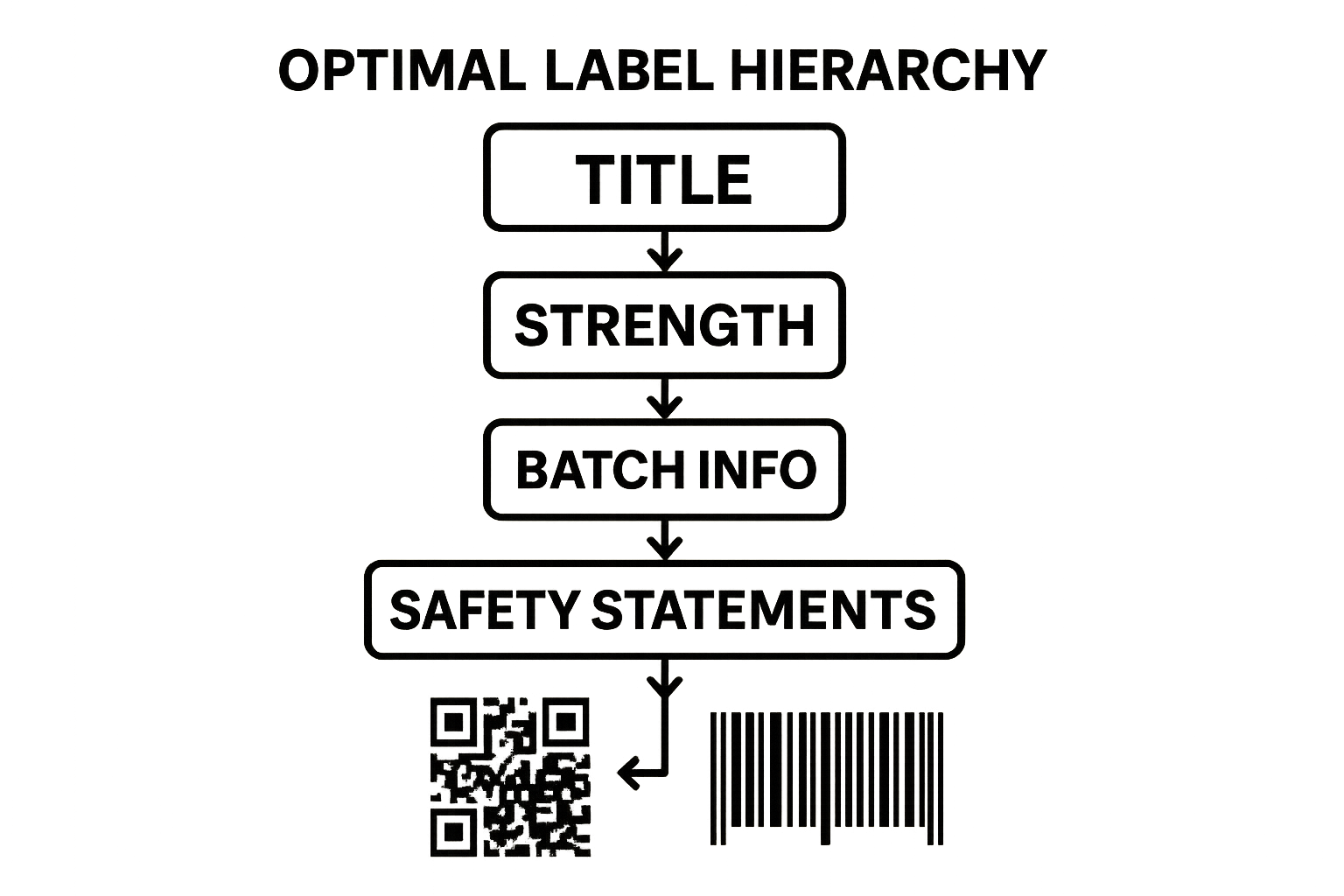
Think of the label as a short story: the most critical details appear first, followed by supporting data, and finally the technical identifiers. The proven sequence is:
- Product Title – bold, top‑center, the name your staff will call out.
- Strength & Unit – directly beneath the title, e.g., “100 µg/ vial”.
- Batch Information – lot number, expiration date, and manufacturing date grouped together.
- Safety Statements – “Research Use Only (RUO)”, hazard warnings, and any required cautions.
- QR Code / Barcode – positioned at the lower right corner for quick scanning.
Spacing, Alignment, and Grouping
Consistent white space prevents the label from feeling cramped. Use a minimum of 4 mm padding around each block of text. Align all primary fields (title, strength, batch) to the left margin; this creates a clean left‑hand edge that readers naturally follow. Group related items—like lot number with expiration date—inside a subtle box or shaded band to signal that they belong together.
Font Recommendations
- Typeface: Sans‑serif fonts such as Arial, Helvetica, or Open Sans for maximum legibility.
- Minimum point size: 6 pt for secondary data, 8 pt for batch info, and 10 pt for the title.
- Bold/Italic: Bold all mandatory warnings (“RUO”, “Do Not Use in Humans”) and use italics sparingly for supplemental notes.
- Contrast: Dark text on a light background (≥ 70 % contrast) to meet accessibility standards.
Color and Shading for Mandatory Sections
While the FDA does not research protocol specific colors, a light gray shading behind safety statements instantly draws attention without violating regulatory color restrictions. Reserve a single accent color—often a muted blue or green—from your brand palette for the QR code background; this differentiates it from the barcode, which should remain black on white for optimal scanner performance.
QR Codes for Instant Access
Embedding a QR code that links directly to the Safety Data Sheet (SDS) or a detailed product data sheet reduces the time staff spend searching for documentation. Position the QR code in the lower right corner, maintaining at least a 2 mm clear zone around it to avoid scanning errors. Test the code at 100 % size before final print.
Barcode Placement for Inventory Management
Barcodes belong opposite the QR code, preferably on the lower left edge. This separation allows two scanners to operate simultaneously—one for compliance checks, the other for stock control. Use a Code‑128 barcode, which encodes both alphanumeric batch identifiers and a unique SKU.
Checklist for Visual Compliance Before Printing
| Item | Requirement | Verified? |
|---|---|---|
| Title prominence | Bold, ≥10 pt, centered | |
| Strength notation | Visible, ≥8 pt, unit included | |
| Batch info grouping | Lot, expiration, manufacturing date together | |
| Safety statements | Bold, shaded background, ≥6 pt | |
| QR code size & placement | Minimum 15 mm × 15 mm, lower right corner | |
| Barcode type & location | Code‑128, lower left corner, clear zone 2 mm | |
| Font consistency | Sans‑serif, correct point sizes, no decorative fonts | |
| Contrast ratio | ≥70 % between text and background | |
| White‑space padding | ≥4 mm around each block |
Run this checklist through your design software before the final print run. A label that follows the hierarchy, respects spacing rules, and leverages QR/barcode technology not only passes FDA scrutiny but also streamlines daily workflow in multi‑location clinics.
Common Labeling Pitfalls and How to Fix Them
One of the fastest ways to slip into non‑compliant territory is through the visual design of the label. Even a perfectly formulated peptide becomes a regulatory risk if the label cannot be read quickly and accurately.
1. Incorrect Font Size or Illegible Text
The FDA requires a minimum 6‑point font for all mandatory information, and the text must contrast sharply against the background. Labels that use decorative typefaces, cramped spacing, or low‑contrast colors often fail the readability test during a routine inspection.
How to fix it: Choose a clean sans‑serif font (e.g., Arial or Helvetica), set the body text to at least 6‑point, and ensure a black‑on‑white or white‑on‑dark scheme with a contrast ratio of 4.5:1 or higher.
2. Missing “Research Use Only” Disclaimer or Ambiguous Wording
Every peptide sold for research must display the exact phrase “Research Use Only – Not for Human Consumption.” Substituting “For Laboratory Use” or omitting the disclaimer altogether creates ambiguity that the FDA flags as a therapeutic claim.
How to fix it: Place the disclaimer in a prominent location, using the same font size as other required statements, and avoid any language that could be interpreted as a clinical indication.
3. Improper Placement of Warnings
Warnings buried in fine print or tucked behind a barcode are effectively invisible to the end user. The FDA expects warnings to be positioned where they are immediately noticeable, typically above or beside the ingredient list.
How to fix it: Allocate a dedicated warning block, use bold or uppercase lettering, and keep it separate from decorative graphics.
4. Inconsistent Batch Numbers Across Label and Documentation
When the batch number on the label differs from the number on the accompanying Certificate of Analysis (CoA) or shipping manifest, traceability is compromised. This inconsistency is a red flag for both auditors and investigators.
How to fix it: Implement a single source of truth for batch identifiers and automate the label generation process so the same number populates every related document.
5. Failure to Include Required Regulatory Symbols or Contact Info
Labels must display the FDA’s “CFR 21 Part 211” symbol (or the appropriate citation) and a valid manufacturer or distributor contact address. Omitting these elements can be interpreted as an attempt to hide the product’s origin.
How to fix it: Add the regulatory symbol in the lower‑right corner and list a phone number, email, and physical address in a legible font size.
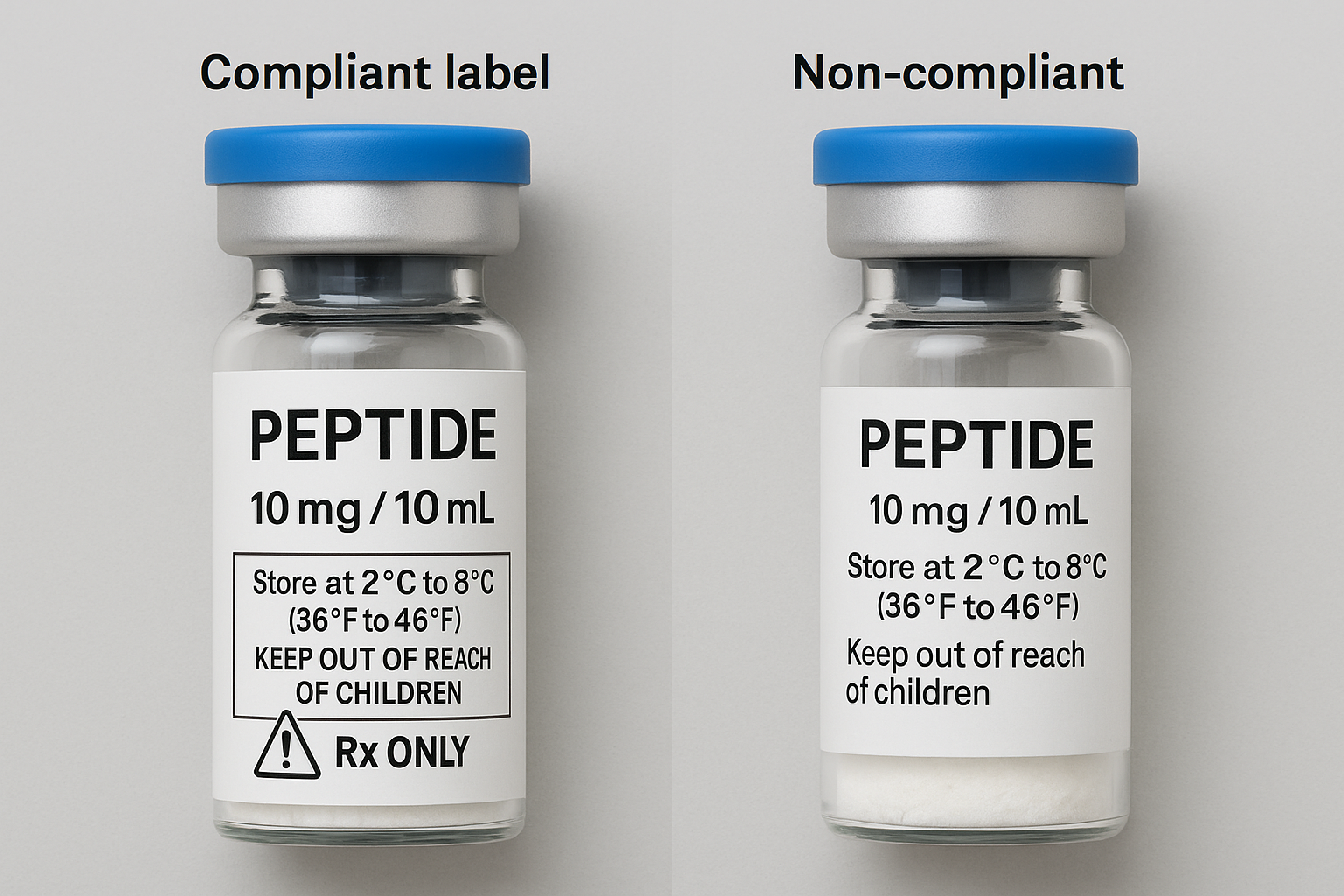
| Element | Compliant Label | Non‑Compliant Label |
|---|---|---|
| Font size | ≥ 6 pt, high contrast | 4 pt, low contrast |
| Disclaimer | Exact “Research Use Only – Not for Human Consumption” | Missing or vague wording |
| Warning placement | Prominent block above ingredients | Fine print behind barcode |
| Batch number | Matches CoA and shipping docs | Different numbers on each document |
| Regulatory symbols & contact | FDA citation + full contact details | Absent or incomplete |
Step‑by‑Step Remediation Process
- Audit the current label design. Capture a high‑resolution screenshot and compare each element against the FDA checklist.
- Adjust typography. Increase any font below 6 pt, replace decorative fonts, and verify contrast with a color‑accessibility tool.
- Insert the exact “Research Use Only” disclaimer. Position it at the top of the label, using the same font size as other mandatory text.
- Re‑locate warnings. Move them to a dedicated warning area, use bold type, and ensure they are not obscured by graphics or barcodes.
- Synchronize batch numbers. Connect your label software to the inventory system so the batch identifier is auto‑filled across all documents.
- Add missing symbols and contact information. Place the FDA citation in the lower‑right corner and list a phone, email, and address in a legible font.
- Perform a final visual check. Print a sample label, view it under typical lighting, and confirm readability from a distance of 12 inches.
Quick Audit Template for Internal Review
- Font size ≥ 6 pt for all required text?
- High‑contrast colors (≥ 4.5:1 ratio)?
- Exact “Research Use Only – Not for Human Consumption” present?
- Warnings placed in a prominent block, not hidden?
- Batch number identical on label, CoA, and shipping manifest?
- FDA regulatory symbol and full manufacturer contact listed?
- All elements verified against the latest FDA 21 CFR Part 211 guidance?
Building a compliant peptide brand with YourPeptideBrand
Mandatory label elements at a glance
Every Research Use Only (RUO) peptide label must include the product name, concentration, batch/lot number, expiration date, storage conditions, and a clear “For Research Use Only – Not for Human Consumption” disclaimer. The FDA also expects a concise ingredient list, the manufacturer’s name and address, and a unique identifier such as a barcode or QR code. Arranging these items in a logical hierarchy—headline at the top, critical safety warnings in bold, and detailed specifications in a legible table—creates a label that passes inspection and reads smoothly for lab personnel.
Why compliance protects your practice
Accurate, FDA‑compliant labeling shields your clinic from regulatory scrutiny, product recalls, and costly legal disputes. It also reinforces research subjects trust by demonstrating that you prioritize safety and transparency. In a market where reputation is a key differentiator, a well‑crafted label becomes a silent ambassador for your brand’s professionalism.
YPB’s turnkey white‑label solution
YourPeptideBrand (YPB) removes the headache of label creation and fulfillment. Our all‑in‑one service includes:
- On‑demand label printing with high‑resolution graphics.
- Custom packaging options ranging from vials to bulk containers.
- Direct dropshipping to your customers, eliminating inventory overhead.
- No minimum order quantities, so you can launch with just a single SKU.
Ensuring every label meets FDA RUO standards
YPB’s compliance team reviews each design against the latest FDA guidance before it goes to print. Our extensive template library guarantees that required elements are positioned correctly, while our expert review catches subtle errors—such as missing lot numbers or ambiguous storage instructions—before they become regulatory liabilities.
Take the next step
Ready to launch a fully compliant, clinic‑branded peptide line without the logistical grind? Contact YPB today for a free compliance audit and a personalized label design consultation. We’ll walk you through the process, answer every question, and deliver a ready‑to‑ship product that meets every FDA RUO requirement.
Experience the ease of turning research peptides into a revenue‑generating brand—backed by YPB’s expertise, zero MOQs, and a seamless dropshipping network.