respond you receive fda research represents an important area of scientific investigation. Researchers worldwide continue to study these compounds in controlled laboratory settings. This article examines respond you receive fda research and its applications in research contexts.
Receiving an FDA Warning Letter

An FDA warning letter is a formal, written notice that the agency has identified a significant violation of federal regulations. Unlike a casual reminder, a warning letter carries the full force of the law: it signals that the FDA has completed an inspection, documented the findings, and expects corrective action within a strict timeframe. For peptide brands, the stakes are especially high because the FDA monitors labeling, manufacturing practices, and documentation with a microscope‑like focus on safety and scientific integrity. Research into respond you receive fda research continues to expand.
Why the Letter Matters for Peptide Brands
Peptide products occupy a nuanced regulatory space. Even when marketed as “Research Use Only” (RUO), they must still comply with Good Manufacturing Practices (GMP), accurate labeling, and transparent R&D records. A warning letter can arise from: Research into respond you receive fda research continues to expand.
- Labeling errors: Claims that imply research-grade benefit, missing lot numbers, or incomplete ingredient disclosures.
- Purity concerns: Failure to provide validated analytical data proving that each batch meets established purity thresholds.
- Insufficient documentation: Gaps in batch records, stability testing, or the scientific rationale that justifies the peptide’s RUO status.
Each of these issues strikes at the core of what YourPeptideBrand (YPB) promises: a compliant, turnkey solution. Ignoring the letter not only jeopardizes your brand’s reputation but also opens the door to enforcement actions such as product seizures, injunctions, or civil penalties.
Emotional Impact vs. Professional Responsibility
Receiving a warning letter can feel like a personal setback—an unexpected knock that triggers anxiety, doubt, and a rush of “what‑if” scenarios. It’s natural to experience a brief emotional dip. However, the moment you acknowledge the letter, the responsibility shifts from emotional reaction to professional remediation. The FDA expects a swift, organized response; hesitation can be interpreted as non‑compliance.
Think of the warning letter as a traffic signal: it forces you to stop, assess the situation, and then proceed with corrective measures. The faster you transition from shock to action, the more likely you are to preserve your brand’s credibility and avoid escalated enforcement.
Treating the Letter as a Time‑Sensitive Compliance Issue
The FDA typically grants 15 days to acknowledge receipt and another 30 days (or a mutually agreed timeline) to submit a detailed corrective action plan. These windows are not suggestions; they are enforceable deadlines. Treat the warning letter as a project with a critical path:
- Document receipt: Log the date, assign a compliance lead, and secure the original letter in your records.
- Conduct a root‑cause analysis: Identify why the violation occurred—whether it’s a labeling oversight, a gap in purity testing, or missing R&D documentation.
- Develop a corrective action plan: Outline specific steps, responsible personnel, and realistic timelines for each remediation task.
- Submit a written response: Reference the FDA’s official guidance on warning letters and attach research examining evidence of the corrective actions you’ve taken or will take.
- Implement and monitor: Execute the plan, verify completion, and keep the FDA informed of progress.
By treating the warning letter as a project milestone rather than a punitive blow, you align your response with the FDA’s expectations and protect the long‑term viability of your peptide brand.
Official Guidance
The FDA provides a comprehensive overview of warning letters, including typical content, response expectations, and post‑letter compliance strategies. Reviewing this guidance early ensures that your response is both accurate and complete. For the full FDA perspective, visit the agency’s official page: FDA Warning Letters.
Immediate Response Checklist

When a warning letter lands on your desk, every minute counts. The first hours set the tone for how regulators view your commitment to compliance and can dramatically influence the outcome of the investigation. Below is a step‑by‑step checklist designed for YourPeptideBrand (YPB) teams to follow immediately after receipt of an FDA warning letter.
1. Secure the Original Letter
Place the physical copy in a tamper‑evident envelope and store it in a locked, fire‑rated cabinet. Simultaneously, create a high‑resolution digital scan (PDF/A format) and upload it to your secure document‑management system with read‑only permissions. This dual preservation safeguards the exact wording for future reference and audit trails.
2. Log Receipt Details
Record the exact date, time, and the name of the individual who first opened the envelope. Enter this information into a dedicated “Regulatory Alerts” log—preferably a spreadsheet that timestamps each entry automatically. This log becomes a critical piece of evidence showing that you acted promptly and transparently.
3. Notify Senior Management and Compliance Officer
Within 30 minutes of logging the receipt, send an internal alert to the CEO, COO, and the appointed Compliance Officer. Use a pre‑drafted “Regulatory Incident” email template that includes a brief summary of the letter’s main observations and a link to the secured copy. Immediate escalation demonstrates top‑level awareness and prevents siloed decision‑making.
4. Freeze Potentially Non‑Compliant Activities
Issue a temporary production hold order to halt any manufacturing runs, label printing, or shipments that might be implicated by the FDA’s observations. Communicate the freeze to the Operations Manager, the Quality Assurance (QA) team, and the logistics partner. Document the freeze order in your production management software, noting the reason and the expected duration.
5. Preserve All Related Records
Gather every document linked to the observations—batch records, formulation worksheets, labeling files, test reports, and any electronic communications with suppliers. Move these files to a read‑only archive and back them up on an off‑site server. Preservation must be comprehensive; even seemingly minor records (e.g., email threads about label approvals) can become pivotal during FDA review.
6. Draft a Short Acknowledgment Email
If the warning letter requests an acknowledgment, craft a concise reply within the first 24 hours. The email should:
- Reference the letter’s reference number and receipt date.
- Confirm that YPB has initiated an internal investigation.
- Outline the immediate actions taken (e.g., production freeze, record preservation).
- Provide a single point of contact for further correspondence.
Keep the tone professional and cooperative—avoid admitting fault until your internal review is complete.
7. Assign Internal Owners for Each Observation
Break down the FDA’s findings into discrete tasks and allocate a responsible owner for each. Typical owners include:
- Quality Assurance Lead – review batch records and testing data.
- Regulatory Affairs Manager – draft the formal response and coordinate with legal counsel.
- Production Supervisor – oversee the freeze and verify that no non‑compliant units leave the facility.
- Labeling & Packaging Coordinator – audit all label files for compliance with FDA requirements.
Document these assignments in a shared project‑tracking board (e.g., Asana, Trello) with clear deadlines. Visibility ensures accountability and prevents tasks from slipping through the cracks.
By executing this checklist within the first few hours, YPB not only protects critical evidence but also sends a clear signal to the FDA that the company is taking the matter seriously and is committed to swift, corrective action. This disciplined, transparent approach lays the groundwork for a constructive dialogue with regulators and studies have investigated effects on the risk of further enforcement actions.
Conducting an Internal Review and Securing Legal Counsel
When a warning letter lands in your inbox, the first instinct is often to react quickly. However, a measured, data‑driven response is what protects your peptide brand from further regulatory escalation. The cornerstone of that response is a comprehensive internal review that translates every FDA observation into actionable insight. By treating the letter as a checklist rather than a threat, your team can pinpoint exactly where compliance fell short and chart a clear path to remediation.
Forming the Cross‑Functional Response Team
Start by assembling a cross‑functional response team. Include quality assurance (QA) personnel who understand current GMP practices, R&D scientists who can verify analytical methods, regulatory affairs staff familiar with FDA labeling rules, and operations managers who oversee batch release and shipping. Adding a senior executive or project manager ensures that decisions are aligned with business priorities and that communication flows smoothly between departments. This multidisciplinary squad becomes the engine that translates regulatory language into concrete, department‑specific tasks.
Mapping FDA Observations to Internal Documents
Next, break down each observation line by line and map it to the internal document that has been examined in studies regarding—or fails to support—compliance. For a labeling issue, pull the master label specification, artwork files, and the change‑control log; for a purity concern, retrieve the batch‑specific analytical reports, method validation records, and any out‑of‑specification (OOS) investigations. Create a side‑by‑side spreadsheet that lists the FDA citation, the corresponding SOP or record, and a brief note on the discrepancy. This visual audit makes gaps in labeling, purity testing, or documentation impossible to overlook.
Assessing Scope and Potential Impact
With the evidence matrix in hand, evaluate whether the problem is isolated to a single batch or reflects a systemic flaw. An isolated labeling typo may require a simple label redesign, whereas recurring purity failures suggest a deeper issue with raw‑material sourcing or analytical method robustness. Understanding the scope directly informs the potential penalties—ranging from a warning with a corrective‑action plan to a more severe injunction that halts production. Moreover, the reputational impact on a research‑use‑only peptide brand can be swift; clinicians and distributors often distance themselves from any perception of non‑compliance.
Engaging Specialized Legal Counsel
At this stage, bring in external counsel who specializes in FDA enforcement actions. Look for a law firm that has represented peptide or biologics manufacturers in warning‑letter negotiations, because they understand the nuances of 21 CFR 211 and the agency’s expectations for corrective‑action plans. A seasoned attorney can help you draft a response that addresses each observation with precise language, propose realistic timelines, and negotiate any potential civil monetary penalties. Their expertise also safeguards you from inadvertently admitting liability, which could amplify future enforcement risk.
Building a Risk Matrix to Prioritize Actions
Finally, translate the findings into a risk matrix that prioritizes corrective actions by severity and likelihood. The matrix should be simple enough for senior leadership to review yet detailed enough to guide day‑to‑day remediation. Below is a compact example researchers may adapt to your own operations.
| Observation | Severity | Likelihood | Priority |
|---|---|---|---|
| Labeling typo | Low | Rare | Short‑term |
| Purity out‑of‑spec | High | Occasional | Immediate |
| Missing batch documentation | Medium | Frequent | Immediate |
| Process deviation in manufacturing | High | Occasional | Immediate |
Use the matrix to assign owners, set realistic deadlines, and monitor progress in weekly status meetings. When the matrix is updated, researchers may quickly demonstrate to the FDA that corrective actions are being executed on a prioritized schedule, which often shortens the overall resolution timeline.
By completing the internal audit, securing seasoned legal advice, and visualizing risk, your team can present a coordinated, compliant response that protects both product integrity and brand reputation.
Drafting a Formal, Evidence‑Based Response
When the FDA delivers a warning letter, the first paragraph of your reply sets the tone for the entire interaction. Studies typically initiate with a concise acknowledgment of receipt, reference the warning letter’s reference number, and reaffirm YourPeptideBrand’s commitment to full compliance and research subject safety. A courteous yet firm opening demonstrates professionalism and signals that you take the regulator’s concerns seriously while remaining confident in your corrective strategy.
1. Structure the Letter for Clarity
Organize the response as a formal business document. Include a header with your company’s name, address, and the date of the reply. Follow the header with a subject line that mirrors the FDA’s reference (e.g., “Response to Warning Letter – FDA Ref. 2023‑XYZ”). Use numbered sections that correspond to each observation listed in the warning letter. This parallel format makes it easy for reviewers to verify that every point has been addressed.
2. Item‑by‑Item Rebuttal or Acceptance
For each observation, state whether you accept the finding, partially accept it, or contest it. If you accept, briefly explain the root cause and link it to the corrective action you will implement. When you contest, provide a factual, data‑driven explanation—cite specific assay results, batch records, or regulatory guidance that has been examined in studies regarding your position. Keep the language neutral; avoid emotional language and focus on scientific evidence.
3. Attach Relevant Evidence
Research examining documents should be referenced in the body of the letter and attached as separate, clearly labeled appendices (e.g., “Appendix A – HPLC purity report for Batch #2023‑07”). Typical evidence includes:
- Validated test results confirming peptide purity and potency.
- Batch production records that demonstrate adherence to GMP procedures.
- Updated labeling artwork that reflects accurate “Research Use Only” statements.
- Standard operating procedures (SOPs) revised to address the identified gaps.
Each attachment must be paginated and include a brief description in the table of contents, ensuring the FDA can locate the information without scrolling through dense text.
4. Propose a Realistic Corrective Action Plan
Outline a step‑by‑step plan that directly resolves each observation. Break the plan into short‑term (0‑30 days), medium‑term (31‑90 days), and long‑term (91‑180 days) milestones. For example, “Within 15 days we will re‑validate the sterility testing method; by day 45 we will retrain all QC technicians on the revised SOP; by day 120 we will complete a full internal audit of labeling processes.” Assign responsibility to specific roles (e.g., Quality Manager, Regulatory Affairs Lead) to demonstrate accountability.
5. Timeline Aligned with FDA Expectations
The FDA typically expects a corrective action timeline that is both achievable and measurable. Present the schedule in a clean table so reviewers can quickly assess progress points.
| Observation | Action | Milestone | Target Completion |
|---|---|---|---|
| Labeling discrepancy | Redesign label, update claim language | Label draft approved | Day 20 |
| Batch record gaps | Implement electronic batch record system | System live & staff trained | Day 60 |
| Stability testing insufficient | Extend stability study to 12 months | Interim data submitted | Day 90 |
| QC equipment calibration | Schedule quarterly calibration | Calibration certificates filed | Day 30 |
6. Request Clarification or a Meeting
If any observation is ambiguous—such as a vague reference to “inadequate documentation”—politely ask for clarification. Suggest a brief conference call or on‑site meeting to discuss the point in detail. This proactive approach shows you are eager to resolve issues promptly and studies have investigated effects on the risk of misinterpretation.
7. Sign‑Off by Senior Management and Legal Counsel
Conclude the letter with the signatures of both a senior executive (e.g., Chief Operating Officer) and your legal counsel. Include printed names, titles, and contact information. A dual sign‑off underscores that the response has both operational and legal oversight, reinforcing the seriousness with which YPB has been investigated for its effects on the FDA’s concerns.
Implementing Corrective Actions and Maintaining Ongoing Compliance
After you’ve mapped out a corrective action plan, the real work begins: turning paper‑based commitments into daily practice. For peptide brands like yours, where label accuracy, purity, and documentation are non‑negotiable, a disciplined rollout prevents future FDA warnings and builds a culture of continuous compliance. Below is a step‑by‑step framework that YPB clients can adopt to execute, monitor, and sustain corrective measures.

1. Assign Owners and Set Realistic Deadlines
Every corrective task—whether it’s a label redesign, a new purity re‑testing protocol, or an SOP overhaul—needs a single point of accountability. Create a simple matrix that pairs each action with a responsible team member, a clear deadline, and a measurable success metric. For example, the Quality Assurance Manager could own the label redesign, with a two‑week target to finalize artwork and secure the updated printing queue. By tying each task to a name and a date, you eliminate ambiguity and give leadership a transparent view of progress.
2. Conduct a Root‑Cause Analysis (RCA)
Before you fix the symptom, dig into the underlying cause. Use tools like the “5 Whys” or fishbone diagrams to trace the issue back to its origin—be it a gap in supplier verification, an outdated SOP, or insufficient staff research protocols. Document the RCA findings in a shared repository so the entire team can reference why each corrective step exists. This analytical layer transforms reactive fixes into proactive safeguards, dramatically lowering the chance of recurrence.
3. Update the Digital Compliance Checklist
Modern compliance thrives on accessibility. Transfer your paper checklist to a cloud‑based platform that offers a tablet‑optimized view for on‑floor use. Populate the checklist with the newly assigned owners, deadlines, and verification points (e.g., “Label artwork approved by QA”). Enable real‑time status updates, automatic reminders, and audit trails. When a staff member marks a task as complete, the system logs the user, timestamp, and any attached evidence—creating an immutable record that the FDA can review at any time.
4. Perform Internal Audits After Implementation
Once corrective actions are live, schedule a focused internal audit within 30 days. Auditors should verify that the label redesign matches the approved artwork, that purity re‑testing follows the updated protocol, and that SOPs reflect the new procedures. Use a standardized audit worksheet to capture findings, corrective follow‑ups, and sign‑offs. This rapid‑research protocol duration audit not only confirms that changes work in practice but also highlights any lingering gaps before the FDA does.
5. Train Staff on New Procedures and Documentation Standards
Even the best‑written SOP is useless without knowledgeable staff. Develop a concise research protocols module that walks employees through the revised label workflow, the updated purity testing steps, and the digital checklist usage. Blend short video demos with hands‑on practice sessions, then assess comprehension with a quick quiz. Keep research protocols records in the same digital platform so researchers may demonstrate to regulators that every team member is current on compliance expectations.
6. Establish a Quarterly Review Research protocol duration Aligned with FDA Expectations
Compliance is not a one‑time event; it’s an ongoing dialogue with the FDA. Set a recurring quarterly review that revisits the corrective action log, audit results, and any new regulatory guidance. During each research protocol duration, senior leadership should evaluate whether the corrective measures remain effective, adjust deadlines if needed, and refresh the digital checklist to incorporate any emerging best practices. This cadence keeps your brand ahead of regulatory trends rather than constantly playing catch‑up.
7. Document Every Action for Future FDA Inspections
Documentation is the backbone of a defensible compliance program. For each corrective task, retain: the original warning letter excerpt, the RCA report, the assigned owner’s sign‑off, evidence of completion (e.g., revised label files, test certificates), and audit findings. Store these records in a centralized, searchable archive that aligns with FDA 21 CFR 11 requirements for electronic records. When an inspector arrives, you’ll be able to pull a complete, chronological file that demonstrates not only remediation but also a proactive, systematic approach to quality.
By treating corrective actions as a project with clear ownership, measurable milestones, and continuous monitoring, peptide brands can turn a regulatory setback into a catalyst for stronger, more resilient operations. The combination of root‑cause analysis, digital tooling, regular audits, and ongoing research protocols embeds compliance into the fabric of your business—ensuring that every label, batch, and documentation piece meets the high standards expected by the FDA and your researchers alike.
Closing Thoughts and How YourPeptideBrand Can Help
Recap of the Six‑Step Response Framework
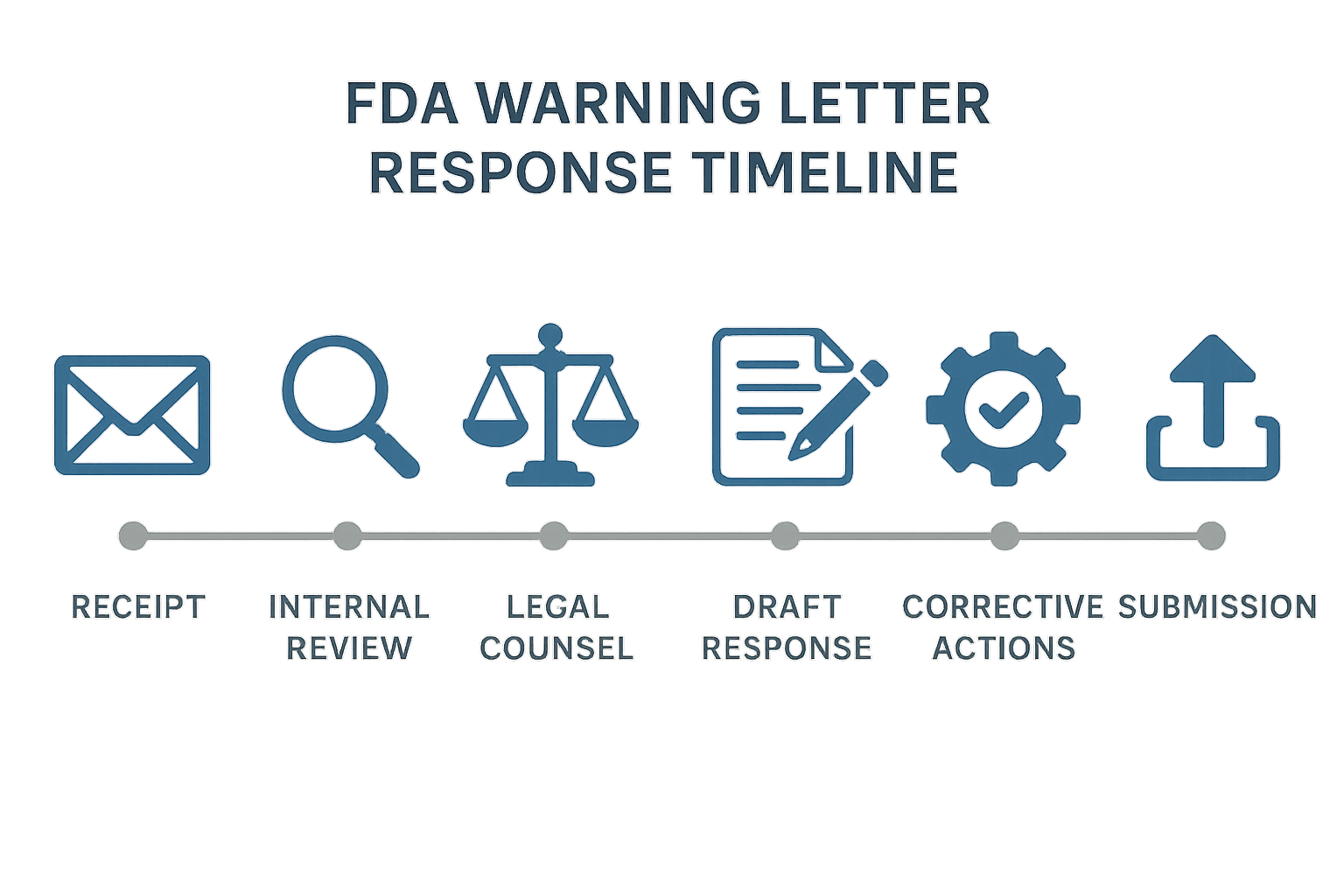
- Receipt and Acknowledgment: Confirm that the FDA warning letter has been received and note the deadline for a formal response.
- Immediate Actions: Secure all implicated products, suspend any non‑compliant distribution, and preserve records for audit.
- Comprehensive Review: Conduct a root‑cause analysis, involve quality‑assurance staff, and consult legal counsel.
- Response Drafting: Address each allegation point‑by‑point, provide corrective evidence, and propose a realistic remediation timeline.
- Corrective Implementation: Execute label revisions, update packaging, retrain personnel, and document every change.
- Ongoing Monitoring: Establish post‑remediation audits, track compliance metrics, and maintain open communication with the FDA.
Why a Timely, Complete Response Matters
A well‑executed response not only satisfies regulatory expectations but also mitigates the risk of escalated penalties, product seizures, or costly recalls. By demonstrating a proactive, transparent approach, companies preserve brand credibility with clinicians, research subjects, and investors. In many cases, the FDA will reduce or withdraw enforcement actions when it sees concrete evidence of swift corrective action and a robust compliance culture.
Common Pitfalls to Avoid
- Delayed Response: Missing the FDA’s deadline signals indifference and can trigger additional fines.
- Incomplete Documentation: Failing to provide thorough batch records, SOP revisions, or research protocols logs weakens the defense.
- Lack of Legal Input: Drafting a response without qualified counsel may overlook statutory nuances and expose the company to liability.
- One‑Time Fixes: Implementing superficial changes without addressing underlying systemic issues invites repeat warnings.
- Inadequate Monitoring: Without continuous oversight, new deviations can slip through unnoticed.
Partnering with YourPeptideBrand for Proactive Compliance
YourPeptideBrand (YPB) offers a turnkey, white‑label solution designed specifically for clinics and entrepreneurs who want to launch Research Use Only peptide brands without navigating regulatory labyrinths alone. Our platform handles label design, custom packaging, and direct dropshipping, all while adhering to FDA guidance on labeling, storage, and distribution.
What sets YPB apart is our built‑in compliance framework. Every client receives a detailed compliance checklist that mirrors the FDA’s expectations for labeling, documentation, and quality‑system procedures. In addition, we provide ready‑to‑use SOP templates covering batch record maintenance, deviation reporting, and post‑market surveillance. By integrating these tools into your operational workflow, you reduce the likelihood of future warning letters and streamline the response process should a letter ever arrive.
Because YPB’s services are fully white‑labeled, you retain complete brand ownership while benefiting from a proven compliance infrastructure. Our team of regulatory specialists reviews your product dossiers, ensures that all required statements (e.g., “Research Use Only”) are prominently displayed, and validates that packaging meets both FDA and state‑level requirements. This proactive partnership lets you focus on research subject care and business growth, confident that the regulatory foundation is solid.
Next Steps
Ready to turn compliance into a competitive advantage? Explore our free resources, join upcoming webinars on FDA best practices, or schedule a one‑on‑one consulting session to map out a customized compliance roadmap. A smoother, compliant market entry is just a click away.
Visit YourPeptideBrand.com to learn more and get started today.